
LCA vs PCF vs PEF: Differences, Examples & How to Choose
Understand LCA vs PCF vs PEF, their standards, environmental impacts and EU requirements. Learn which method to choose with practical textile examples.
LCA, PCF and PEF at a glance
Life Cycle Assessment (LCA) evaluates potential environmental impacts across a product’s life cycle. Product Carbon Footprint (PCF) quantifies greenhouse gas emissions and removals in kilograms of carbon dioxide equivalent (kg CO₂e). Product Environmental Footprint (PEF) is the European Commission’s LCA-based method, with common modelling rules and 16 impact categories.
Choose PCF for product climate accounting, a multi-impact LCA for design decisions involving environmental trade-offs, and PEF for assessments under the EU Environmental Footprint method. These approaches can share inventory data, so choosing the intended output first can reduce repeat requests to suppliers.
A mill calculating emissions from finished fabric, a brand comparing cotton and polyester garments, and a supplier responding to a buyer’s PEF request need different outputs. For example, a dyeing process may reduce energy-related emissions while increasing chemical use or wastewater impacts. A climate-only result cannot resolve that trade-off.
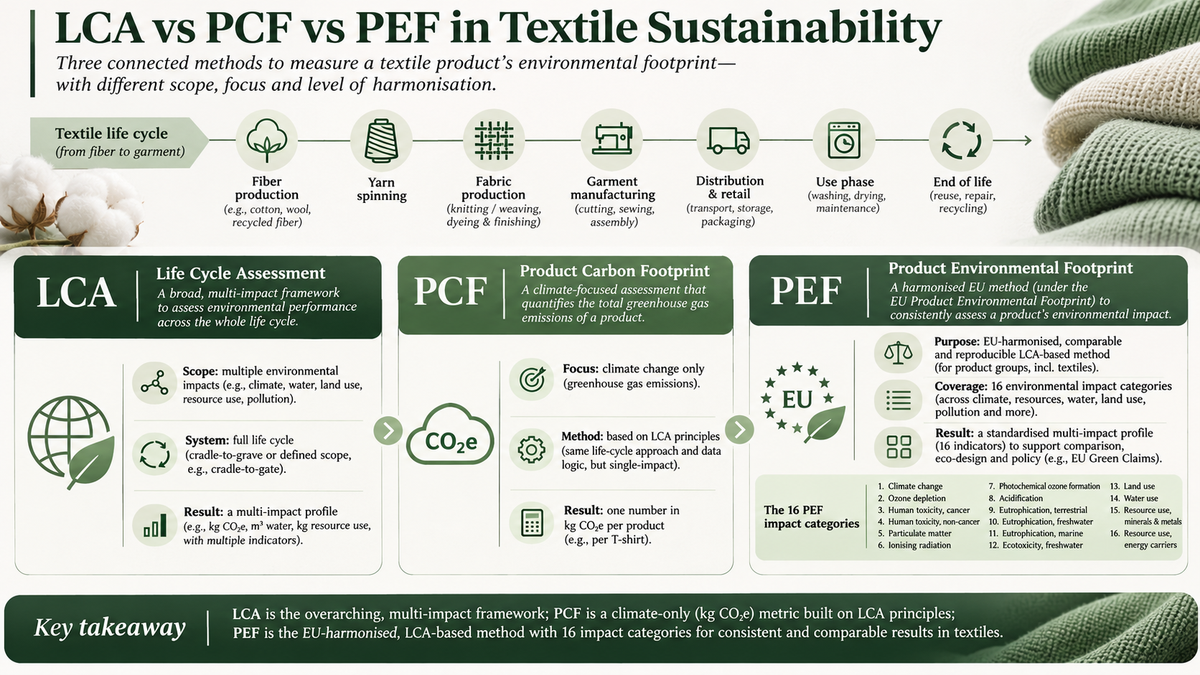
Infographic comparing LCA, PCF and PEF across the textile life cycle.
1. What is Life Cycle Assessment (LCA)?
LCA evaluates the potential environmental impacts associated with producing, using and disposing of a product. ISO 14040 and ISO 14044 describe four linked phases.
Goal and scope definition sets the purpose, functional unit and system boundary. Life cycle inventory records material and energy inputs, water, emissions and waste. Life cycle impact assessment translates those flows into potential impacts. Interpretation identifies major contributors and considers uncertainty and study limitations.
For a cotton T-shirt, an LCA can examine cultivation and manufacturing emissions, water impacts from farming and wet processing, nutrient-related eutrophication, resource use, and the effects of washing, drying and end-of-life treatment. Biodiversity, microplastic shedding and site-specific damage may need complementary assessment.
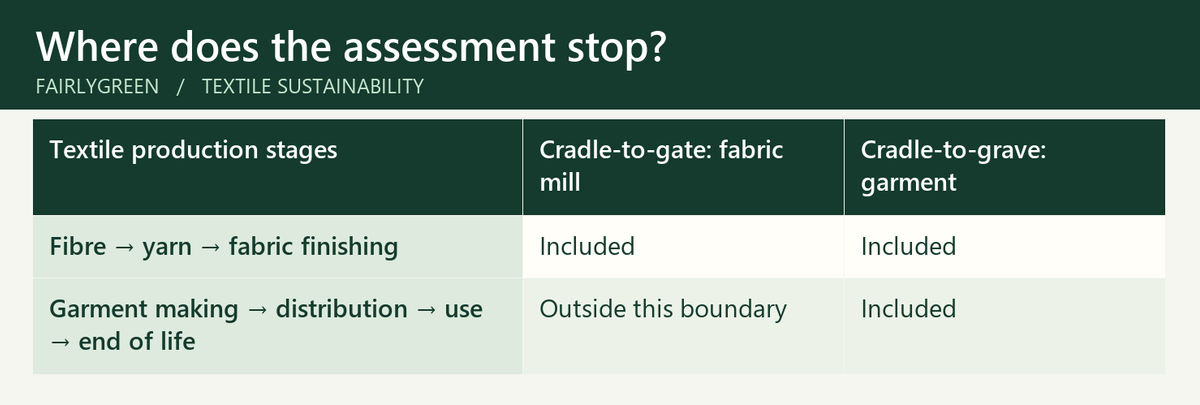
Cradle-to-gate at a fabric mill versus cradle-to-grave for a finished garment.
2. What is a Product Carbon Footprint (PCF)?
A PCF measures greenhouse gas emissions and removals across a defined life cycle boundary. It combines different gases into kg CO₂e per reference unit. ISO 14067:2018 covers full and partial product footprints. The GHG Protocol Product Life Cycle Accounting and Reporting Standard also provides a framework for product-level greenhouse gas accounting. Carbon offsetting is outside ISO 14067 footprint quantification.
A simplified calculation sums activity data multiplied by applicable emission factors. For example, multiply electricity consumption by its emission factor. Include relevant upstream materials, fuels, transport, process emissions and waste treatment within the defined boundary.
A mill can report a partial PCF per kilogram of finished fabric, covering greige fabric, purchased electricity, steam, dyes, chemicals, transport and waste up to the mill gate. A full garment assessment also considers downstream stages such as garment manufacturing, distribution, use and end of life.
3. What is Product Environmental Footprint (PEF)?
PEF applies harmonised rules for modelling, data quality and reporting under Commission Recommendation (EU) 2021/2279. The method includes 16 impact categories, such as climate change, water use, land use, acidification, eutrophication, toxicity, and use of fossil resources, minerals and metals. It reports category-level results and a score calculated using prescribed normalisation and weighting factors. Review the category results and uncertainty alongside the score.
Product Environmental Footprint Category Rules (PEFCRs) specify how to assess a product category. They may define the functional unit, boundaries and scenarios, primary data requirements, allocation and recycling rules, datasets, reporting and verification. Follow the relevant PEFCR when claiming conformity with it.
In June 2025, the European Commission welcomed the completed Apparel and Footwear PEFCRs. They cover the life cycle of clothing and footwear. Microplastic shedding and biodiversity remain areas for further methodological development.
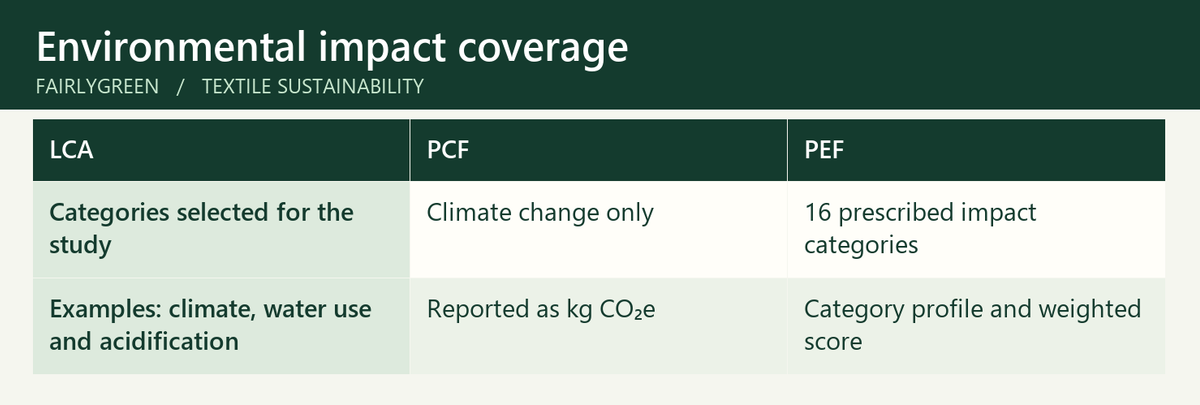
Environmental impacts covered by LCA, PCF and PEF.
4. LCA vs PCF vs PEF: Side-by-side comparison
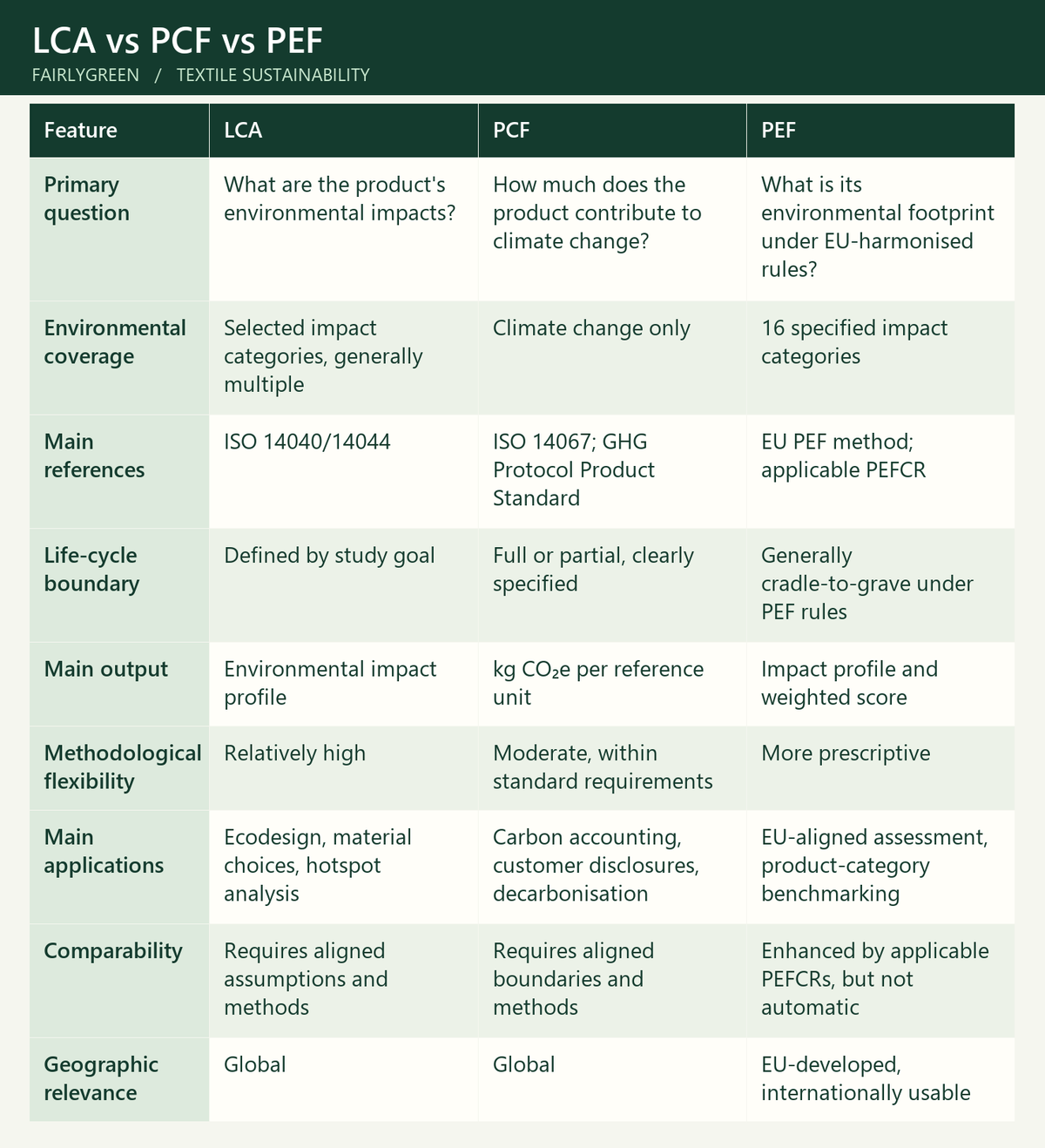
Full side-by-side comparison of LCA, PCF and PEF.
LCA usually reports a profile for the impact categories selected for the study. PCF reports climate impact in kg CO₂e per reference unit. PEF provides a prescribed multi-impact profile and a weighted score. In every method, comparisons depend on equivalent functions, boundaries, assumptions and data.
5. Which method should a textile or fashion business choose?
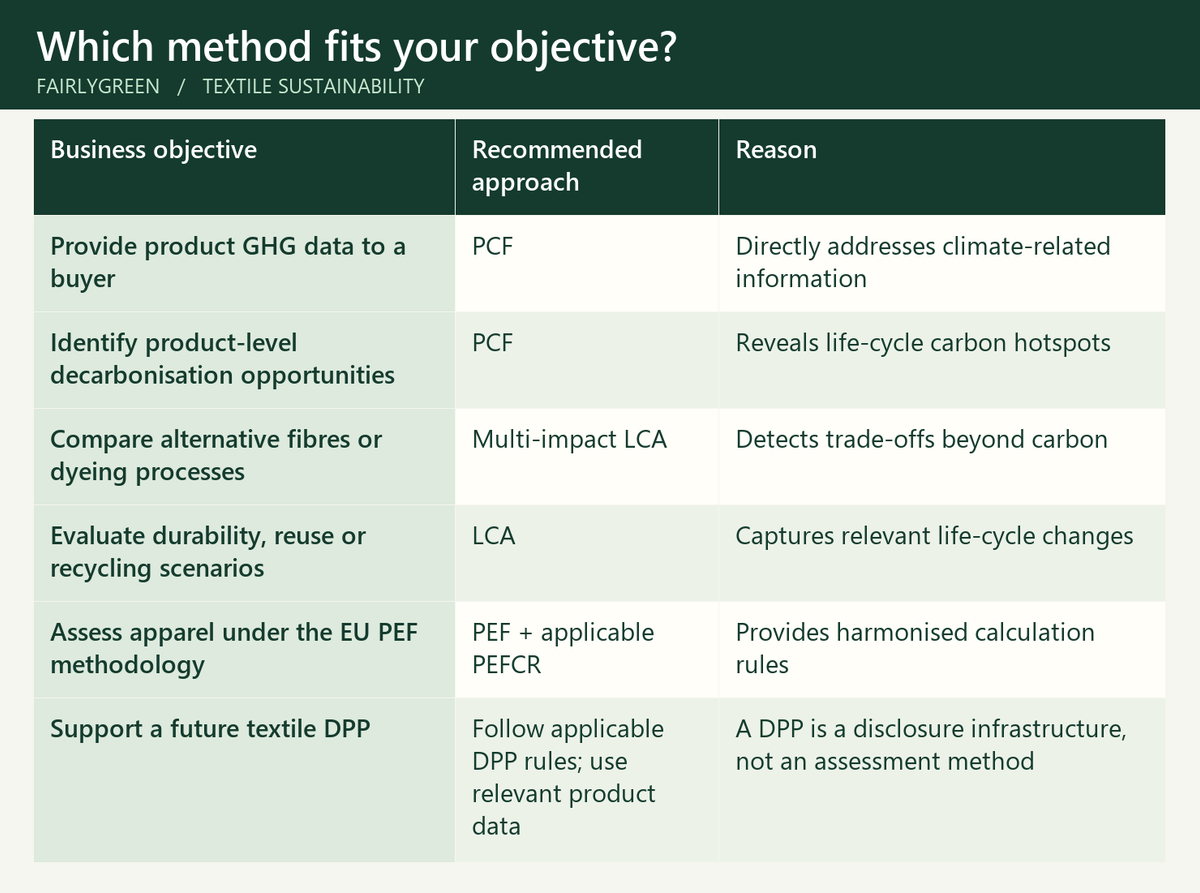
Business objectives and the recommended footprint method.
Start with the output you need, then choose the method and collect the data. A Pakistani textile exporter responding to a buyer’s ISO 14067 request for finished fabric can assess the specified cradle-to-gate footprint. A brand choosing between fibres or dyeing processes can use multi-impact LCA to evaluate trade-offs. An assessment under EU PEF rules calls for PEF and any applicable category rules.
A Digital Product Passport (DPP) provides product information.
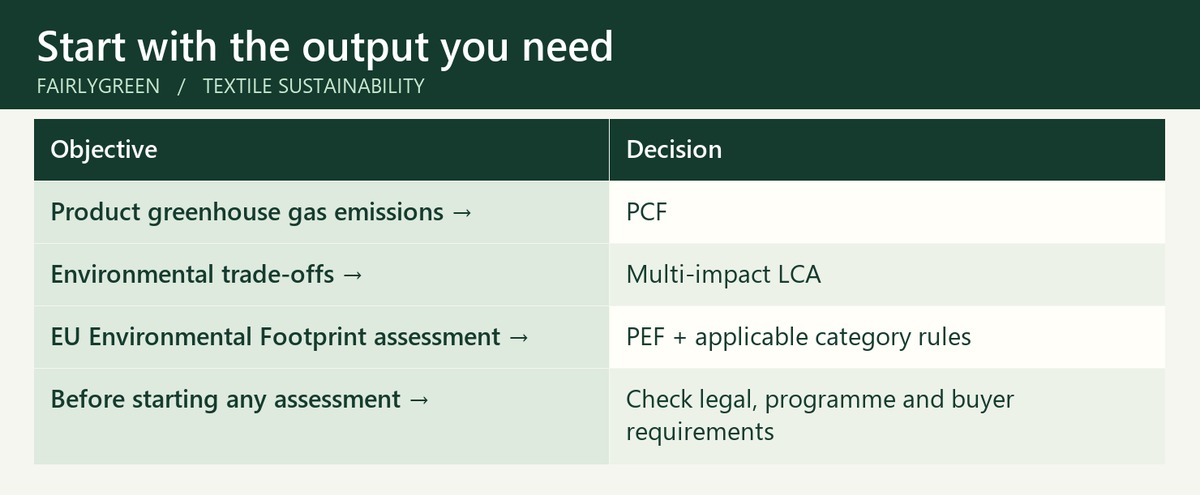
Decision guide for selecting PCF, multi-impact LCA or PEF and checking applicable requirements.
Use the data and methods required by the applicable passport rules. A reusable inventory helps teams respond to carbon requests today and support broader assessments later.
6. Worked example: Calculating a textile PCF
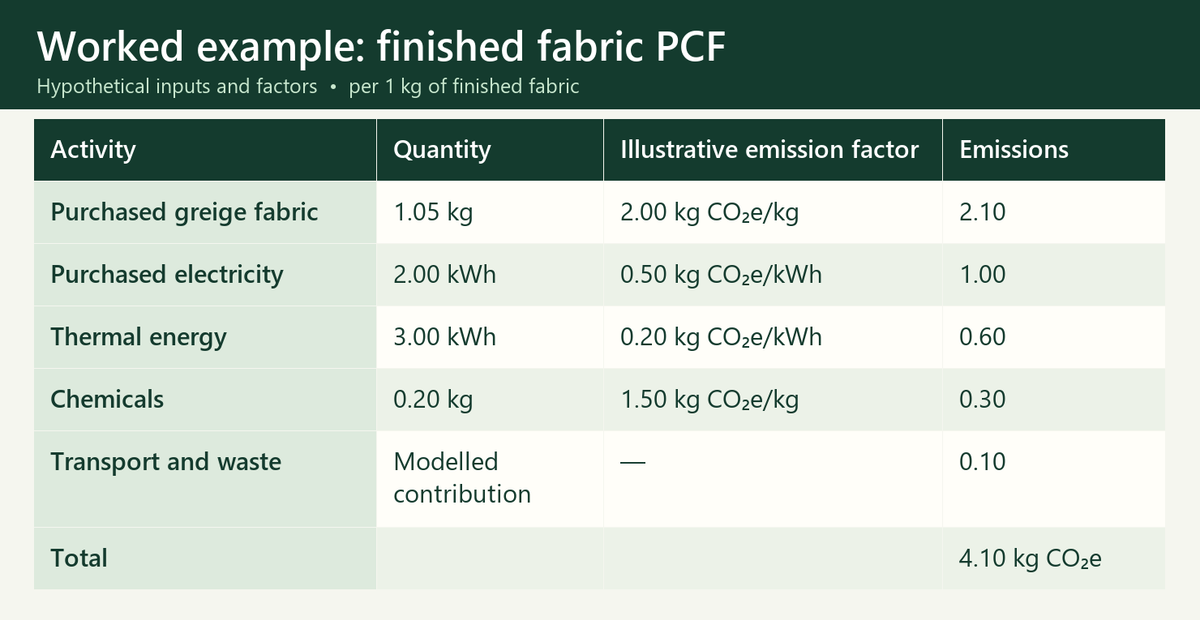
Hypothetical fabric carbon footprint calculation totaling 4.10 kg CO₂e per kilogram.
Consider a dyeing and finishing mill assessing 1 kg of finished fabric, from upstream greige production to the finishing factory gate. The values below are hypothetical and illustrate the calculation.
Purchased greige fabric: 1.05 kg × 2.00 kg CO₂e/kg = 2.10 kg CO₂e. Purchased electricity: 2.00 kWh × 0.50 kg CO₂e/kWh = 1.00 kg CO₂e. Thermal energy: 3.00 kWh × 0.20 kg CO₂e/kWh = 0.60 kg CO₂e. Chemicals: 0.20 kg × 1.50 kg CO₂e/kg = 0.30 kg CO₂e. Transport and waste contribute another 0.10 kg CO₂e.
The illustrative total is 4.10 kg CO₂e per kg of finished fabric.
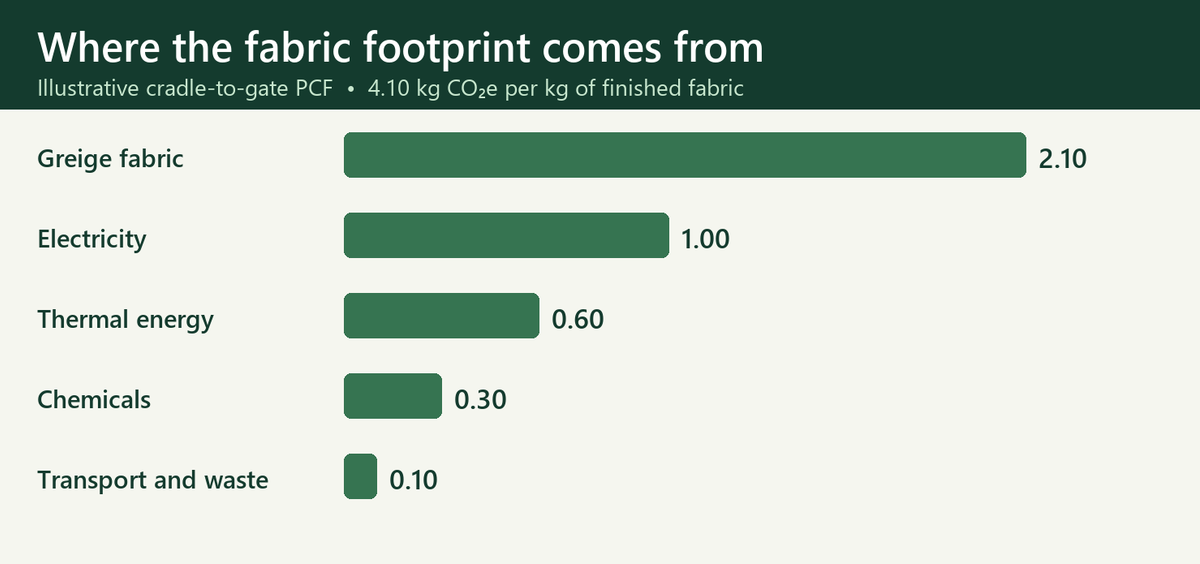
Bar chart of the five contributions to the illustrative 4.10 kg CO₂e fabric footprint.
The greige factor covers upstream production and excludes the finishing activities counted separately. Greige fabric is the biggest climate contributor in this example. Water, discharge and other impact data would support a broader assessment of process changes.
7. How to implement LCA, PCF or PEF
Define the product and purpose
Responsible teams: Sustainability, product development and commercial teams.
Document:
- Product identifier, composition and manufacturing route.
- Intended customer or regulatory use.
- Selected methodology and version.
- Study period and geographical coverage.
Define the functional unit and boundary
Responsible teams: LCA practitioner, technical team and product owner.
A functional unit expresses the function being assessed, rather than merely the product's mass.
For example, comparing two T-shirts solely per kilogram may overlook differences in garment durability and number of wears.
For intermediate textiles, a declared quantity such as 1 kg of specified finished fabric may be appropriate, provided the objective and limitations are clear.
Define explicitly whether the study is cradle-to-gate or cradle-to-grave.
Build a life cycle inventory
Responsible teams: Procurement, production, utilities, quality and sustainability.
Collect:
- Material quantities, supplier identities and traceability records.
- Electricity, steam, natural gas and other fuel consumption.
- Dyes, chemicals, water consumption and relevant discharges.
- Waste quantities, destinations and treatment methods.
- Processing yields and allocation information.
- Transport distances, modes and loads.
- Relevant downstream-use assumptions for full garment assessments.
Prefer representative, process-specific data rather than generic estimates.
Choose compatible datasets
Responsible teams: LCA practitioner and sustainability data team.
Use primary data for controlled processes and appropriately representative supplier or secondary datasets elsewhere.
Check geographical, technological and temporal representativeness.
For PEF studies, follow the EU Environmental Footprint dataset hierarchy and the applicable PEFCR.
The European Commission's EF data guidance also addresses interim dataset arrangements while the next EF database generation is developed.
Calculate, validate and interpret
Responsible teams: LCA practitioner, engineering and quality assurance.
Review:
- Mass and energy balances.
- Consistency of production periods and units.
- Emission-factor versions and sources.
- Double counting across supplier and factory datasets.
- Allocation choices and recycling assumptions.
- Missing processes and uncertainty.
- Sensitivity to important modelling choices.
Preserve activity records, assumptions, calculation versions and evidence links. Commissioning an independent review or verification should depend on applicable standards, intended claims, programme requirements and commercial co
8. Common mistakes
Mistake 1: Comparing products with different boundaries
A cradle-to-gate yarn PCF cannot be directly compared with a cradle-to-grave garment PCF.
Correction: Align the functional unit, included processes and methodological assumptions before comparing results.
Mistake 2: Treating low carbon as overall environmental superiority
A lower-carbon material may have higher impacts in another category.
Correction: Use multi-impact assessment when the decision involves broader environmental trade-offs.
Mistake 3: Confusing water consumption with water impact
Equal water volumes can have different environmental consequences depending on location, scarcity and assessment method.
Correction: Use appropriate impact indicators rather than treating cubic metres of water as a complete measure of environmental harm.
Mistake 4: Assuming PEF guarantees comparability
Even PEF results require aligned product functions, applicable category rules, appropriate data and verification.
Correction: Check the precise PEFCR scope and conditions for comparative assertions.
Mistake 5: Rebuilding supplier datasets for every customer
Repeatedly requesting the same utility, material and chemical records creates inconsistent versions and unnecessary administrative work.
Correction: Maintain reusable supplier master data with controlled methodology-specific calculations and disclosure outputs.
This is particularly important for textile supply chains where one manufacturer may serve multiple brands with different reporting expectations.
9. Is LCA, PCF or PEF legally required in the EU?
None of these three methods is universally mandatory for every textile product placed on the EU market. Specific legislation, contractual obligations, reporting frameworks or environmental claims can nevertheless require particular measurements or methodologies. Businesses must identify the applicable obligation before selecting a calculation method.
As of 14 November 2026:
- ISO 14040, ISO 14044 and ISO 14067: International standards, not blanket EU legal obligations.
- EU PEF method: Governed by Commission Recommendation (EU) 2021/2279; its use may be specified by other applicable rules.
- Apparel and Footwear PEFCR: Completed in 2025 and available for relevant product assessments.
- Textile Digital Product Passports: The Ecodesign for Sustainable Products Regulation, Regulation (EU) 2024/1781, establishes the legal framework, but textile-specific requirements are still being developed.
The European Commission's textile DPP guidance identifies Q4 2027 as the planned adoption period for the textile delegated act. This is not a confirmed date on which every textile product must already carry a passport.
For exporters supplying EU brands, the immediate priority is maintaining traceable, reusable product and supplier data while monitoring final product-specific requirements.
10. Practical implementation checklist
Use this checklist before commissioning or publishing a product environmental assessment.
Must do — to meet the selected method or applicable obligation
- Identify the customer, programme, standard or legal requirement.
- Define the study's functional unit, reference flow and system boundary.
- Apply the required methodology and relevant product category rules.
- Document data sources, exclusions, allocation and assumptions.
- Meet applicable reporting, review and verification requirements.
Should do — to improve decision quality
- Prioritise measured facility and supplier-specific data.
- Reconcile material and energy balances.
- Assess material data gaps and uncertainty.
- Check whether comparisons use equivalent functions and assumptions.
- Review material environmental trade-offs beyond carbon.
Good practice — for efficient, scalable implementation
- Maintain one controlled source of supplier activity data.
- Version emission factors, datasets and calculation methods.
- Link calculations to bills, meters, procurement and production evidence.
- Separate raw activity data from calculated results.
- Reuse validated inputs across PCF, LCA, PEF and relevant disclosures.
11. Frequently asked questions
Is PCF part of LCA?
PCF uses life cycle assessment principles to quantify greenhouse gas emissions and removals. ISO 14067 sets requirements for full and partial footprints.
Is PEF the same as LCA?
PEF is a specific application of LCA with prescribed modelling and reporting rules. General ISO-based LCA allows more methodological choice.
Can one inventory support both PCF and PEF?
Yes, if it includes the data required by both methods and each calculation applies the relevant rules. A PEF climate-change result can differ from an ISO 14067 PCF because of boundaries, datasets, modelling and reporting requirements.
Is PEF the same as an Environmental Product Declaration (EPD)?
PEF is an assessment method. An EPD is a structured disclosure governed by programme rules and standards such as ISO 14025.
Does a Digital Product Passport require PEF?
The applicable product rules determine what environmental data and methods a passport requires.
12. Key takeaways
Match the assessment to the decision. Use PCF to identify climate hotspots, multi-impact LCA to weigh broader trade-offs, and PEF for work under the EU Environmental Footprint method. Align methods and boundaries for comparisons, and retain a reusable inventory linked to evidence.
13. How FairlyGreen fits in
Textile manufacturers and brands often need to answer several customer requests using the same production and supplier records. FairlyGreen helps teams organise that information, preserve traceability and manage product-level calculations. Book a demo to see how it can support your reporting workflow.
Sources and standards
EU Recommendation 2021/2279 on Environmental Footprint methods
Share this article
Help others discover this content
Similar Articles
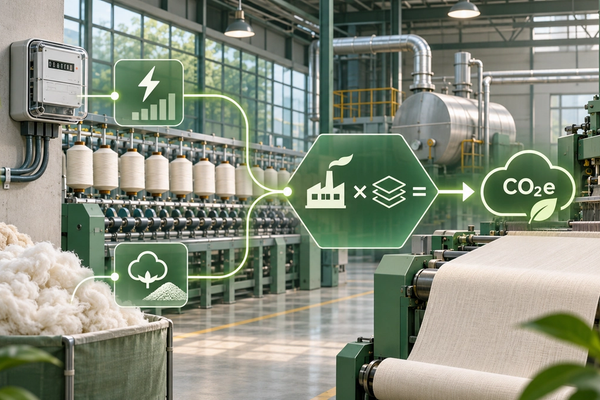
Emission Factors Explained: How to Choose, Calculate and Use Them in Carbon Accounting
Learn what emission factors are, how to calculate GHG emissions, where to find reliable 2026 data, and how to avoid costly carbon accounting errors.
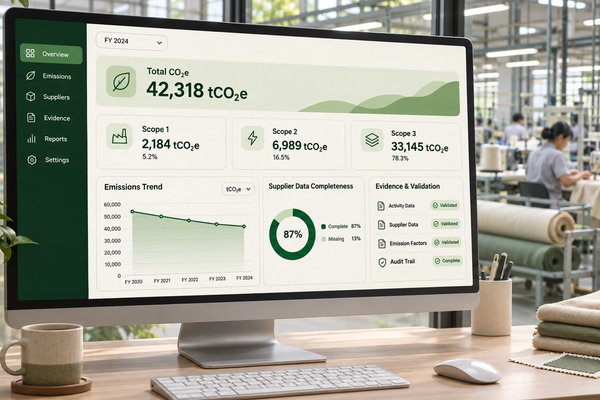
Carbon Accounting Software: Complete Guide for Businesses (2026)
Learn how carbon accounting software works, essential features, GHG Protocol requirements, costs, and how to choose the right platform in 2026.

Digital Product Passport for Textile Apparel: A Beginner’s Guide
Understand digital product passports for textiles and apparel, the EU regulatory timeline, essential product data, and practical steps to prepare.