
Digital Product Passport for Textile Apparel: A Beginner’s Guide
Understand digital product passports for textiles and apparel, the EU regulatory timeline, essential product data, and practical steps to prepare.

At a glance
A digital product passport is an electronically accessible product information record connected to a physical product through an identifier and data carrier, such as a QR code. For apparel, it can make information about materials, maintenance, and circularity easier to access. As of 3 October 2026, textile-specific EU requirements remain under development, with delegated-act adoption planned for Q4 2027. Start by organizing product identities, supplier records, and supporting evidence. European Commission
Updated: 3 October 2026
What is a digital product passport?
A digital product passport (DPP) is a structured digital record connected to a product. It enables relevant users to access product information electronically. The European Commission describes DPPs as a way to support sustainability, circularity, and compliance by making reliable information accessible to businesses, consumers, repairers, recyclers, and authorities. European Commission
Imagine scanning a code on a jacket and finding its material composition, care instructions, and repair guidance. A recycler might need different information, such as component construction or disassembly instructions.
The passport needs three connected elements:
Product identity
- Plain-English meaning: Identifies what the record describes
- Apparel example: A jacket model, production batch, or individual jacket
Data carrier
- Plain-English meaning: Connects the physical product to information
- Apparel example: A scannable code on a label
Information system
- Plain-English meaning: Stores, updates, and shares the data
- Apparel example: Product records with controlled access and supporting evidence
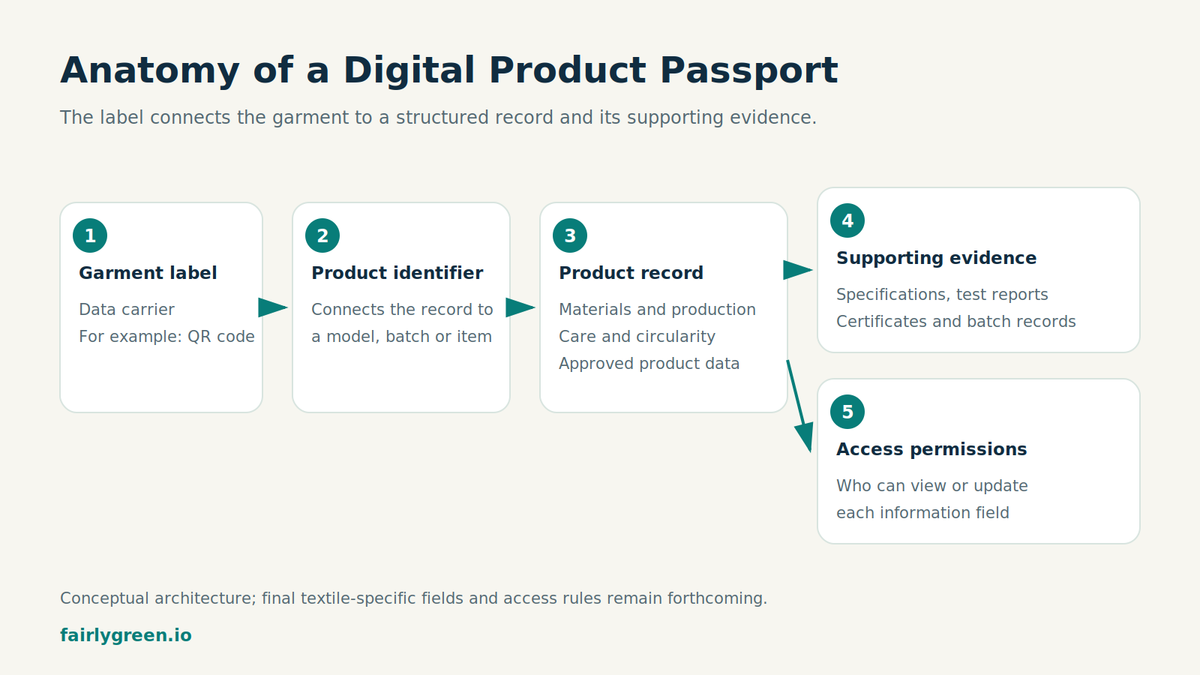
Digital product passport for textiles connecting garment identity, product data and evidence
A QR code provides access; the information behind it creates the passport’s usefulness.
How does a textile DPP work?
A textile DPP connects product identification with structured information and defined access permissions. In practice, a business gathers data, associates it with the correct product, and makes it available through a digital interface. Users access the information relevant to their role. Registration arrangements connect applicable passports with the EU’s supporting infrastructure. European Commission
Consider a cotton T-shirt:
- The brand identifies the product and its production batch.
- Suppliers provide composition and manufacturing records.
- The business reviews the evidence and approves the information.
- A code connects the garment to its passport.
- Consumers access care information; authorized users access additional records.
Traceability and a DPP serve different purposes. Traceability establishes connections between materials, facilities, and production events. A DPP makes relevant product information accessible. A passport cannot resolve an unsupported supply-chain claim simply by displaying it.
When will digital product passports become mandatory for apparel?
There is currently no finalized, universal textile DPP compliance date. The European Commission’s textile page schedules adoption of the textile delegated act for Q4 2027. Adoption establishes the detailed rules; the application date determines when businesses must follow them. These are separate milestones, and the published schedule remains indicative. European Commission
ESPR framework
- Status: Regulation (EU) 2024/1781 is in force
- Business implication: The legal framework exists
EU DPP Registry
- Status: Launched on 20 July 2026
- Business implication: Supporting infrastructure is operational
Textile delegated act
- Status: Adoption planned for Q4 2027
- Business implication: Detailed textile rules remain forthcoming
Textile compliance deadline
- Status as of 3 October 2026: Not yet finalized
- Business implication: Monitor the adopted act’s application date
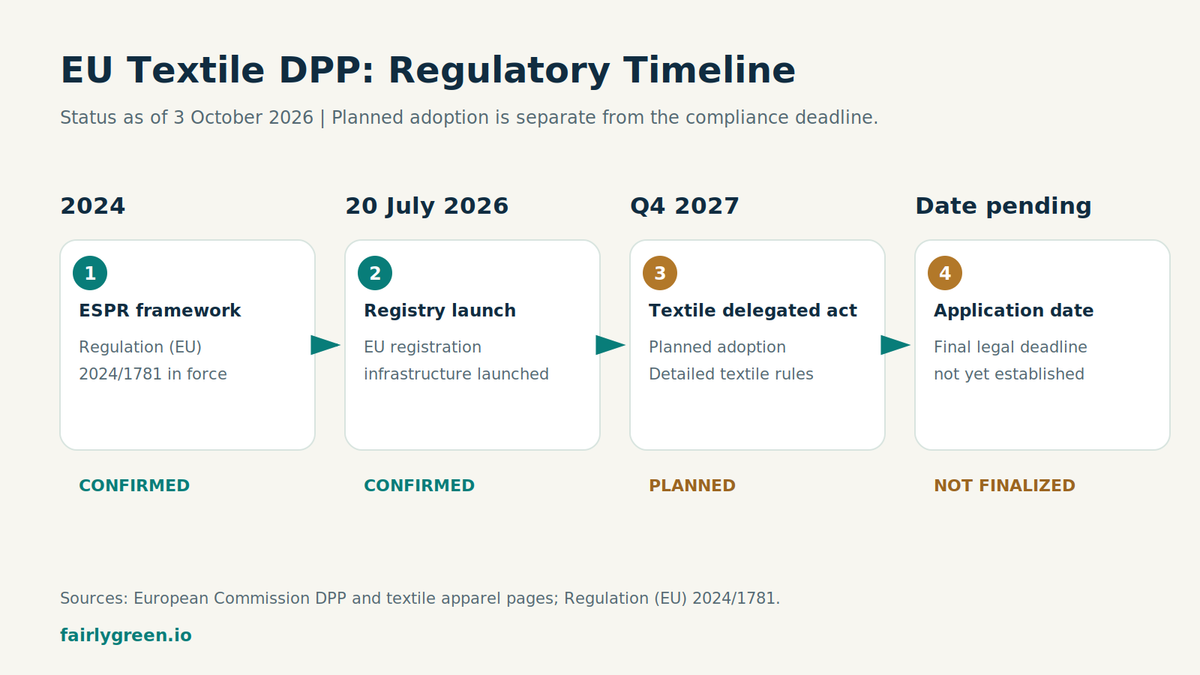
EU textile digital product passport timeline as of October 2026
The Registry stores identifiers and registration metadata; full product information is stored separately by economic operators or service providers. Its launch does not establish a textile compliance deadline. single-market-economy.ec.europa.eu
Under ESPR Article 4(4), application is generally no earlier than 18 months after a delegated act enters into force, subject to specified exceptions. Consequently, 2029 is a plausible planning scenario if the textile act follows the current schedule, rather than a confirmed deadline. EUR-Lex
Who needs to prepare?
Businesses serving the EU apparel market should prepare according to their role. The Commission identifies manufacturers, producers, or importers as potential operators responsible for making passports available. Distributors and dealers will need to ensure availability, while suppliers may have obligations to provide relevant information. Exact responsibilities depend on the applicable rules and commercial arrangements. European Commission
For a Pakistani manufacturer supplying an EU brand, the immediate task is to connect buyer requests with reliable production records. A UK or US business selling apparel into the EU should assess its role in the EU supply chain.
Ask your buyer: Which products, identifiers, evidence formats, and supplier records should our pilot support?
What information should a textile passport contain?
The final mandatory textile fields have not been settled. Businesses can nevertheless prepare a useful data foundation covering identity, materials, production, product use, and evidence. Keep each field clearly classified as an existing obligation, buyer request, voluntary pilot field, or anticipated requirement. This prevents preparation assumptions from becoming misleading compliance claims.
The following is a recommended preparation dataset, not a finalized legal checklist:
Product identity
- Information to organize: Style, variant, SKU, batch, product description
- Evidence or source: Product master and production orders
Materials
- Information to organize: Component composition, garment weight, supported recycled content
- Evidence or source: Bill of materials, specifications, transaction records
Manufacturing
- Information to organize: Facility identities and relevant production stages
- Evidence or source: Purchase orders, production and shipment records
Use and circularity
- Information to organize: Care, repair, component removal, recycling guidance
- Evidence or source: Technical specifications and documented assessments
Compliance and claims
- Information to organize: Relevant test results and certificates
- Evidence or source: Laboratory reports and certificate records
Environmental performance
- Information to organize: Footprint results with methods and assumptions, if included
- Evidence or source: Calculation files and source datasets
Industry pilots offer useful starting points. The Trace4Value protocol contains 126 data points across nine categories, but it is a preparation resource rather than the EU’s mandatory textile dataset.
Model, batch, or item: which level should you use?
A model describes a product design; a batch identifies a production group; an item identifies one physical unit. ESPR leaves the required passport level to product-specific delegated acts. Companies should therefore preserve relationships between these levels while awaiting textile rules. EUR-Lex
For example, two visually identical T-shirts may come from different dyeing facilities. If the difference affects published information, a shared model record needs batch-specific supporting data.
Does a DPP require a carbon footprint?
A DPP communicates information; a product carbon footprint calculates greenhouse-gas emissions. The final textile act will determine mandatory environmental information. Businesses including footprints voluntarily should explain the calculation method and coverage so readers can interpret the result. A number without its unit, boundary, and assumptions can create confusion.
A product carbon footprint (PCF) measures climate impact. A life cycle assessment (LCA) can assess multiple environmental impacts. Neither is interchangeable with a company’s annual emissions inventory: corporate and product accounting answer different questions. GHG Protocol
Before publishing a footprint, record:
- The product and unit assessed.
- The stages included: for example, raw materials through the factory gate.
- The method, dataset versions, and reporting period.
- Supplier-specific data, estimates, and assumptions.
- Allocation rules and review status.
“Cradle-to-gate” ends at the factory gate; “cradle-to-grave” extends through use and end-of-life. Do not compare results with different boundaries as though they measure the same thing.
How can a brand or supplier implement a DPP?
Begin with a limited pilot and a clear data owner. Build the connections between products, suppliers, evidence, and publishing permissions before scaling the customer-facing experience. The objective is to prove that the business can produce dependable product records repeatedly, including when materials or suppliers change.
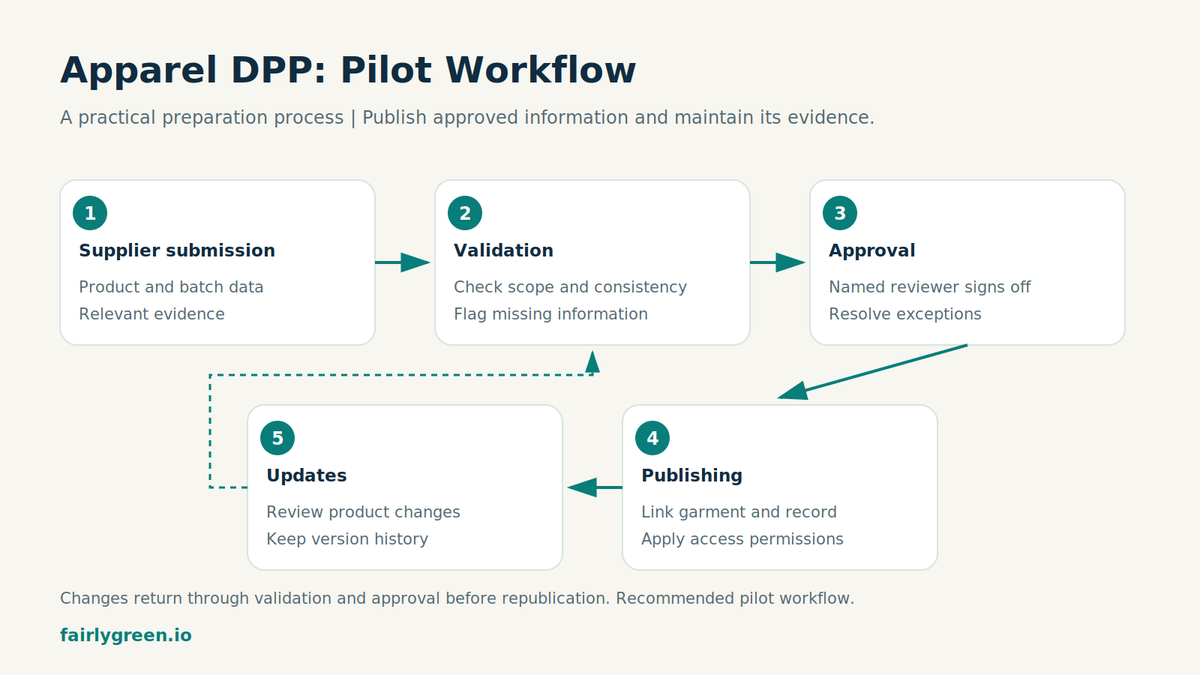
Apparel digital product passport implementation workflow
Step 1: Select the pilot and assign ownership
Choose one product family and a manageable supplier group. Assign an accountable program owner, supported by product development, sourcing, quality, sustainability, compliance, and IT.
Define a tangible outcome: each pilot record links approved product information to retrievable evidence.
Step 2: Create a shared data dictionary
For every field, specify its definition, unit, product level, source, owner, update trigger, and access permission.
For “recycled content,” specify the component and percentage basis. Avoid mixing a main-fabric percentage with a whole-garment percentage.
Step 3: Request product-specific supplier evidence
Ask for records tied to the relevant material, order, or batch. Useful requests include:
- Facility identities and production locations.
- Component specifications and composition.
- Relevant batch and shipment references.
- Certificates and transaction documentation where applicable.
- Test reports supporting published claims.
A facility certificate may support supplier qualification without proving the content of a particular shipment. Review the evidence’s scope before attaching it to a product claim.
Step 4: Validate before publishing
Check that records agree across systems. Confirm that composition, identifiers, certificate validity, and production dates correspond to the product described.
Separate measured, calculated, estimated, and missing data. Assign each gap an owner and resolution date.
Step 5: Connect records and control access
Link product development, purchasing, supplier, and sustainability records through consistent identifiers. An application programming interface (API) allows systems to exchange data automatically.
GS1 Digital Link offers a standards-based way to connect GS1 identifiers with online information. It can support implementation, but using it alone does not establish legal compliance. support.gs1.org
Define who can view and update each field. Plan for readable exports, backups, hosting continuity, and provider changes.
Step 6: Test the complete experience
Check the code on a physical sample and the corresponding online product page. Test permitted access, evidence retrieval, correction workflows, and label readability after realistic handling.
Measure data completeness, unresolved exceptions, and time required to publish an approved record.
What does good product evidence look like?
Good evidence connects a claim to the precise product and explains what the evidence supports. For a beginner, the safest approach is to start with a few well-supported statements, retain their source records, and identify limitations. Expand the passport when the business can maintain the additional information reliably.
Illustrative pilot: A manufacturer supplies a cotton T-shirt to an EU retailer.
Main fabric is 100% cotton
- Supporting record: Fabric specification and relevant test record
- Review question: Does this describe the main fabric or every component?
Garment assembled at Facility A
- Supporting record: Production order and shipment linkage
- Review question: Does the evidence cover this batch?
Machine wash at 30°C
- Supporting record: Approved care specification
- Review question: Does the instruction match product testing?
Product footprint included
- Supporting record: Documented calculation
- Review question: Are unit, boundary, method, and assumptions disclosed?
This illustrates evidence handling, not the final EU passport format.
Must do, should do, and good practice
Must do now
- Action: Meet existing applicable product obligations and substantiate claims already being made
Must do when applicable
- Action: Meet adopted textile DPP rules by their legal application date
Should do now
- Action: Assign ownership, structure identifiers, collect evidence, and pilot supplier workflows
Good practice
- Action: Test label durability, data portability, backups, and repair or recycling usefulness
Avoid announcing “EU-compliant textile DPP” before the applicable requirements are established and the implementation has been assessed against them.
Practical implementation checklist
- Define EU-facing products and business responsibilities.
- Appoint an accountable owner and field-level data owners.
- Connect model, variant, batch, and item identifiers.
- Create a data dictionary and supplier evidence template.
- Link claims to relevant supporting records.
- Flag estimates, missing information, and exceptions.
- Define access permissions and approval workflows.
- Document methods for any environmental calculations.
- Test physical labels, online access, exports, and continuity.
- Monitor the textile delegated act and revise the pilot accordingly.
FAQ
Is a QR code enough for a digital product passport?
A QR code is an access mechanism. A useful passport also needs accurate product information, identifiers, evidence, and maintained digital access.
Is blockchain mandatory?
The ESPR framework does not prescribe blockchain. Evaluate technology against applicable requirements and operational needs. EUR-Lex
Must every garment have an individual serial number?
That is not yet established for textiles. The delegated act will determine whether passports operate at model, batch, or item level. EUR-Lex
Will all supplier information be public?
Access is differentiated. ESPR provides for product-specific rules identifying which actors can access which data. EUR-Lex
Does a passport replace certification or testing?
A passport can reference supporting documents. Publishing information does not itself establish certification or prove that a product passed a test.
What does implementation cost?
There is no universal price. Budget for supplier onboarding, data cleanup, integration, labels, hosting, and continuing maintenance—not only software.
Key takeaways
- Textile-specific EU rules remain forthcoming; Q4 2027 is the planned adoption milestone.
- Prepare product identities, supplier evidence, and ownership now.
- Treat voluntary pilot fields separately from legal requirements.
- Publish environmental results with their methods and limitations.
- Build a repeatable information process before scaling passports.
Explore FairlyGreen
FairlyGreen describes its DPP offering as connecting a public passport experience, machine-readable information, and verifiable assurance. Assess the fit against your product data, integration needs, and evolving requirements. fairlygreen.io
Book a demo to see how FairlyGreen can help turn fragmented sustainability data into structured, audit-ready intelligence.
Authoritative external references
- Regulation (EU) 2024/1781 — ESPR: legal framework, particularly Articles 4 and 9–15.
- European Commission: Textile Apparel and the DPP: textile status, responsibilities, and indicative timeline.
- European Commission: Digital Product Passport: system overview and implementation milestones.
- European Commission: Registry launch: registration infrastructure.
- GS1: Digital Link: identifiers linked to online information.
- GHG Protocol: Product Standard: product-level greenhouse-gas accounting.
Share this article
Help others discover this content
Similar Articles

Digital Product Passports: A Practical Buyer’s Guide for Fashion and Textile Teams
Digital Product Passports are becoming a practical compliance and product-data challenge for fashion and textile teams. Here’s what buyers should understand before selecting a DPP solution.
EU Digital Product Passport for Textiles: What Brands Must Prepare for Now
The EU Digital Product Passport for textiles is not just a QR code. Learn what is decided, what remains proposed, and how to prepare now.
EU Digital Product Passport for Textiles: Why Fashion Brands Must Build Data Readiness Now
The EU Textile Digital Product Passport is not final yet. Here is what fashion brands, apparel manufacturers and suppliers should do now.