
EU Digital Product Passport for Textiles: Why Fashion Brands Must Build Data Readiness Now
The EU Textile Digital Product Passport is not final yet. Here is what fashion brands, apparel manufacturers and suppliers should do now.
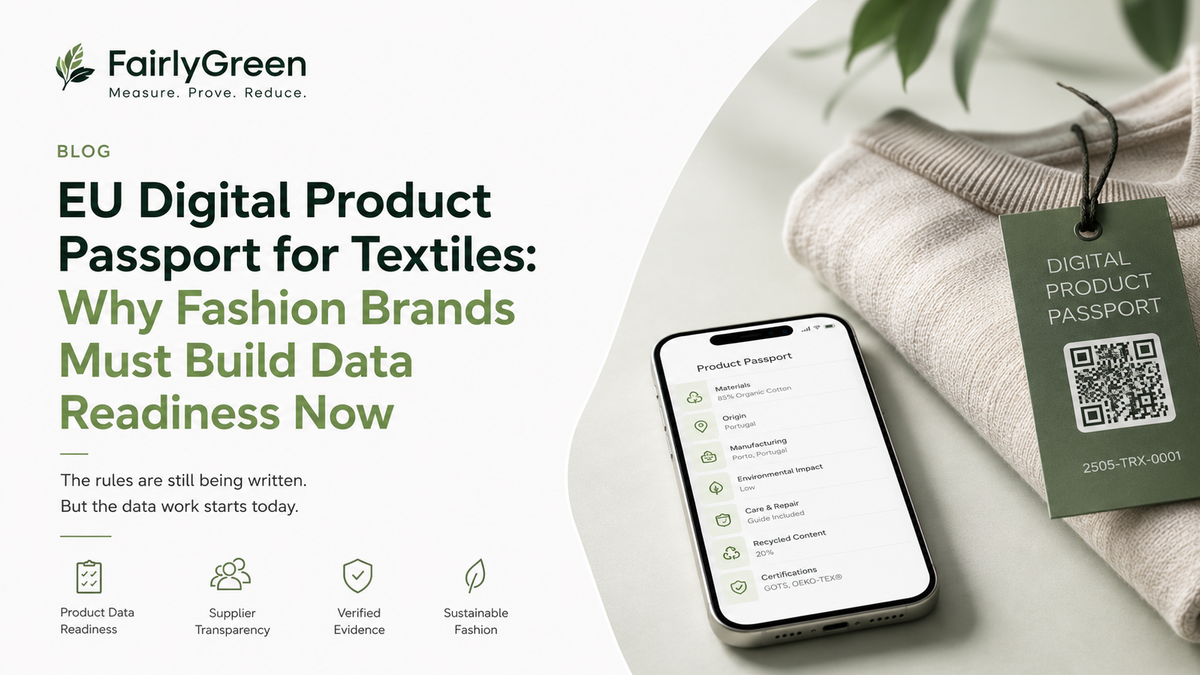
EU Digital Product Passport for Textiles: The Real Readiness Challenge Is Not the QR Code
A fashion brand with 500 SKUs does not have a “500 Digital Product Passports” problem.
It has a product-data, supplier-evidence and governance problem.
That distinction matters.
A Digital Product Passport is often reduced to a QR code on a garment. In reality, the QR code is only a doorway. The real work is building a reliable, updateable and defensible product record behind it.
For textiles and apparel, that record may eventually need to connect product identity, bill of materials, fibre composition, manufacturing evidence, recycled-content claims, chemical information, durability data, environmental performance and compliance documentation.
The final legal requirements for textile Digital Product Passports are still being developed.
But that does not make waiting the right strategy.
It means companies should avoid two equally costly mistakes:
- Waiting for every detail before improving their data foundations.
- Building expensive DPP technology around assumptions that may change.
The practical path sits in the middle.
Build the data capability now. Keep the implementation flexible enough to adapt when the final textile rules arrive.
The first thing fashion brands need to understand
The EU Digital Product Passport is a framework, not a single pre-built compliance checklist.
The future textile delegated act is expected to define the specific product scope, required information, data carrier, access rights, verification expectations and whether information should sit at model, batch or item level.
That means several commonly repeated claims should be treated with caution.
It is not yet accurate to say that every apparel brand must collect the same final list of fields for every garment.
It is not yet accurate to say that every garment will need an individual serialised passport.
It is not yet accurate to say that all supplier data must be verified in exactly the same way.
And it is not yet accurate to attach a fixed textile DPP compliance deadline to every fashion business.
However, the absence of final detail does not remove the need for readiness.
Because the slowest part of DPP implementation is not generating the passport.
It is finding, validating, structuring and maintaining the data.
The real DPP readiness equation
Most companies measure readiness by SKU count.
That is the wrong unit of analysis.
The real workload is driven by:
Product complexity × supplier depth × data quality × change frequency × evidence maturity
A basic cotton T-shirt with one fabric source, one factory and stable construction may be relatively manageable.
A technical jacket with multiple fabrics, membranes, trims, treatments, colourways, factories, sourcing regions and seasonal revisions is not one product record.
It is a network of changing evidence relationships.
This is why two companies with the same number of SKUs can face completely different DPP workloads.
A 200-SKU collection with disciplined bills of materials, approved supplier lists, version control and accessible certificates may progress quickly.
A 50-SKU collection with fragmented spreadsheets, changing suppliers, incomplete product specifications and unclear ownership may be much harder.
The question is not:
“How many passports do we need?”
The better question is:
“How many product-data relationships can we prove, update and govern?”
What fashion companies should build now
The final textile DPP rules may evolve.
But several capabilities are “no-regret” investments because they support buyer requirements, sustainability reporting, product footprinting, traceability, recycled-content claims and future compliance.
1. A reliable product identity
Every product family should have a structured product identity.
This includes model identifiers, season, version history, colourway, size range, market, product category and links to relevant technical documentation.
A product passport cannot be credible when the organisation cannot clearly answer a basic question:
“Which exact version of the product are we talking about?”
2. A connected bill of materials
The bill of materials must move beyond a design specification.
It should connect materials, components, trims, coatings, packaging and relevant process details to the finished product.
For apparel, this means being able to distinguish between:
- Fibre composition
- Fabric composition
- Components and trims
- Recycled content
- Material suppliers
- Manufacturing locations
- Production batches where variation matters
This is particularly important for blended products, coated fabrics, complex garments and products with multiple sourcing routes.
3. A supplier-and-facility evidence chain
The DPP obligation may sit with the economic operator placing the final product on the EU market.
But much of the information will originate upstream.
Brands and importers cannot produce credible product information without data from textile mills, dye houses, printers, garment factories, recyclers, certification bodies and material suppliers.
That means supplier engagement should not be treated as a one-off questionnaire.
It should become an operating process.
For every critical data point, define:
- Who provides it
- What evidence supports it
- How it is checked
- How often it is updated
- What happens when data is missing
- Who is accountable for approval
This is where most DPP timelines will be won or lost.
4. Evidence, not declarations
A sustainability claim is not yet DPP-ready simply because it appears in a supplier declaration.
Companies should distinguish between:
- Data that is self-declared
- Data supported by certificates
- Data supported by test reports
- Data calculated through a recognised methodology
- Data linked to transaction or chain-of-custody evidence
- Data that is still unknown
This does not mean every field must be audited in the same way.
It means the business needs a clear evidence model.
The more important the claim, the stronger the proof trail should be.
5. Data governance across teams
The DPP should not become the responsibility of one sustainability manager working alone.
Sustainability may define the purpose and requirements.
But product teams control specifications.
Sourcing teams manage supplier relationships.
Operations teams understand production flows.
IT teams manage systems and integration.
Legal teams assess disclosure, liability and contractual risk.
Finance and commercial teams may need to understand the future implications of circularity, EPR and product design choices.
The best model is a cross-functional DPP working group with a senior owner, defined decision rights and an agreed data-governance model.
Without this structure, the DPP becomes another spreadsheet project.
With it, the DPP becomes product intelligence.
A practical 90-day DPP readiness roadmap
Do not attempt to digitise the entire product portfolio first.
Start with one representative product family.
Choose a product that reflects real business complexity: multiple materials, supplier layers, production processes, recycled-content claims or high commercial importance.
Days 1–30: Create the operating model
Appoint an executive sponsor.
Build a cross-functional working group from sustainability, product, sourcing, operations, IT and legal.
Select one product family for the pilot.
Define what “DPP-ready” means internally: reliable product information, documented evidence, data ownership, update rules and an auditable record.
Days 31–60: Run a data and evidence audit
For the pilot products, identify:
- What data already exists
- Where it is stored
- Who owns it
- Which information is inconsistent
- Which claims lack evidence
- Which supplier inputs are missing
- Which systems need to connect
Start with the reality of your data.
Days 61–90: Build a minimum viable product record
Create one structured product record that includes:
- Product identity and version
- Bill of materials
- Core supplier and facility mapping
- Material and fibre information
- Existing certifications and test evidence
- Recycled-content documentation, where relevant
- Environmental data inputs, where available
- Known gaps, assumptions and validation status
The goal is not to create a perfect public passport.
The goal is to prove that your organisation can assemble, validate and update one defensible product record.
That pilot will reveal the real blockers before you attempt portfolio-wide scale.
What not to do
Do not wait until the final delegated act is published before beginning supplier data governance.
Do not assume that a QR-code provider has solved your DPP challenge.
Do not ask suppliers for every possible data field without explaining why, how it will be used or how confidentiality will be protected.
Do not treat JRC proposals as final legal requirements.
Do not launch a portfolio-wide programme before testing one representative product family.
And do not put the entire responsibility on sustainability teams.
The DPP is not a communications project.
It is a product, supply-chain and data-governance transformation project.
What this means for textile manufacturers and exporters
For textile mills, dye houses, garment manufacturers and exporters supplying EU-facing brands, the immediate question is not:
“Will we need our own mandatory DPP tomorrow?”
The more useful question is:
“Can we provide accurate, structured and reusable upstream evidence when our customers need it?”
Brands will increasingly ask for data on fibre composition, material origin, manufacturing conditions, recycled content, certifications, chemicals, energy, water, traceability and footprint inputs.
The suppliers that can provide this information in structured, auditable form will become easier to source from.
The suppliers that rely on PDFs, emails, disconnected certificates and manual questionnaires will face more repeated requests, more delays and lower buyer confidence.
Frequently asked questions
Is the EU Textile Digital Product Passport mandatory today?
The ESPR framework is in force, but the textile-specific delegated act will define the final mandatory requirements for apparel.
Is there a fixed deadline for textile DPP compliance?
No final textile application date has been established in the delegated act. The European Commission currently lists 2027 as an indicative adoption timeline for textiles/apparel.
Will every garment need an individual QR code?
Not necessarily. The final rules may specify whether information is managed at model, batch or item level.
Do textile mills and garment factories need to prepare?
Yes. Even where a brand or importer is responsible for the final passport, the necessary information originates across the textile value chain.
Should brands wait for the final delegated act?
No. Companies should begin with no-regret foundations: product identity, bills of materials, supplier evidence, data governance, version control and traceability processes.
The bottom line
The companies that will succeed with Digital Product Passports will not be those that rush to publish the first QR code.
They will be the ones that can repeatedly answer, with evidence:
What is this product?
What is it made of?
Which suppliers and facilities contributed to it?
Which claims can be proven?
What changed between product versions?
Who owns the data?
And can the information be updated when the product, supplier or regulation changes?
That is real DPP readiness.
FairlyGreen helps fashion brands, apparel manufacturers and textile suppliers turn fragmented product, supplier, footprint and compliance information into audit-ready sustainability intelligence.
Book a demo to assess your textile DPP data readiness.
Share this article
Help others discover this content
Similar Articles
EU Digital Product Passport for Textiles: What Brands Must Prepare for Now
The EU Digital Product Passport for textiles is not just a QR code. Learn what is decided, what remains proposed, and how to prepare now.

Digital Product Passports: A Practical Buyer’s Guide for Fashion and Textile Teams
Digital Product Passports are becoming a practical compliance and product-data challenge for fashion and textile teams. Here’s what buyers should understand before selecting a DPP solution.
PEFCR v3.1 Is Final - Here’s What Fashion Brands Must Do Next
After five years of development, the Product Environmental Footprint Category Rules (PEFCR v3.1) for apparel and footwear are official. This is no longer a pilot - this is the standard.