
EU Digital Product Passport for Textiles: What Brands Must Prepare for Now
The EU Digital Product Passport for textiles is not just a QR code. Learn what is decided, what remains proposed, and how to prepare now.
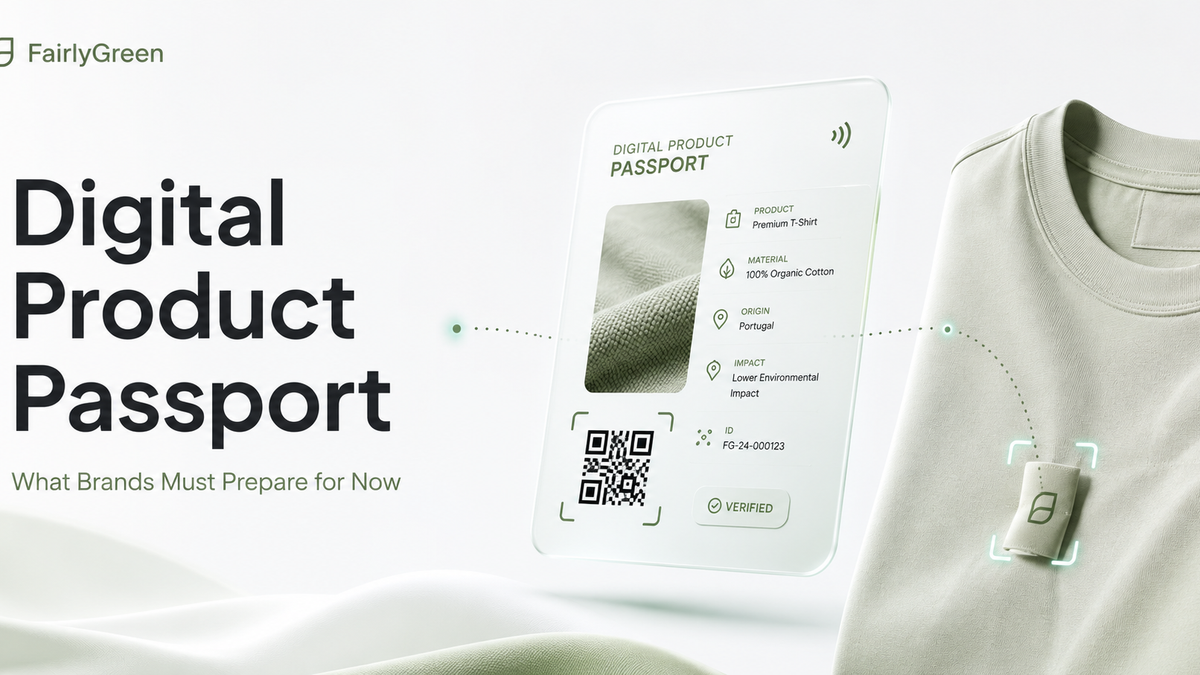
EU Digital Product Passport for Textiles: What Is Decided, What Is Proposed, and How Brands Should Prepare
The EU Digital Product Passport for textiles is often simplified as “a QR code on a garment.”
That is not the real story.
A QR code, NFC tag, RFID tag, watermark, or other data carrier may provide access to the passport. But the Digital Product Passport itself is a structured product-data system designed to connect product information, sustainability evidence, traceability records, compliance documentation, and access rights across the value chain.
For fashion brands, textile manufacturers, exporters, and suppliers, this is not simply a labelling project.
It is a product-data transformation project.
The companies that prepare early will not only be better positioned for future EU requirements. They will also be better equipped to respond to buyer questionnaires, support sustainability claims, improve product-level footprinting, manage supplier evidence, and reduce dependence on fragmented spreadsheets, PDFs, and email trails.
What is the EU Digital Product Passport for Textiles?
The Digital Product Passport, or DPP, is part of the EU’s Ecodesign for Sustainable Products Regulation framework.
Its purpose is to make selected product information digitally accessible, structured, interoperable, and verifiable across the product lifecycle.
For textiles and apparel, the passport is expected to support information such as:
- Product and model identification
- Fibre composition and component information
- Manufacturing and facility details
- Recycled-content evidence
- Substances-of-concern information
- Durability and recyclability performance
- Environmental or carbon-footprint information
- Care, repair, warranty, and end-of-life guidance
- Compliance evidence and supporting documentation
However, one distinction is essential:
The DPP framework is legally established. The detailed textile requirements are still being developed.
That means brands should prepare seriously, without treating every current proposal as final law.
What is decided, and what is still proposed?
The DPP discussion can become confusing because three different layers are moving in parallel.
1. The legal framework
The EU Ecodesign for Sustainable Products Regulation establishes the DPP framework.
It sets the direction for persistent product identifiers, digital access to product information, interoperability, data access controls, and long-term availability of passport data.
But the final textile-specific requirements will be defined through a future delegated act.
That delegated act will determine important details such as:
- Which product categories are in scope
- Which data points are mandatory
- Which data carrier or carriers may be used
- Whether information is held at model, batch, or item level
- Which information is public, restricted, or authority-only
- The exact compliance and application timeline
2. The JRC technical proposal
The Joint Research Centre has published a detailed proposal for possible DPP content for textile apparel products.
This is highly important because it shows the likely direction of travel.
The proposal outlines approximately 49 potential data fields across areas including product identification, producer identification, product information, environmental performance, circularity, chemical information, and compliance documentation.
But these data fields should not yet be described as final mandatory requirements.
They are a technical foundation for consultation, impact assessment, and future legal drafting.
The most useful takeaway is not the number “49.”
It is the emerging logic behind the data.
Future compliance is likely to depend on whether a company can connect product information, manufacturing evidence, material data, chemical records, environmental calculations, and conformity documentation into one credible structure.
The biggest misconception: every product will need item-level tracking
Not necessarily.
The DPP framework allows information to be managed at three possible levels:
- Model level: Data shared across products with the same relevant specifications
- Batch level: Data linked to a defined production batch, facility, time period, dye lot, or material input
- Item level: Data linked to an individual physical product
For apparel, the most practical emerging approach is a mixed model.
Stable product characteristics may sit at model level. Facility-specific, chemical, or traceability information may sit at batch level. Individual identifiers may become relevant for repair, resale, authentication, refurbishment, or future circular business models.
This matters because item-level serialisation across millions of garments can create substantial cost and operational complexity.
Brands should therefore avoid building their DPP strategy around a simplistic assumption that every garment must immediately carry a fully unique item-level passport.
The smarter approach is to build a flexible data architecture that can support model, batch, and item-level information when needed.
A DPP is not a public disclosure of every supplier secret
Another concern is confidentiality.
Suppliers may be reluctant to disclose sensitive chemistry, costing information, production recipes, or proprietary material formulations.
That concern is legitimate.
The DPP is expected to use role-based access, rather than placing all information in the public domain.
A consumer may see product composition, care guidance, recycled content, or a sustainability performance class.
A regulator may require access to conformity evidence, calculation parameters, or technical files.
A recycler or repair operator may need more detailed material and end-of-life information.
The objective is not unrestricted transparency.
The objective is controlled, traceable, and purpose-specific access to information.
For manufacturers, this means the right question is not:
“Will we have to disclose all our data?”
The better question is:
“Which data must be collected, who needs to access it, and how can we protect sensitive information while proving compliance?”
The technical standards are becoming real
The DPP is also moving beyond policy language into technical architecture.
European standards are now covering areas such as:
- Unique product, operator, and facility identifiers
- Data carriers linking physical products to digital records
- Data exchange protocols and formats
- APIs for passport lifecycle management
- Data storage, archiving, and persistence
- System interoperability
- Access-rights management and data security
- Data authentication, reliability, and integrity
This is important because a DPP cannot become effective if every brand, retailer, supplier, and technology provider creates a closed system.
Interoperability is the real requirement.
A future-ready DPP should not become another isolated portal, spreadsheet, or QR-code landing page with no usable data behind it.
It should connect with existing business systems such as ERP, PLM, supplier platforms, LCA tools, certification records, and traceability workflows.
What fashion brands and textile manufacturers should do now
The best preparation is not to wait for final legal wording.
It is to fix the data foundations that will be difficult to create at the last minute.
1. Run a product-data gap analysis
Identify what information already exists and where it sits.
Is it stored in ERP, PLM, spreadsheets, PDF certificates, laboratory reports, supplier emails, chemical-management platforms, or employee knowledge?
Then identify what is missing, inconsistent, unverified, or impossible to retrieve product by product.
2. Build a product-level data model
For priority products, create a structured record covering:
- Product and model identifiers
- Bill of materials
- Fibre composition
- Suppliers and manufacturing facilities
- Process routes
- Recycled-content evidence
- Chemical and compliance documentation
- Product environmental footprint inputs
- Care, repair, warranty, and end-of-life information
This structure will become valuable beyond DPP compliance. It can improve product development, sourcing, buyer reporting, and sustainability decision-making.
3. Improve batch-level traceability where variation matters
A garment model may be produced in different factories, countries, seasons, colourways, or material batches.
Those differences can affect chemical records, energy sources, recycled-content evidence, production conditions, and environmental performance.
Companies should therefore identify where model-level information is sufficient and where batch-level records are necessary.
4. Turn certificates into connected evidence
Certificates are useful, but a passport cannot rely on disconnected files.
A credible system should connect each certificate, test result, transaction record, footprint calculation, and supplier declaration to the relevant product, material, facility, or batch.
The goal is evidence that can be found, checked, updated, and reused.
5. Pilot one passport before scaling
Do not begin with the full product portfolio.
Select one representative product category, such as a cotton T-shirt, denim jean, fleece hoodie, sportswear style, or textile accessory.
Build the full data chain from material input to finished product.
Test the customer-facing experience, restricted-access information, supplier workflows, data quality controls, and internal approval process.
Then scale what works.
Why this matters for Pakistan and other export manufacturing countries
For apparel exporters, DPP readiness will increasingly become a buyer-readiness issue.
Even where the legal responsibility sits with the brand or EU importer, suppliers will be expected to provide credible upstream data.
This includes material composition, facility information, energy and process data, chemical evidence, recycled-content documentation, certifications, and traceability records.
The exporters that can provide structured, auditable evidence will be easier for brands to work with.
The exporters that rely on scattered files and manual questionnaires will face slower onboarding, repeated data requests, lower buyer confidence, and higher compliance costs.
The competitive advantage will not be sustainability claims alone.
It will be the ability to prove them.
Frequently asked questions
Are the proposed 49 DPP data points mandatory today?
No. They are part of a technical proposal and indicate the likely direction of the final requirements. The final mandatory data fields will be defined in the textile delegated act.
Will every textile product need an RFID tag?
Not necessarily. The DPP can use different data carriers, and the final textile rules will determine the accepted options and positioning requirements.
Is the textile DPP already legally mandatory?
The DPP framework exists, but the detailed textile requirements and application date are still pending.
Will all supply-chain data become public?
No. The expected direction is role-based access, balancing public transparency, regulatory oversight, recycling needs, and protection of commercially sensitive information.
Should brands wait for the final regulation?
No. The final rules may change, but the core data foundations will remain essential: product identification, material composition, traceability, facility data, supplier evidence, environmental calculations, and compliance documentation.
The bottom line
The EU Digital Product Passport is not a future QR-code exercise.
It is the beginning of a new operating model for product information.
The winners will be the brands and manufacturers that stop treating sustainability data as a reporting burden and start treating it as strategic infrastructure.
FairlyGreen helps fashion brands and textile manufacturers turn fragmented sustainability, supplier, product, and footprint data into structured, auditable intelligence.
Book a demo to assess your DPP data readiness and build a practical roadmap for your products, suppliers, and export markets.
Share this article
Help others discover this content
Similar Articles
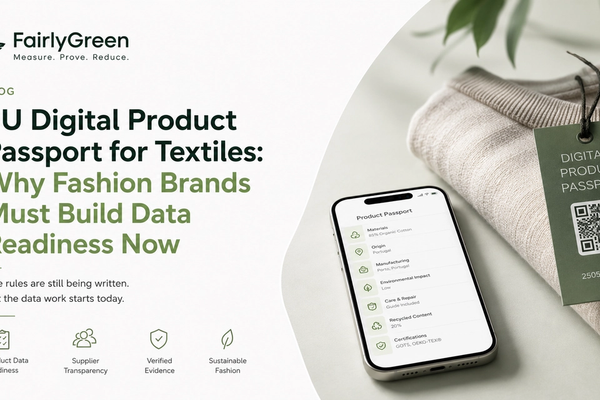
EU Digital Product Passport for Textiles: Why Fashion Brands Must Build Data Readiness Now
The EU Textile Digital Product Passport is not final yet. Here is what fashion brands, apparel manufacturers and suppliers should do now.
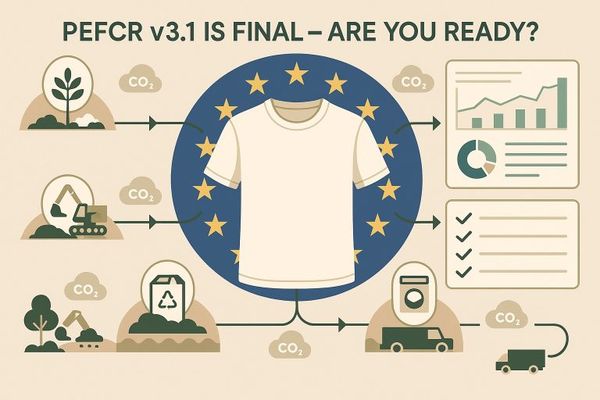
PEFCR v3.1 Is Final - Here’s What Fashion Brands Must Do Next
After five years of development, the Product Environmental Footprint Category Rules (PEFCR v3.1) for apparel and footwear are official. This is no longer a pilot - this is the standard.

Digital Product Passports Are Coming for Fashion - Here’s What You Need to Know
Fashion brands selling in the EU must adopt Digital Product Passports (DPPs)—a new legal requirement under the Ecodesign for Sustainable Products Regulation (ESPR). The goal? Total product transparency. The pressure? Massive. But with the right systems in place, DPPs can move you from regulatory scramble to sustainability leadership.