
Emission Factors Explained: How to Choose, Calculate and Use Them in Carbon Accounting
Learn what emission factors are, how to calculate GHG emissions, where to find reliable 2026 data, and how to avoid costly carbon accounting errors.

Executive Answer / TL;DR
An emission factor is a coefficient used to estimate greenhouse gas emissions associated with a unit of activity, such as consuming one kilowatt-hour of electricity, burning one litre of diesel or producing one kilogram of cotton fibre.
The basic calculation is:
GHG emissions = Activity data × Emission factor
For example, if a textile factory consumes 100,000 kWh of electricity and the applicable emission factor is 0.50 kg CO₂e/kWh, its estimated electricity-related emissions are 50,000 kg CO₂e, or 50 tonnes.
The factor in this example is hypothetical, not an actual country's grid factor.
But using the formula is easy. Choosing the correct emission factor is where carbon accounting becomes challenging.
A reliable factor must match the activity's geography, reporting year, technology, units, greenhouse gases and accounting boundary.
For textile manufacturers, correct factors are essential for corporate GHG inventories, product carbon footprints (PCFs), lifecycle assessments (LCAs), supplier reporting and credible decarbonization decisions.
1. What Is an Emission Factor?
An emission factor expresses the amount of greenhouse gas emitted per unit of activity or product. It provides a practical way to estimate emissions without directly measuring every gas released. Companies multiply actual activity data—such as fuel consumption, electricity use or material quantities—by a factor appropriate to that activity.
Consider three examples:
- Electricity consumption: Typical factor unit: kg CO₂e/kWh; What it estimates: Emissions associated with electricity generation or a specified lifecycle boundary
- Natural gas combustion: Typical factor unit: kg CO₂e/m³ or kg CO₂e/kWh; What it estimates: Emissions from burning natural gas
- Cotton fibre production: Typical factor unit: kg CO₂e/kg fibre; What it estimates: Specified lifecycle emissions associated with producing cotton fibre
Emission factors may represent a single gas, such as CO₂, or several greenhouse gases combined as carbon dioxide equivalent (CO₂e).
CO₂e expresses different greenhouse gases in a common unit using their global warming potentials (GWPs).
For example, methane and nitrous oxide contribute differently to global warming. Their emissions can be converted into CO₂e using a specified GWP time horizon and assessment method.
The GHG Protocol recommends appropriately representative emission factors rather than relying automatically on generic defaults.
Emission factor vs. global warming potential: What is the difference?
These terms are related but are not interchangeable.
Emission factor: How much greenhouse gas is associated with an activity, such as kilograms of CO₂e per kWh of electricity.
Global warming potential: A characterization factor describing the climate impact of a greenhouse gas relative to CO₂ over a specified period.
Carbon intensity: Emissions per unit of output, such as kg CO₂e per kg of fabric. It may describe a process, product, company or economy, depending on its boundary.
A composite CO₂e emission factor may already incorporate GWP calculations. Applying GWP again would be incorrect.
For GHG Protocol inventories, 100-year GWP values are required, with the latest IPCC assessment values recommended and consistent application important. See the GHG Protocol's GWP guidance.
2. How Are Emission Factors Developed?
Emission factors are developed using scientific measurements, engineering calculations, statistical averages, process models or combinations of these methods.
For fuel combustion, factors may be calculated from the carbon content and combustion characteristics of a fuel. Electricity factors are commonly derived from emissions and generation data for a particular grid. Product-level factors may require lifecycle inventory models covering several processes and supply-chain stages.
Consequently, two credible datasets can provide different results for what appears to be the same activity.
Differences may arise from geographical conditions, technology, data year, system boundaries, allocation rules or GWP methodology.
An emission factor is not a universal property of a material or activity. It is a value defined by its underlying context and methodology.
3. What Types of Emission Factors Are Used in Carbon Accounting?
The correct factor depends first on whether a company is measuring direct emissions, purchased energy, value-chain emissions or a product's lifecycle footprint.
- Scope 1: Direct emissions: Example for textile businesses: Natural gas burned in a dyeing boiler; Required factor characteristics: Combustion factor matched to fuel and units
- Scope 2: Purchased energy: Example for textile businesses: Grid electricity used in spinning; Required factor characteristics: Appropriate electricity generation factor and accounting method
- Scope 3: Purchased materials: Example for textile businesses: Cotton, polyester, yarn, dyes; Required factor characteristics: Relevant upstream or cradle-to-gate product factor
- Scope 3: Transportation: Example for textile businesses: Fabric transported by truck; Required factor characteristics: Factor matched to vehicle, transport activity and boundary
- Product carbon footprint: Example for textile businesses: One kilogram of dyed fabric; Required factor characteristics: Consistent lifecycle inventory and emission factors across included processes
- Spend-based Scope 3: Example for textile businesses: Purchased services without physical activity data; Required factor characteristics: Economic-input-output factor expressed per currency unit
These categories must not be mixed indiscriminately.
For example, a diesel combustion factor normally represents direct emissions from burning fuel. A well-to-wheel factor may additionally include upstream fuel production and distribution.
Using the latter entirely within Scope 1 would incorrectly classify upstream emissions.
Similarly, a cradle-to-gate cotton factor can already include several upstream processes. Adding those processes again separately would double-count emissions.
4. How Do You Calculate Emissions Using an Emission Factor?
The general equation is:
Emissions (kg CO₂e) = Activity quantity × Emission factor (kg CO₂e per activity unit)
If the factor already includes the greenhouse gases relevant to the selected accounting boundary, the calculation produces an estimated CO₂e result.
Worked example: Electricity consumption in a textile dyeing factory
Assume a Pakistani dyeing factory has the following monthly data.
- Purchased grid electricity: Illustrative value: 150,000 kWh
- Assumed grid emission factor: Illustrative value: 0.60 kg CO₂e/kWh
- Finished fabric production: Illustrative value: 100,000 kg
Step 1: Calculate electricity emissions
150,000 × 0.60 = 90,000 kg CO₂e
Step 2: Convert into tonnes
90,000 ÷ 1,000 = 90 tonnes CO₂e
Step 3: Calculate electricity-related emissions intensity
90,000 ÷ 100,000 = 0.90 kg CO₂e/kg finished fabric
Result: The factory's estimated Scope 2 electricity emissions are 90 tonnes CO₂e for the month, with an allocated electricity-emissions intensity of 0.90 kg CO₂e per kilogram of finished fabric.
These figures are illustrative. The 0.60 factor is not presented as Pakistan's official electricity emission factor.
The calculation excludes boiler fuel, other direct emissions, upstream energy emissions, purchased materials, wastewater treatment and other lifecycle stages. It is therefore not the total product carbon footprint of the fabric.
For an actual inventory, the factory must use an appropriately sourced electricity factor and apply the required Scope 2 accounting method.
Worked example: Purchased cotton fibre
Suppose a spinning mill purchases 2,000 kg of cotton lint.
Assume a hypothetical cradle-to-gate factor of 2.30 kg CO₂e per kilogram of lint.
2,000 × 2.30 = 4,600 kg CO₂e
These are estimated upstream emissions associated with the purchased cotton lint, based on the hypothetical factor.
For the spinning mill, such emissions would normally contribute to Scope 3 Category 1, Purchased Goods and Services, under the GHG Protocol.
They would also be relevant to the upstream raw-material stage of a yarn product footprint.
However, the result is not a complete yarn footprint. Spinning energy, auxiliary materials, transport within the defined boundary and relevant waste or co-product treatment must also be addressed.
Importantly, cotton lint and seed cotton are different reference products. Their emission factors cannot be substituted without accounting for ginning yields, allocation and other methodological differences.
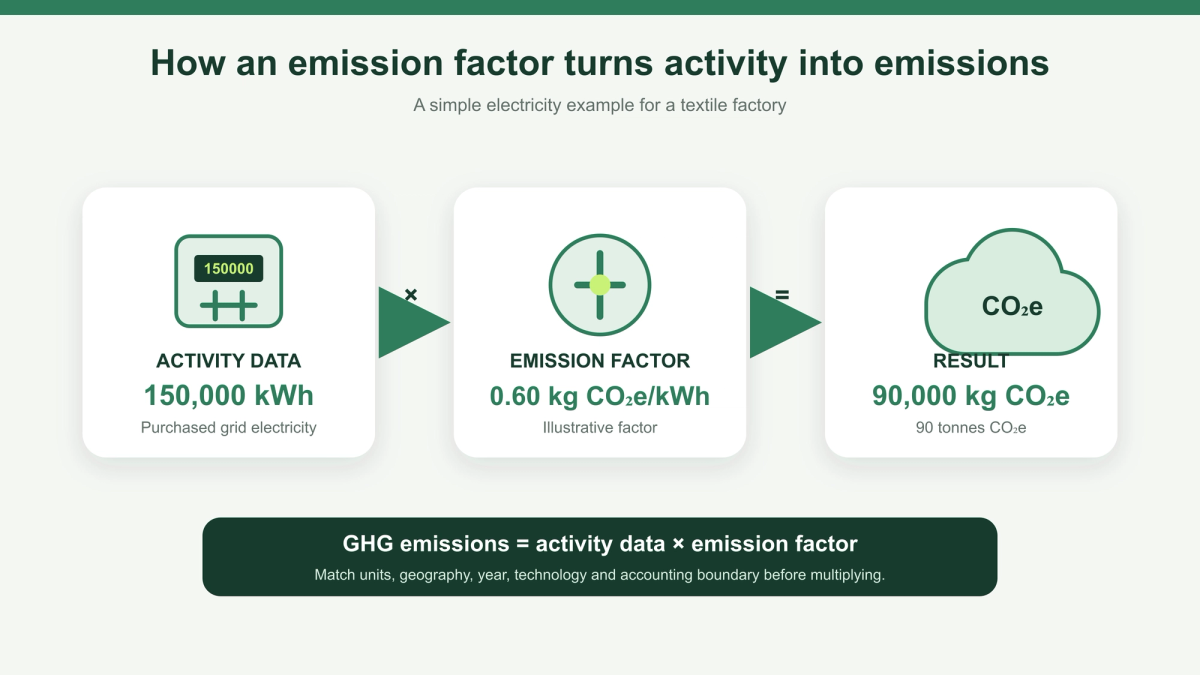
How emission factors convert textile factory electricity consumption into greenhouse gas emissions
5. How Do You Choose the Right Emission Factor?
The most defensible factor is not necessarily the newest or lowest available value. It is the factor that best represents the activity being assessed and complies with the chosen methodology.
The GHG Protocol's April 2026 guidance identifies five core data-quality considerations.
- Geographical representativeness: Question to ask: Does the factor represent the actual location?; Textile example: Electricity in Pakistan versus electricity in Germany
- Temporal representativeness: Question to ask: Does it reflect the relevant reporting period?; Textile example: Grid data from 2023 versus activity in 2026
- Technological representativeness: Question to ask: Does it represent the actual production technology?; Textile example: Ring spinning versus rotor spinning
- Completeness: Question to ask: Does it cover the relevant activities and data?; Textile example: Cotton cultivation and ginning versus cultivation alone
- Reliability: Question to ask: Can the data and methodology be trusted?; Textile example: Documented, reviewed data versus an unsupported supplier estimate
Two additional compatibility checks are essential.
Boundary compatibility: Determine whether the factor includes combustion only, upstream production, cradle-to-gate impacts or a broader lifecycle.
Methodological compatibility: Verify greenhouse gas coverage, GWP version, allocation approach, reference unit and any product-category rules.
A practical selection sequence is:
- Define the exact activity and reporting boundary.
- Identify the required units and greenhouse gases.
- Look for a relevant supplier-specific or recognized official source.
- Check geography, year and technology.
- Review lifecycle coverage and potential overlaps.
- Confirm consistency with the chosen reporting standard.
- Document the selected factor and rejected alternatives.
- Obtain internal approval before applying the factor at scale.
When suitable supplier-specific information is unavailable, a representative secondary factor is often a legitimate starting point. Its limitations should be documented.
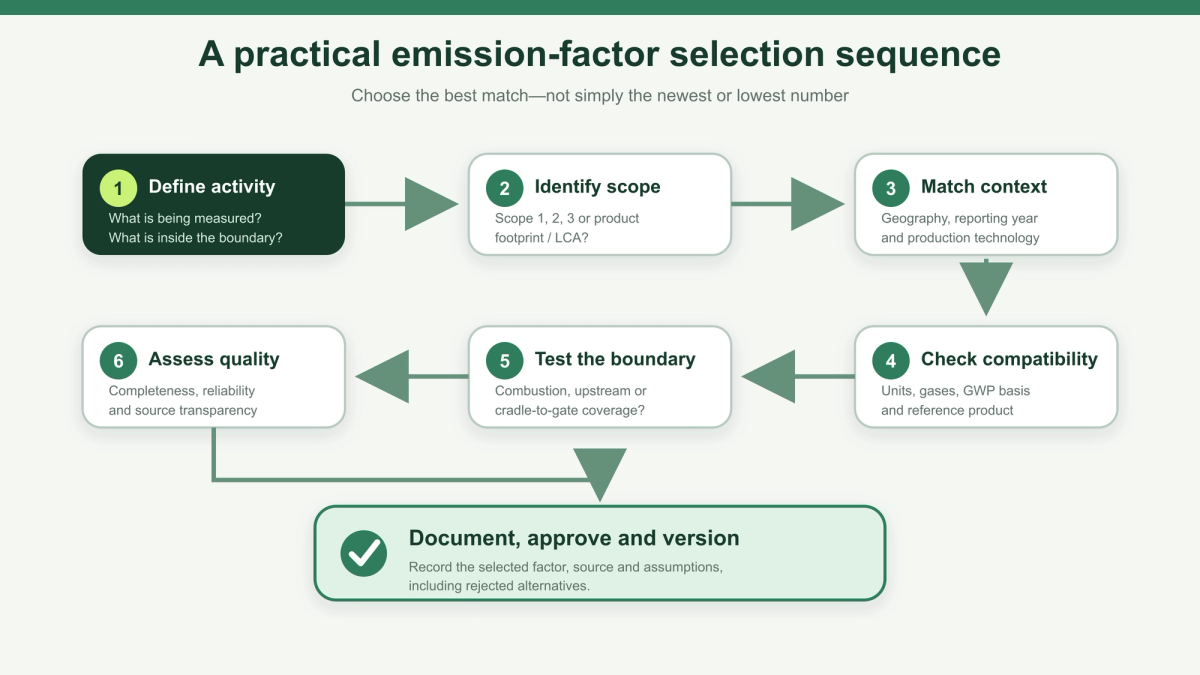
Step-by-step decision tree for selecting accurate GHG emission factors
6. Where Can Businesses Find Reliable Emission Factors in 2026?
No single database contains the best factor for every activity worldwide. Different sources serve different accounting purposes.
- IPCC Emission Factor Database: Best suited for: Default factors and technical parameters, particularly for national inventory methods; Important 2026 consideration: Confirm suitability before transferring defaults to corporate accounting
- US EPA Emission Factors Hub: Best suited for: US organizational GHG reporting; Important 2026 consideration: Latest Hub edition listed as 2025
- EPA eGRID: Best suited for: US electricity emissions; Important 2026 consideration: Latest published edition identified in the reviewed source uses 2023 data
- UK DESNZ Conversion Factors: Best suited for: UK organizational activities; Important 2026 consideration: 2026 factors published 11 June; flat-file correction issued 31 July 2026
- ecoinvent: Best suited for: Lifecycle inventory modeling and product assessments; Important 2026 consideration: Version 3.13 released 4 November 2026, including textile-related updates
- Supplier-specific PCFs: Best suited for: Purchased goods and supply-chain footprints; Important 2026 consideration: Check boundary, methodology, product identity, data quality and verification status
The publication year of a database and the underlying data year are not necessarily identical.
For example, an electricity dataset released in 2025 may describe actual electricity generation during 2023.
Record both dates.
For textile manufacturers in Pakistan, Bangladesh, India or Vietnam, UK and US electricity factors should not automatically be used for local operations.
Prefer credible factors representing the actual electricity system and reporting year. Where these are unavailable, disclose the proxy and assess its likely influence.
For product footprints, also review the database's system model and licensing conditions. An ecoinvent lifecycle dataset is not necessarily interchangeable with a direct-combustion emission factor.
7. Why Do Scope 2 Electricity Emission Factors Require Special Attention?
Scope 2 accounting distinguishes between the physical electricity system and qualifying contractual information about purchased energy.
The location-based method generally reflects average emissions from the electricity grid where energy is consumed.
The market-based method uses eligible contractual information, such as qualifying electricity supplier data, energy contracts or energy attribute certificates, following a specified hierarchy and quality criteria.
Under the GHG Protocol's current Scope 2 Guidance, companies operating in markets with relevant contractual-instrument information must report both methods.
A renewable electricity purchase does not automatically justify using a zero-emission factor. The contractual instrument must meet the applicable quality criteria.
See the GHG Protocol Scope 2 Guidance and its dual-reporting explanation.
November 2026 status: The GHG Protocol is revising its Scope 2 approach, but proposals discussed during the 2025–2026 consultation should not be treated as finalized requirements. The existing guidance remains the relevant published basis until formally superseded.
This distinction matters particularly when textile exporters report emissions reductions associated with rooftop solar, renewable electricity procurement or changes in electricity supply.
8. How Should Fashion Brands Use Emission Factors for Scope 3?
Scope 3 emissions occur across a company's value chain rather than directly within its own operations or purchased-energy generation.
For fashion brands, purchased fibres, fabrics, trims and finished garments can contribute materially to Scope 3 Category 1.
The GHG Protocol recognizes four calculation approaches for purchased goods and services.
- Supplier-specific: Data used: Product-level cradle-to-gate footprint from the actual supplier; Suitable application: Priority purchased materials and products
- Hybrid: Data used: Supplier activity or emissions data combined with secondary data for gaps; Suitable application: Partial primary-data availability
- Average-data: Data used: Physical quantities multiplied by representative average factors; Suitable application: Early physical-data-based assessments
- Spend-based: Data used: Expenditure multiplied by economic emission factors; Suitable application: Screening where better data is unavailable
Source: GHG Protocol Scope 3 Calculation Guidance.
A spend-based factor such as kg CO₂e per dollar purchased may be useful for screening, but the result can change with prices, exchange rates and purchasing patterns even when underlying production processes have not improved.
For example, a brand buying fabric from a Pakistani mill can obtain more decision-useful information if it knows the actual fabric quantity, material composition and relevant supplier product footprint instead of relying exclusively on the purchase value.
However, primary data is not automatically accurate. It still requires validation, appropriate allocation and transparent calculation methods.
For meaningful supplier decarbonization, the objective should be to progressively replace weak estimates with representative, verifiable physical and product-level information.
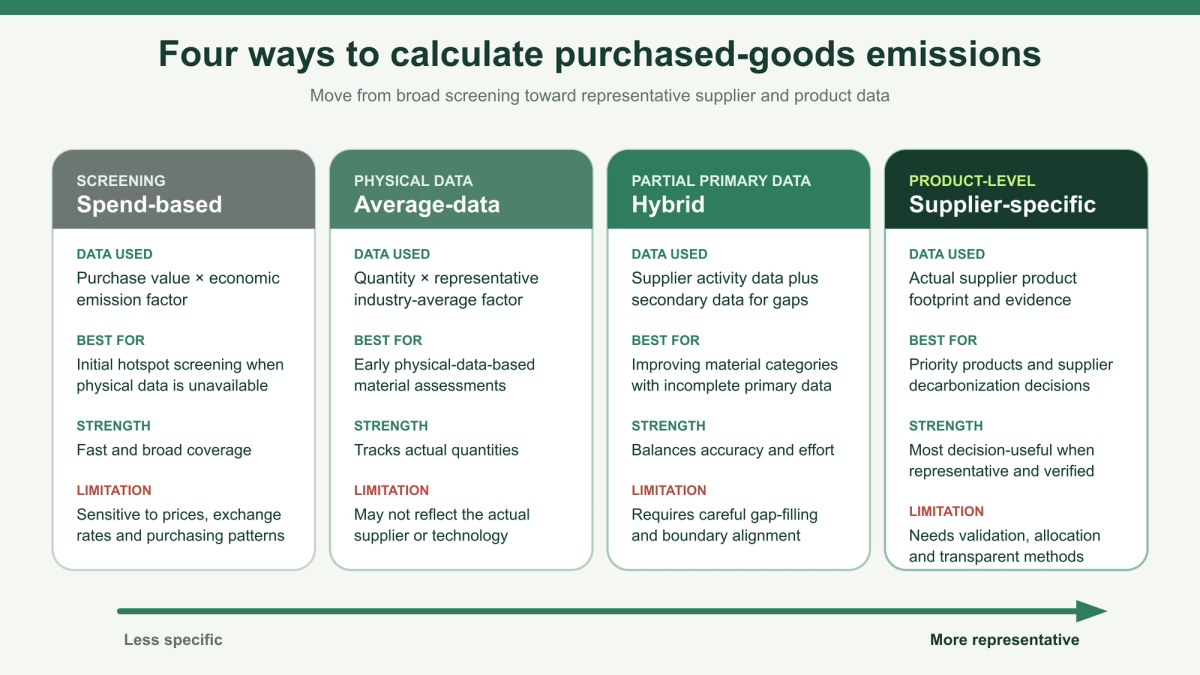
9. How Are Emission Factors Used in Textile Product Carbon Footprints and LCA?
A product carbon footprint estimates greenhouse gas impacts across a defined product lifecycle or partial lifecycle. Individual emission factors are building blocks within that calculation.
For a cotton T-shirt, relevant processes can include cotton cultivation, ginning, spinning, knitting, dyeing, garment manufacturing, packaging, transport, consumer use and disposal, depending on the required boundary.
Three frameworks serve different purposes:
ISO 14067:2018 establishes requirements and guidance for quantifying and reporting product carbon footprints. It remains current following its 2024 review.
GHG Protocol Product Life Cycle Standard provides a framework for product lifecycle greenhouse gas accounting.
PACT Methodology V3, released in April 2025, supports consistent calculation and exchange of cradle-to-gate PCFs between companies.
The EU Apparel and Footwear PEFCR, presented in June 2025, addresses broader lifecycle environmental assessment. Its methodology covers multiple environmental impacts, not just climate change.
A PEF climate-change result and a PACT-aligned PCF should not automatically be assumed equivalent. Their boundaries, modeling requirements, greenhouse gas treatment and reporting conventions must be checked.
The same caution applies to biogenic carbon, land-use change, recycled materials and allocation between co-products.
Product-specific methods can require separate treatment of these elements even where an existing database already provides an aggregated CO₂e result.
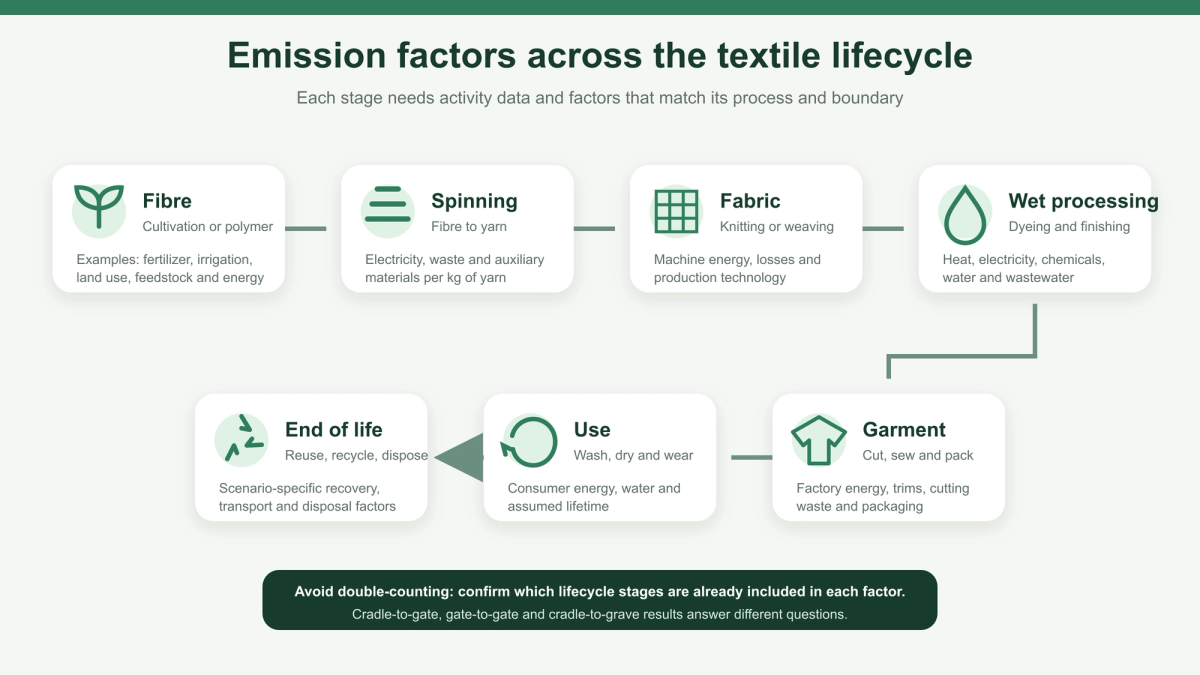
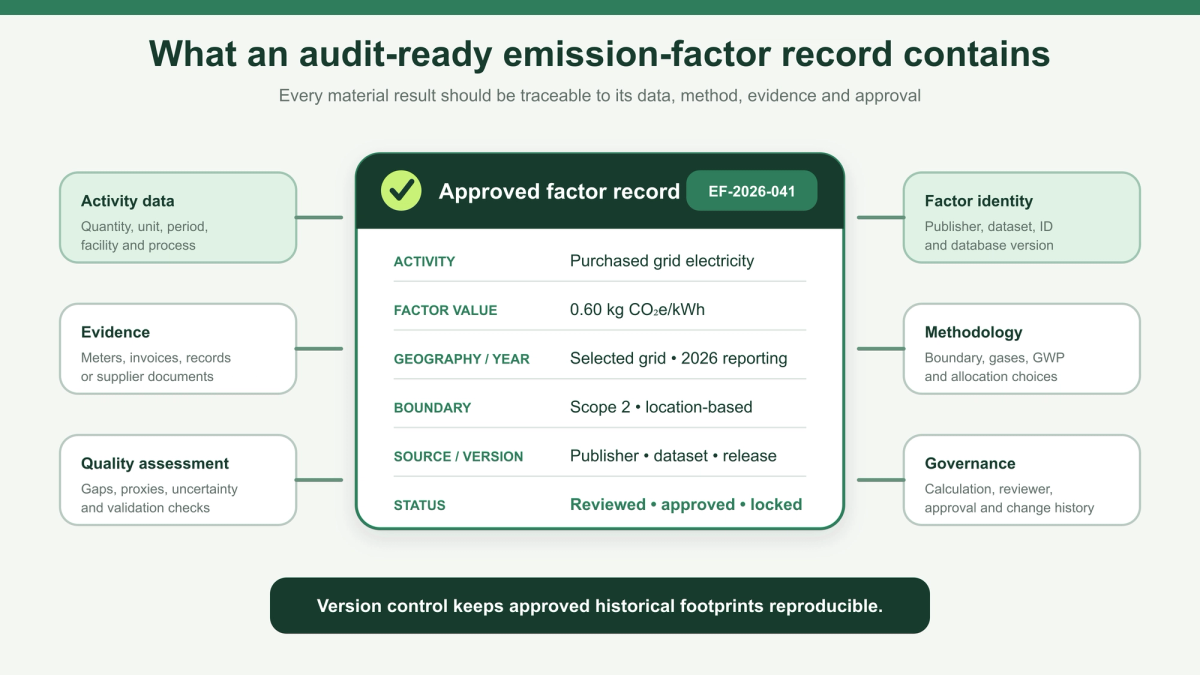
10. What Makes an Emission Factor Audit-Ready?
An audit-ready factor must be traceable from the published emissions figure back to its source, methodology and underlying activity.
For every material calculation, retain:
- Activity data: Information to preserve: Quantity, unit, reporting period, facility and process
- Evidence: Information to preserve: Meter readings, invoices, production records or supplier documents
- Factor identification: Information to preserve: Publisher, dataset, factor ID and database version
- Factor characteristics: Information to preserve: Value, units, reference year and geography
- Methodology: Information to preserve: Boundary, included gases, GWP basis and allocation assumptions
- Quality assessment: Information to preserve: Data gaps, proxies, uncertainty and validation checks
- Governance: Information to preserve: Calculation date, reviewer, approval and change history
This is especially important when multiple textile suppliers contribute information to one garment's footprint.
A useful system should also prevent silent historical changes when emission-factor libraries are updated. New calculations can use updated datasets, while previously approved footprints should retain their original factors unless formally recalculated.
The GHG Protocol emphasizes relevant primary supplier data, supported by secondary information where necessary.
11. Seven Common Emission Factor Mistakes
- Using the wrong country: Applying an electricity factor from another grid without justification.
- Confusing CO₂ with CO₂e: Omitting relevant non-CO₂ gases or applying inconsistent GWP assumptions.
- Mixing system boundaries: Treating a lifecycle fuel factor as a combustion-only factor.
- Ignoring units: Mixing kilograms and tonnes, litres and kilograms, or energy units based on different heating-value conventions.
- Confusing products: Using a cotton lint factor for seed cotton or a yarn factor for finished fabric.
- Double-counting upstream processes: Adding material or energy impacts already included in a cradle-to-gate dataset.
- Updating factors without version control: Creating misleading changes in reported emissions across years.
A further mistake is assuming that a lower published factor demonstrates actual decarbonization. The apparent reduction might arise from a changed database, boundary or calculation method.
Changes in emission factors should therefore be distinguished from changes in real activity and operational performance.
12. Practical Implementation Checklist
Use this checklist when introducing or improving an emission-factor management process.
Must do — when required by the selected accounting standard or reporting obligation
- Define the organization, product or lifecycle boundary.
- Use emission factors consistent with that boundary.
- Apply the required greenhouse gas coverage and GWP conventions.
- Follow applicable Scope 2 accounting and reporting requirements.
- Meet the calculation, allocation and disclosure requirements of any standard under which conformity is claimed.
These are conditional requirements, not a claim that one universal law applies to every business worldwide.
Should do — to improve accuracy and defensibility
- Prioritize representative activity and supplier data for material emission sources.
- Check geographical, temporal and technological representativeness.
- Retain source documents, assumptions and dataset versions.
- Review missing values, unit conversions and calculation anomalies.
- Reassess factors when reporting periods or production conditions change.
Good practice — for scalable sustainability management
- Maintain one centrally governed emission-factor library.
- Assign approved factors to facilities, processes, materials and suppliers.
- Track the proportion of calculations based on primary versus secondary data.
- Maintain a controlled recalculation and version-history process.
- Link footprint results to reduction projects, targets and supplier engagement.
Responsibility should be shared: operations teams supply activity data, procurement manages supplier information, sustainability teams own calculation methodology, and authorized reviewers approve results.
13. Frequently Asked Questions
What is the difference between an emission factor and a carbon footprint?
An emission factor describes emissions per unit of activity or product. A carbon footprint is the calculated total emissions associated with a defined organization, activity or product boundary. Carbon footprints often combine multiple activities and their corresponding emission factors.
Are emission factors the same in every country?
No. Emission factors vary with electricity generation mixes, fuels, production technologies, operating conditions and calculation methodologies. A factor appropriate for one country's textile industry may not accurately represent another country's mills.
Should companies always use the latest emission factors?
Not automatically. Companies should use factors appropriate to the reporting period and required accounting methodology. For historical comparisons, consistency and recalculation policies matter. The latest publication may also contain data representing an earlier year.
Can I use the same emission factors for Scope 1, 2, 3 and product footprints?
Not indiscriminately. An underlying dataset may support multiple calculations, but the factor's lifecycle boundary and emissions coverage must match each application. Corporate inventories and product footprints have different accounting structures.
Is supplier-specific data better than industry-average data?
Representative, high-quality supplier-specific data is generally more useful for tracking actual supply-chain performance. However, poorly measured or incomplete supplier data may be less reliable than a well-documented industry-average dataset. Data quality, not merely data origin, determines usefulness.
Can emission factors be used to calculate the carbon footprint of clothing?
Yes. Emission factors are used with material quantities, energy consumption, process information, transport and other lifecycle activity data to calculate clothing footprints. The calculation must address the defined lifecycle boundary, production losses, allocation, data quality and relevant product-category rules.
Are free emission factor databases sufficient for product LCA?
Sometimes, but not always. Official free resources may adequately support particular operational calculations. Detailed textile product assessments can require additional lifecycle datasets, process models and supplier data. A database's suitability depends on coverage, methodology and licensing.
Can different companies' product footprints be compared directly?
Only when relevant methodological conditions are sufficiently aligned. Differences in functional units, product performance, lifecycle boundaries, datasets, allocation methods and data quality can make seemingly comparable CO₂e numbers misleading.
14. Key Takeaways
- The formula is simple; factor selection determines the credibility of the result. Activity data and emission factors must describe compatible units, processes and boundaries.
- One factor does not fit every geography, reporting year or technology. Representativeness matters more than convenience.
- Corporate GHG inventories and product carbon footprints require different boundary decisions. Factors must be matched to each intended calculation.
- Supplier-specific product data can improve Scope 3 decision-making. But that data must be validated and supported by transparent methods.
- Traceability is essential. Every material emissions result should be linked to its original activity data, factor version, calculation assumptions and supporting evidence.
Ultimately, better carbon accounting is not about producing more numbers. It is about producing numbers that businesses can explain, verify and use to make better decisions.
15. Turning Emission Factors into Actionable Sustainability Intelligence
As textile supply chains become more data-intensive, managing emission factors through disconnected spreadsheets creates unnecessary risks.
A centralized approach helps connect energy data, materials, suppliers, production processes, calculation methods and supporting evidence.
FairlyGreen helps fashion brands and textile manufacturers organize sustainability information across corporate GHG accounting, product footprints, supply-chain traceability and reduction planning.
Book a demo with FairlyGreen to explore how fragmented sustainability data can become structured, traceable and audit-ready intelligence.
17. Authoritative External References
- GHG Protocol. How Do I Choose an Appropriate Emission Factor?. Updated April 2026. Primary guidance on data-quality criteria.
- GHG Protocol. Technical Guidance for Calculating Scope 3 Emissions. Calculation methods for purchased goods and services and other value-chain categories.
- GHG Protocol. Scope 2 Guidance. Electricity accounting, location-based and market-based methods, and contractual-instrument quality criteria.
- US Environmental Protection Agency. GHG Emission Factors Hub. US organizational emission-factor resources.
- UK Department for Energy Security and Net Zero. Greenhouse Gas Reporting Conversion Factors 2026. Official UK factors and methodology.
- Intergovernmental Panel on Climate Change. Task Force on National Greenhouse Gas Inventories. IPCC methodological resources and Emission Factor Database.
- International Organization for Standardization. ISO 14067:2018. Product carbon footprint quantification and reporting.
- Partnership for Carbon Transparency. PACT Methodology V3. Product-level carbon accounting and exchange methodology, released April 2025.
- ecoinvent. Version 3.13. Lifecycle inventory database release of 4 November 2026.
- European Commission. New EU Rules for Measuring Environmental Impact of Clothes and Shoes. Official information about the Apparel and Footwear PEFCR.
- Olugbemi and Bolson. Uncertainty Analysis of Physical-Based Carbon Accounting in Cotton T-Shirt Manufacturing. Scientific Reports, February 2026. A peer-reviewed example of how data and methodological uncertainty affect a textile product footprint.
Share this article
Help others discover this content
Similar Articles
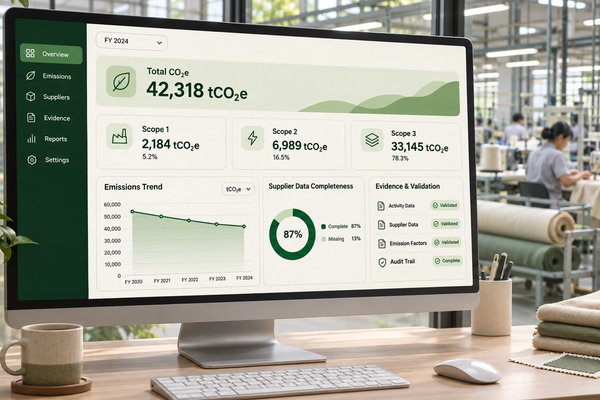
Carbon Accounting Software: Complete Guide for Businesses (2026)
Learn how carbon accounting software works, essential features, GHG Protocol requirements, costs, and how to choose the right platform in 2026.

How to Calculate a Product Carbon Footprint: A Step-by-Step Guide for Textile Manufacturers and Fashion Brands
Learn how to calculate a product carbon footprint (PCF) using ISO 14067, formulas, textile examples, emission factors, and supplier data.
LCA vs PCF vs PEF: Differences, Examples & How to Choose
Understand LCA vs PCF vs PEF, their standards, environmental impacts and EU requirements. Learn which method to choose with practical textile examples.