
EU Textile Sustainability Regulations 2026: What Fashion Brands and Suppliers Must Do to Prepare for 2030
Explore EU textile sustainability regulations in 2026, key deadlines through 2030, and practical steps for fashion brands and suppliers to prepare.
Executive Summary: What Is Changing?
EU textile sustainability regulations are transforming how fashion products are designed, manufactured, documented, marketed and managed after use. As of October 2026, several important requirements already apply, while others—including textile-specific ecodesign and Digital Product Passport (DPP) obligations—are still being developed.
The most immediate priorities include substantiating environmental claims, preventing the destruction of unsold apparel, complying with packaging rules and preparing for new product traceability and circularity requirements.
For global textile suppliers, the practical challenge is broader than understanding individual laws. Brands increasingly need reliable information about materials, production processes, environmental impacts and supply-chain risks.
The most effective preparation strategy is to build one verified sustainability data foundation that can support multiple regulatory and customer requirements.
1. Why EU Textile Sustainability Regulations Matter
The European Union is moving from predominantly voluntary sustainability commitments toward more explicit requirements governing products, commercial claims, reporting and market access.
Its 2022 Strategy for Sustainable and Circular Textiles established a vision of durable, recyclable products, greater material circularity and improved transparency.
Global Fashion Agenda (GFA) organizes the regulatory landscape into five interconnected priorities:
Respectful and secure work environments
- Principal business implications: Human-rights due diligence, forced labour and supplier visibility
Better wage systems
- Principal business implications: Pay transparency, fair working conditions and social reporting
Resource stewardship
- Principal business implications: Energy, emissions, water, chemicals and environmental performance
Smart material choices
- Principal business implications: Fibre composition, material sourcing and environmental claims
Circular systems
- Principal business implications: Durability, recycling, waste management and producer responsibility
These priorities provide a useful management framework, but they are not themselves legal obligations. Each regulation has its own scope, compliance conditions and implementation dates.
Crucially, a regulation being in force does not always mean that every provision already applies to every textile product. A framework may be legally effective while its product-specific requirements remain pending.
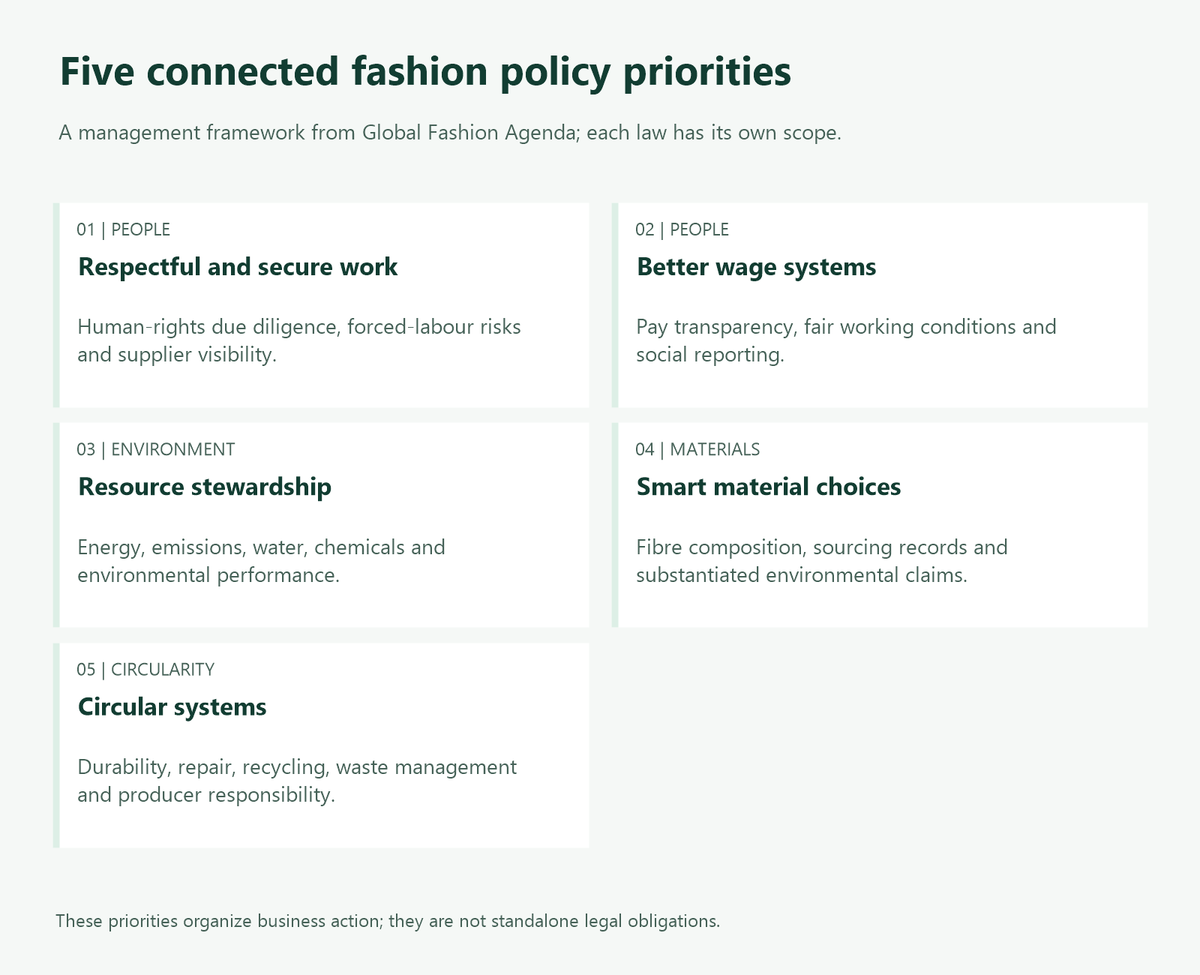
Five priorities of EU fashion sustainability policy
2. Which EU Textile Regulations Matter Most in 2026?
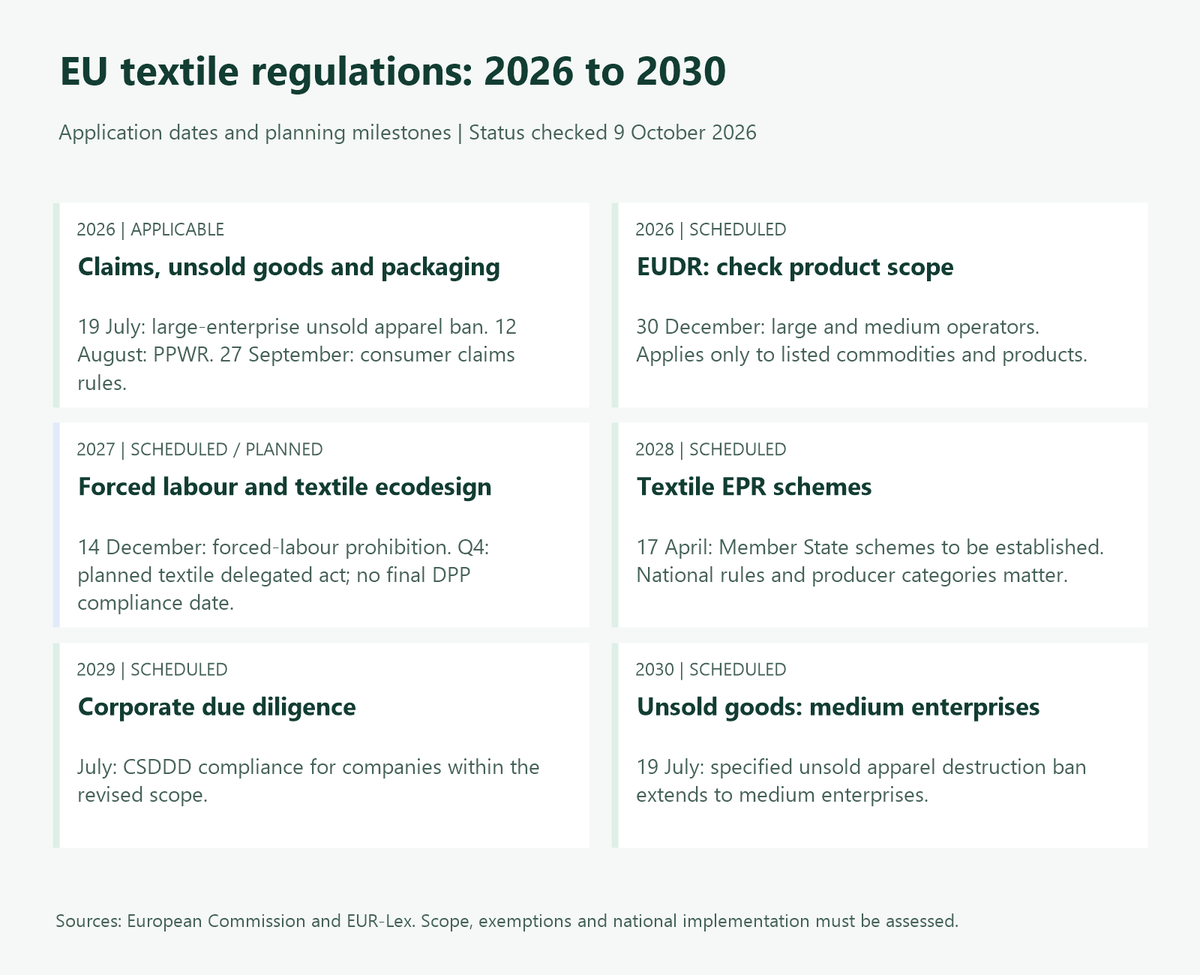
EU textile sustainability regulations timeline 2026 to 2030
The following overview distinguishes applicable rules from future obligations and legislative proposals.
EU Textile Regulatory Timeline: 2026–2030
Empowering Consumers Directive
- Status in October 2026: Applicable through national implementing laws
- Key date or next milestone: 27 September 2026
ESPR ban on destroying unsold apparel
- Status in October 2026: Applies to large enterprises, subject to permitted exemptions
- Key date or next milestone: 19 July 2026
Packaging and Packaging Waste Regulation (PPWR)
- Status in October 2026: Main provisions applying
- Key date or next milestone: 12 August 2026
EU Deforestation Regulation (EUDR)
- Status in October 2026: In force; phased application pending
- Key date or next milestone: 30 December 2026 for large and medium operators
EU Forced Labour Regulation
- Status in October 2026: Adopted; prohibition not yet applicable
- Key date or next milestone: 14 December 2027
Textile Extended Producer Responsibility (EPR)
- Status in October 2026: EU framework adopted; national schemes being established
- Key date or next milestone: Generally by April 2028
Corporate Sustainability Due Diligence Directive (CSDDD)
- Status in October 2026: Revised and narrowed under Omnibus I
- Key date or next milestone: Compliance from July 2029
Textile ecodesign and DPP requirements
- Status in October 2026: Textile-specific delegated act pending
- Key date or next milestone: No final binding textile compliance date
Circular Economy Act
- Status in October 2026: Legislative proposal anticipated
- Key date or next milestone: Expected November 2026
Green Claims Directive
- Status in October 2026: Proposed legislation; negotiations stalled
- Key date or next milestone: No confirmed application date
Sources: European Commission, EUR-Lex, Council of the EU and GFA Policy Matrix, October 2026. Dates may vary by operator category, product scope and national implementation.
3. ESPR and Digital Product Passports: The Biggest Product-Level Transformation
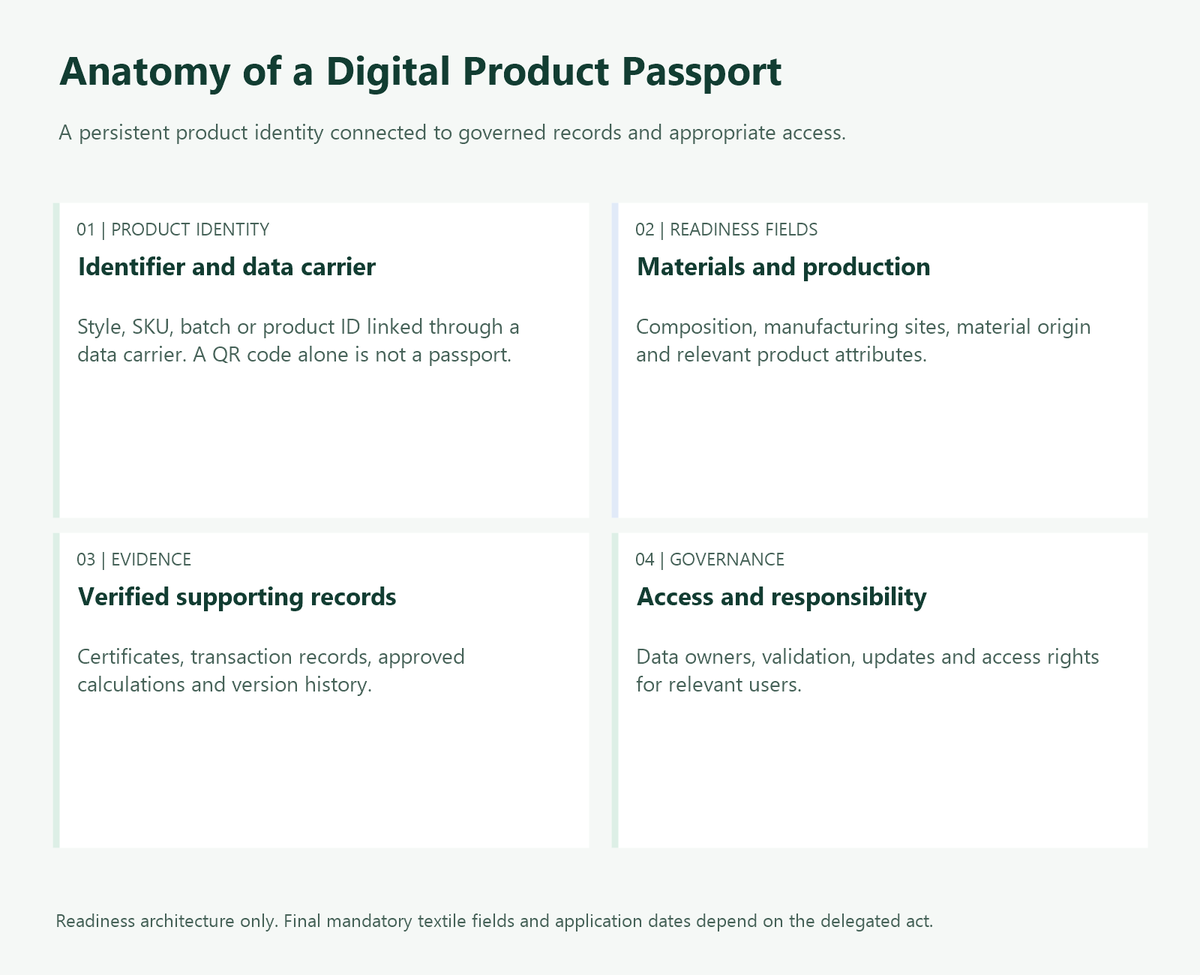
Digital product passport information architecture for apparel
What is the Ecodesign for Sustainable Products Regulation?
The Ecodesign for Sustainable Products Regulation (EU) 2024/1781, which entered into force on 18 July 2024, establishes a framework for environmental performance and information requirements for products placed on the EU market.
Potential textile requirements include:
Product durability and reliability
Repairability and recyclability
Recycled material content
Substances affecting circularity
Resource efficiency and environmental impacts
Product information communicated through a DPP
Specific mandatory requirements for textiles must be established through subsequent delegated legislation.
When will Digital Product Passports become mandatory for textiles?
The ESPR 2025-2030 Working Plan prioritizes apparel textiles. The Commission textile-apparel page currently indicates Q4 2027 for planned adoption of the textile delegated act. This is a planning milestone, not a binding compliance date. The final requirements, covered products and application date depend on the adopted delegated act.
The planning milestone is not a final compliance date. The precise requirements, covered products and application date depend on the eventual delegated act, with a transition period of at least 18 months envisaged for textile-specific requirements.
The EU DPP registry has its own legal framework, including Implementing Regulation (EU) 2026/1778. Its establishment does not make textile DPPs mandatory immediately.
Source: European Commission DPP FAQ
What should suppliers prepare?
A practical product-information record should contain:
Product identification
- Example for a denim garment: Style, SKU, product or batch identifier
Material composition
- Example for a denim garment: 98% cotton, 2% elastane
Manufacturing locations
- Example for a denim garment: Spinning, weaving, dyeing and sewing facilities
Material origin
- Example for a denim garment: Cotton supplier and documented upstream origin
Environmental data
- Example for a denim garment: Verified manufacturing energy and emissions
Circularity attributes
- Example for a denim garment: Recycled content, care and end-of-life information
Supporting evidence
- Example for a denim garment: Certificates, transaction records and approved calculations
These are recommended readiness fields, not a claim that every field will be legally required in the eventual textile DPP.
A DPP is also not simply a QR code. It is a governed information system linking a persistent product identity to reliable, appropriately accessible digital records.
4. CSRD and CSDDD: What Changed Under the EU Omnibus Simplification?
The EU's 2026 Omnibus I reforms significantly narrowed corporate sustainability reporting and due diligence obligations.
Corporate Sustainability Reporting Directive (CSRD)
Under Directive (EU) 2026/470, the general EU-company thresholds are now more than 1,000 employees and €450 million annual net turnover, with separate criteria for non-EU groups.
The legislation also limits certain information requests directed toward smaller value-chain companies.
The Commission adopted simplified European Sustainability Reporting Standards (ESRS) on 3 July 2026. Delegated Regulation (EU) 2026/1563 was published on 21 September 2026, with its effect scheduled for November 2026.
Corporate Sustainability Due Diligence Directive (CSDDD)
The revised CSDDD generally covers EU companies with more than 5,000 employees and €1.5 billion worldwide net turnover, alongside qualifying non-EU companies based on EU turnover.
Its application is scheduled from July 2029.
The rules retain risk-based due diligence but remove the original CSDDD-specific obligation to adopt a climate transition plan.
Source: Council of the EU, February 2026
What does this mean for textile suppliers?
A manufacturer outside the CSRD's direct legal scope may still receive legitimate requests for energy, emissions, workforce and sourcing information from customers, subject to the applicable value-chain limitations.
Therefore, distinguish three categories:
Must do: Meet legal obligations directly applicable to the company.
Should do: Maintain consistent, verified data needed for legitimate customer and contractual disclosures.
Good practice: Use voluntary sustainability reporting frameworks to improve internal performance management.
5. Green Claims: Environmental Marketing Now Requires Greater Discipline
The Empowering Consumers for the Green Transition Directive (EU) 2024/825 became applicable through Member State law on 27 September 2026.
It strengthens protections against misleading environmental claims, including certain generic statements, unreliable sustainability labels and claims that a product has a neutral or reduced greenhouse gas impact based on offsetting.
For fashion brands, expressions such as “eco-friendly,” “green” or “climate neutral” require particular scrutiny.
Consider this comparison:
“Environmentally friendly denim”
- More defensible alternative: “Contains 30% recycled cotton by fibre mass,” if verified
“Zero-carbon T-shirt”
- More defensible alternative: “Manufacturing-stage emissions measured at X kg CO₂e per garment,” with boundary and method disclosed
“100% sustainable fabric”
- More defensible alternative: A specific, substantiated environmental attribute
A quantified claim is not automatically legally compliant. It must also be accurate, relevant, sufficiently qualified and supported by suitable evidence.
The separate proposed Green Claims Directive remains unresolved and should not be presented as an enacted, universally applicable verification requirement.
How should brands prepare?
Establish an environmental-claims register containing the exact claim, affected products, supporting evidence, calculation method, approval authority and review date.
For product footprint claims, document the system boundary, functional unit, emission factors, allocation method and relevant assumptions.
6. Circularity Regulations: EPR, Unsold Products and Packaging
Three regulatory developments already influence fashion business operations.
Textile Extended Producer Responsibility
The revised Waste Framework Directive (EU) 2025/1892 establishes common requirements for textile EPR schemes.
Under EPR, designated producers help finance collection, sorting, reuse and treatment of textiles after use. Member States must establish schemes in accordance with the directive's implementation timetable, generally by April 2028.
Brands should begin tracking product categories, quantities placed on national markets, weights and material composition. Responsibilities and fees will depend on applicable national arrangements.
Ban on destroying unsold apparel
Since 19 July 2026, the ESPR prohibition on destroying specified unsold apparel, clothing accessories and footwear applies to large enterprises, subject to defined exemptions.
Medium-sized enterprises become subject to the prohibition from 19 July 2030.
Brands should establish inventories identifying unsold products, their condition, disposition, recovery route and supporting records.
Packaging and Packaging Waste Regulation
The PPWR began applying on 12 August 2026, although individual obligations have different phase-in arrangements.
Fashion businesses should review e-commerce packaging, transport packaging, materials, recyclability information and applicable EPR arrangements.
Source: European Commission PPWR guidance
7. Forced Labour, Materials and Environmental Footprints
Forced Labour Regulation
The EU Forced Labour Regulation will prohibit products made with forced labour from being placed or made available on the EU market, or exported from the EU, beginning 14 December 2027.
It applies across products and company sizes. Importantly, the regulation does not itself introduce a universal audit or routine reporting obligation; companies may nevertheless need to provide relevant information during investigations.
Textile manufacturers should map higher-risk supply-chain stages, maintain supplier identities and establish credible procedures for identifying and addressing risks.
Source: European Commission Forced Labour Regulation
Fibre traceability and chemical compliance
The EUDR applies to specified commodities and products listed in its legal annexes, not automatically to every textile containing natural or regenerated fibres.
Large and medium operators generally face application from 30 December 2026. Manufacturers must assess the actual product classification before determining whether EUDR applies.
Meanwhile, existing REACH restrictions remain important for dyes, finishes and chemical substances. Work on broader PFAS restrictions is ongoing; a universal ban on all textile PFAS applications should not be assumed to be in force.
Product Environmental Footprint
The EU's Apparel and Footwear Product Environmental Footprint Category Rules (PEFCR), presented in June 2025, provide a harmonized life-cycle assessment approach.
Unlike a product carbon footprint, which measures climate impact in CO₂ equivalents, PEF considers multiple environmental impact categories.
PEFCR is a methodology, not a blanket legal requirement for every apparel product to publish a PEF score.
Source: European Commission, June 2025
8. How to Build One Data System for Multiple EU Requirements
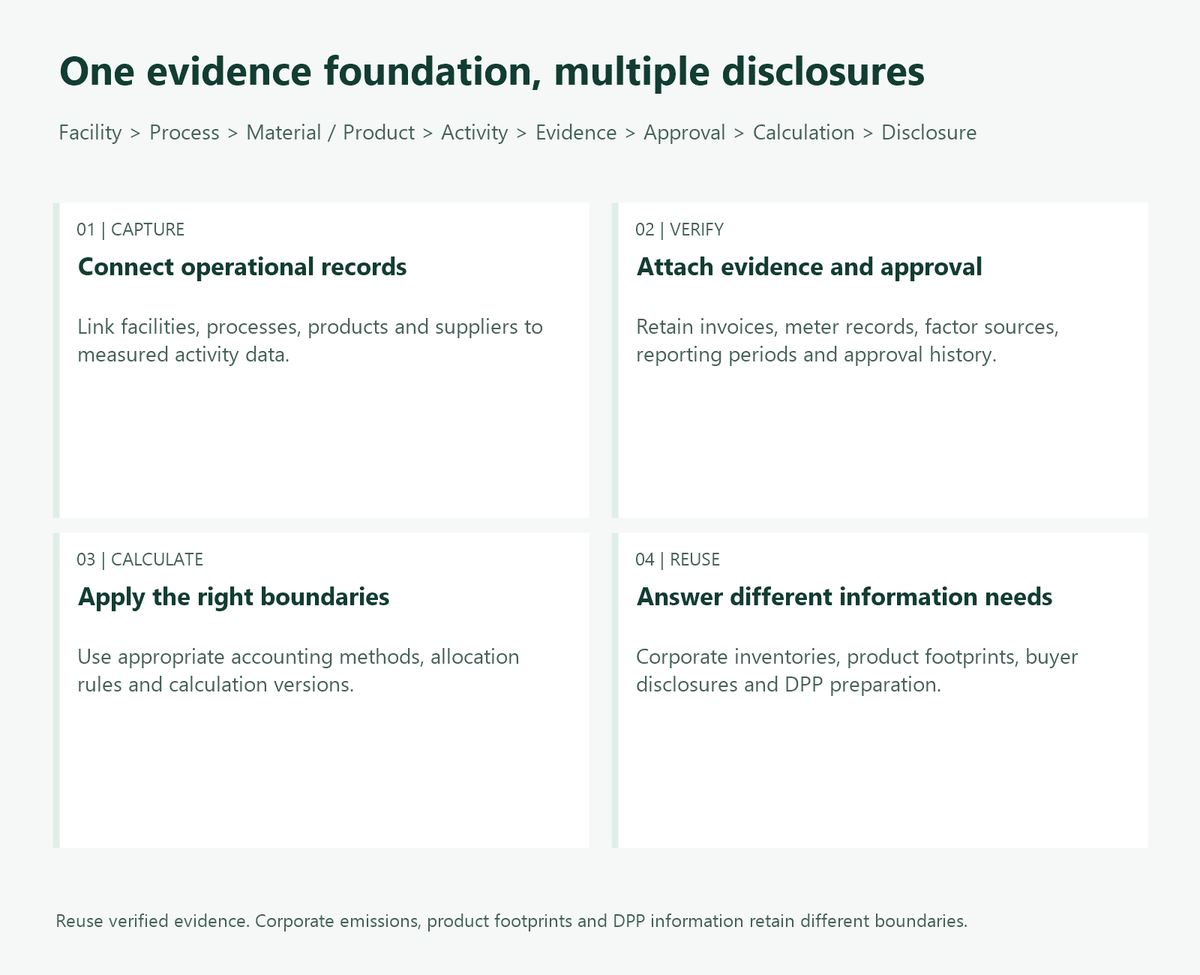
Integrated textile sustainability data model for EU regulatory compliance
The greatest implementation inefficiency arises when each regulation, customer questionnaire or certification program requires suppliers to collect the same information again.
A more scalable approach is to organize data around shared entities.
Recommended Sustainability Data Architecture
Facility → Process → Material/Product → Activity Record → Evidence → Approval → Calculation → Disclosure
For example, a denim mill's electricity invoice can become a verified activity record linked to a facility, reporting period and energy source.
That record can support its corporate Scope 2 inventory and, with an appropriate allocation methodology, product carbon footprint calculations.
Related product and supplier records may subsequently inform DPP preparation or buyer disclosures.
The calculations and boundaries remain different; the underlying verified evidence can be reused.
Example: Energy and carbon data reuse
Suppose a garment production facility records:
Electricity consumed: 100,000 kWh
Illustrative grid emission factor: 0.40 kg CO₂e/kWh
Production: 200,000 garments
Location-based electricity emissions:
100,000 × 0.40 = 40,000 kg CO₂e
Simple production-average electricity emissions:
40,000 ÷ 200,000 = 0.20 kg CO₂e per garment
This is an illustrative allocation, not a complete garment product footprint. Product-specific allocations, electricity accounting methods and other life-cycle stages may change the result.
The same activity record should retain its invoice, meter information, factor source, reporting period, calculation version and approval history.
9. A Practical 90-Day EU Textile Compliance Readiness Plan
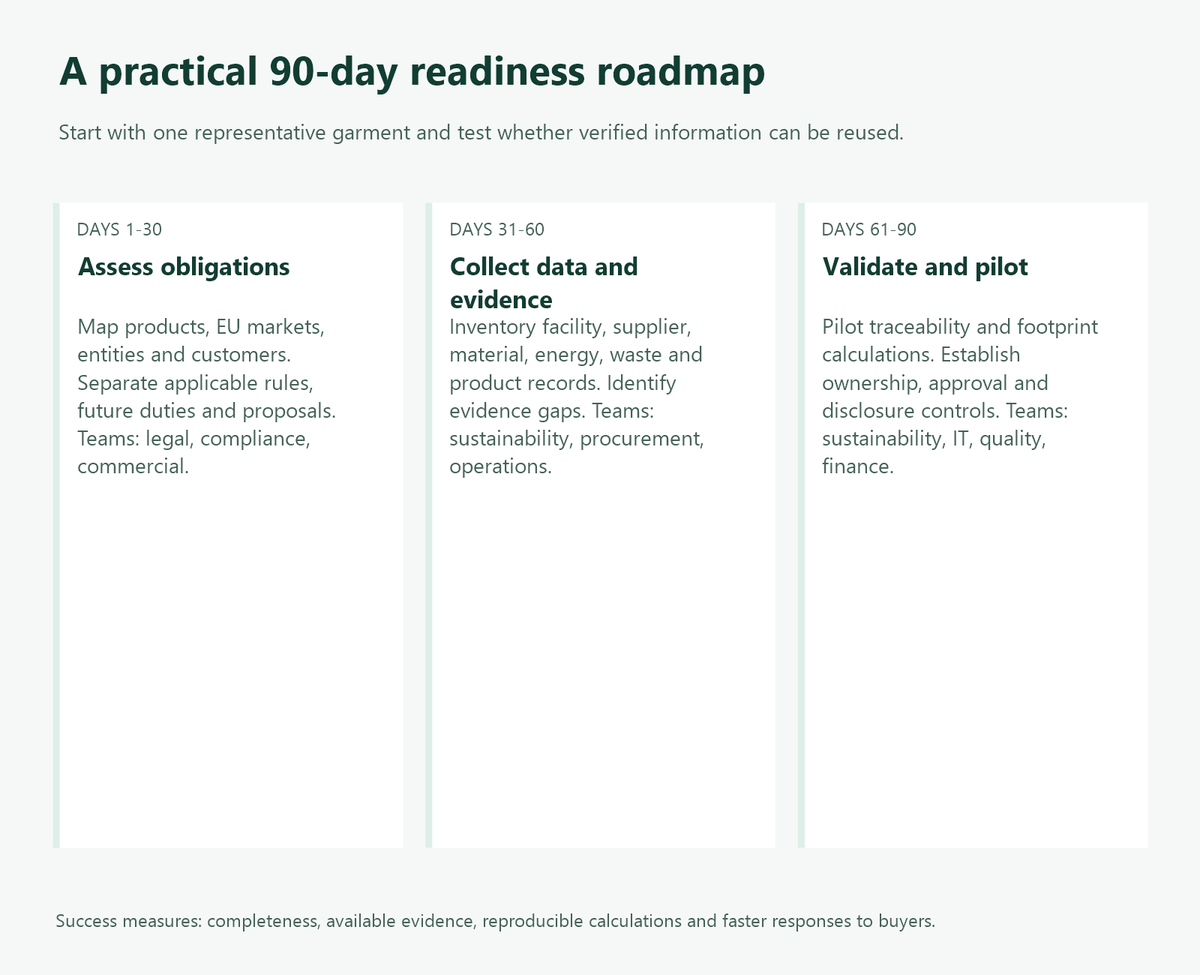
EU textile regulatory compliance 90-day implementation roadmap
Days 1–30
- Priority actions: Map EU products, customers, legal entities and applicable obligations; classify regulatory status
- Responsible teams: Legal, compliance, commercial
Days 31–60
- Priority actions: Inventory facility, material, supplier, energy, waste and product data; identify evidence gaps
- Responsible teams: Sustainability, procurement, operations
Days 61–90
- Priority actions: Pilot product traceability and footprint calculations; establish verification and disclosure controls
- Responsible teams: Sustainability, IT, quality, finance
The pilot should begin with one representative garment and trace its materials and manufacturing records across participating facilities.
Test whether verified information can be reused for different buyer questions without repeated manual entry.
Measure success through data completeness, evidence availability, calculation reproducibility and the time required to answer a new information request.
10. Practical Implementation Checklist
Identify applicable EU laws by product, market and legal entity.
Separate enacted obligations from proposals and voluntary guidance.
Review environmental marketing claims and supporting evidence.
Maintain accurate supplier and manufacturing-site records.
Collect facility energy, fuel, water, waste and emissions data.
Map material composition and upstream traceability.
Establish product identification and version-controlled records.
Assess product carbon footprint and PEF data requirements.
Review unsold-goods, packaging and EPR responsibilities.
Establish evidence approval, data ownership and audit trails.
Monitor future textile ecodesign and DPP delegated acts.
11. Frequently Asked Questions
Are Digital Product Passports mandatory for all textiles in 2026?
No. The ESPR provides the framework, but the relevant textile-specific delegated requirements and their final application dates have not yet been established.
Do EU textile regulations apply to Pakistani, Bangladeshi or Indian suppliers?
Potentially. EU product rules can affect imported goods regardless of manufacturing country. However, the direct legal obligations of an overseas manufacturer differ from those of the EU importer, brand or other economic operator. Customer contracts can create additional information requirements.
Does every textile supplier need CSRD reporting?
No. CSRD applies only to qualifying companies and groups. Smaller suppliers may nevertheless need to supply environmental and social information to customers, within applicable legal limits.
Is a carbon footprint the same as a PEF assessment?
No. A product carbon footprint measures climate impact. A PEF assessment uses life-cycle assessment to evaluate a broader range of environmental impacts.
What should a textile supplier prioritize first?
Start with applicable current obligations, then create a verified facility, product and supplier data repository. This reduces the effort needed to respond to future DPP requirements and customer information requests.
12. Key Takeaways
EU fashion regulation is becoming increasingly product-specific, evidence-based and digitally connected.
The immediate challenge is meeting requirements already applicable in 2026. The next challenge is preparing for forced-labour enforcement, textile EPR and emerging ecodesign and DPP obligations.
For brands, environmental statements and sourcing decisions must be supported by credible documentation. For manufacturers, verified operational and product data are becoming a valuable commercial asset.
The strategic opportunity is not to build a separate compliance process for every regulation, but to establish trusted sustainability information that can serve multiple purposes.
13. How FairlyGreen Can Help
A structured sustainability information platform can help organizations replace disconnected spreadsheets with consistent data for greenhouse gas accounting, Scope 1–3 emissions, product carbon footprints, supplier traceability and digital product passport preparation.
FairlyGreen focuses on these interconnected areas, helping textile and apparel businesses establish stronger foundations for environmental measurement and product-level transparency.
Book a demo to explore how FairlyGreen can help turn fragmented sustainability data into structured, audit-ready intelligence.
Authoritative references
- ESPR: Regulation (EU) 2024/1781
- Commission: textile apparel and DPP timetable
- Revised reporting and due diligence: Directive (EU) 2026/470
- Simplified ESRS: Delegated Regulation (EU) 2026/1563
- Empowering Consumers: Directive (EU) 2024/825
- Textile EPR: Directive (EU) 2025/1892
- Commission: packaging waste
- Commission: Forced Labour Regulation
Share this article
Help others discover this content
Similar Articles

EU Textile Sustainability Regulations 2026: The Practical Guide for Fashion, Apparel and Footwear
A practical 2026 guide to EU textile sustainability regulations covering ESPR, DPP, EPR, PPWR, green claims, CSRD, CSDDD, forced labour and EUDR.

EU Digital Product Passport for Textiles: What Brands Must Prepare for Now
The EU Digital Product Passport for textiles is not just a QR code. Learn what is decided, what remains proposed, and how to prepare now.
PEFCR v3.1 Is Final - Here’s What Fashion Brands Must Do Next
After five years of development, the Product Environmental Footprint Category Rules (PEFCR v3.1) for apparel and footwear are official. This is no longer a pilot - this is the standard.