
EU Textile Sustainability Regulations 2026: The Practical Guide for Fashion, Apparel and Footwear
A practical 2026 guide to EU textile sustainability regulations covering ESPR, DPP, EPR, PPWR, green claims, CSRD, CSDDD, forced labour and EUDR.

Executive answer / TL;DR
The EU textile sustainability framework is no longer one regulation or one reporting exercise. It is becoming an interconnected system covering products, supply chains, claims, packaging, waste, corporate reporting and market enforcement.
As of 25 September 2026, the immediate priorities are clear. The Packaging and Packaging Waste Regulation (PPWR) has applied since 12 August 2026; the ESPR prohibition on destroying unsold apparel and footwear applies to large companies from 19 July 2026; the strengthened consumer rules on environmental claims apply from 27 September 2026; and the revised Waste Shipment Regulation and DIWASS are already operational. Environment
The textile Digital Product Passport is not yet mandatory. The Commission currently indicates a textile-specific ESPR delegated act in Q3–Q4 2027, followed by a transition period of at least 18 months. On that timetable, mandatory textile DPP implementation would point to 2029 rather than 2028, subject to the final delegated act. The EU DPP Registry itself has already been operational since 20 July 2026. Internal Market SMEs
The smartest compliance strategy is therefore not to build a separate spreadsheet for every regulation. It is to establish a shared product and supply-chain data backbone that can feed DPP, EPR, LCA/PEF, claims substantiation, due diligence and reporting.
EU Textile Sustainability Regulations 2026: How the Framework Really Fits Together
The regulatory map for fashion is becoming crowded because the EU is addressing different stages of the same product lifecycle through different legal instruments. The simplest way to understand it is as three connected layers:
- Product obligations — what the product contains, how it performs, how it is labelled and what may be claimed about it.
- Supply-chain and corporate obligations — where products and materials came from, what impacts occurred upstream and what companies must investigate or disclose.
- Circular-system obligations — what happens to packaging, unsold stock, used products and waste.
This matters because the same underlying data increasingly feeds several regulations.
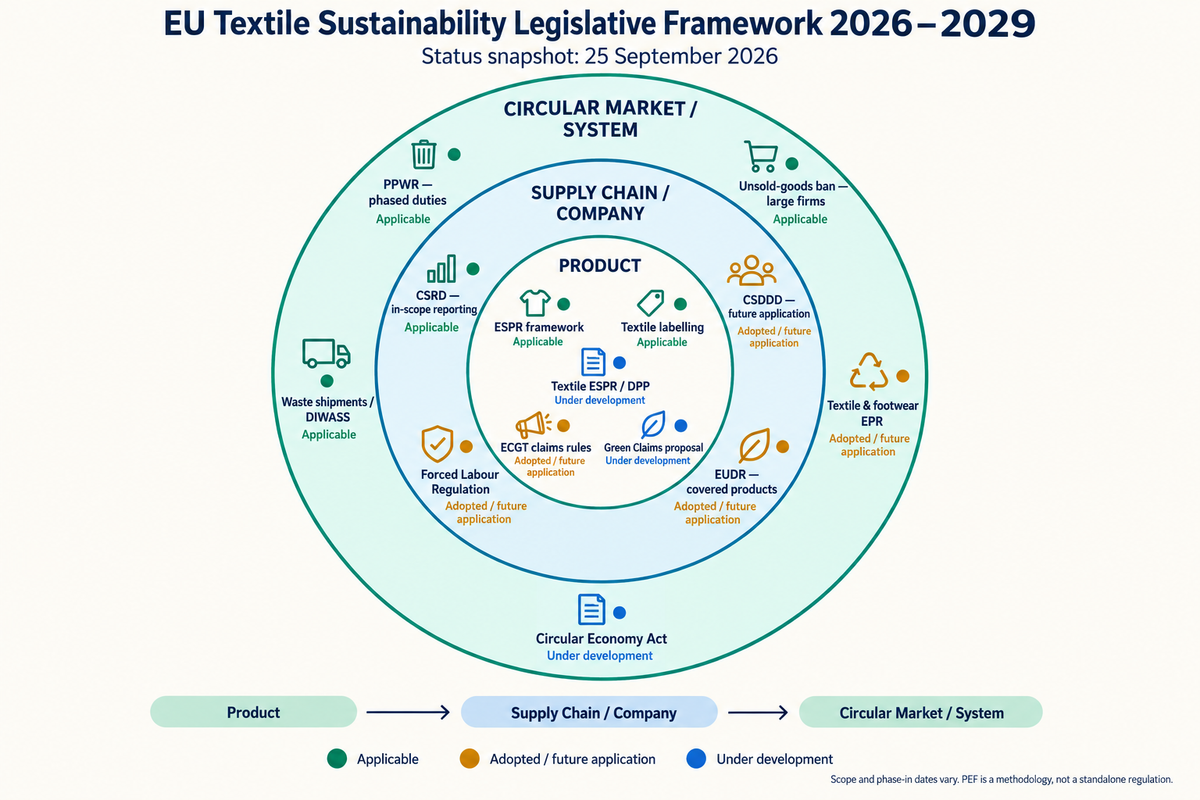
EU textile sustainability regulations mapped across product, supply-chain and circular-economy obligations from 2026 to 2029.
EU textile regulatory roadmap: what matters now?
ESPR + textile DPP
Status at 25 Sep 2026: ESPR in force; textile rules under development.
Key timing: Textile delegated act indicated Q3–Q4 2027; ≥18-month transition.
Build DPP-ready product data now, but do not treat textile DPP as already mandatory. Internal Market SMEs
Unsold apparel/footwear
Status: In application.
Key timing: Large companies: 19 Jul 2026; medium companies: 19 Jul 2030.
Destruction is prohibited except permitted derogations; disclosure rules are also being implemented. EUR-Lex
ECGT / UCPD
Status: Adopted.
Key timing: Applies 27 Sep 2026.
Environmental marketing claims require much tighter control; specified greenwashing practices become prohibited. European Commission
PPWR
Status: In application.
Key timing: From 12 Aug 2026; major requirements phase in later.
Apparel businesses must treat packaging as its own compliance data stream. Environment
Textile & footwear EPR
Status: Directive adopted.
Key timing: Member States must establish schemes by 17 Apr 2028; microenterprises from 17 Apr 2029.
Producers will finance and organise end-of-life management under national schemes implementing common EU rules. EUR-Lex
Waste Shipment Regulation
Status: In application.
Key timing: Most provisions from 21 May 2026.
Cross-border waste movements are increasingly digital and traceable through DIWASS. Environment
CSRD / CSDDD
Status: Revised in 2026.
Key timing: Significantly narrower scopes.
Direct legal scope has contracted, but supply-chain sustainability data remains commercially important. Consilium
Forced Labour Regulation
Status: In force; main obligations forthcoming.
Key timing: Applies 14 Dec 2027.
Products made with forced labour can be prohibited from the EU market. EUR-Lex
EUDR
Status: In force; application forthcoming.
Key timing: Large/medium: 30 Dec 2026; most micro/small: 30 Jun 2027.
Check the current Annex I by CN code—do not assume all fashion materials are covered. Environment
Textile Labelling Regulation
Status: Current law remains applicable; revision pending.
Key timing: No replacement yet.
Fibre-composition compliance remains mandatory while wider physical/digital labelling reform is still being developed.
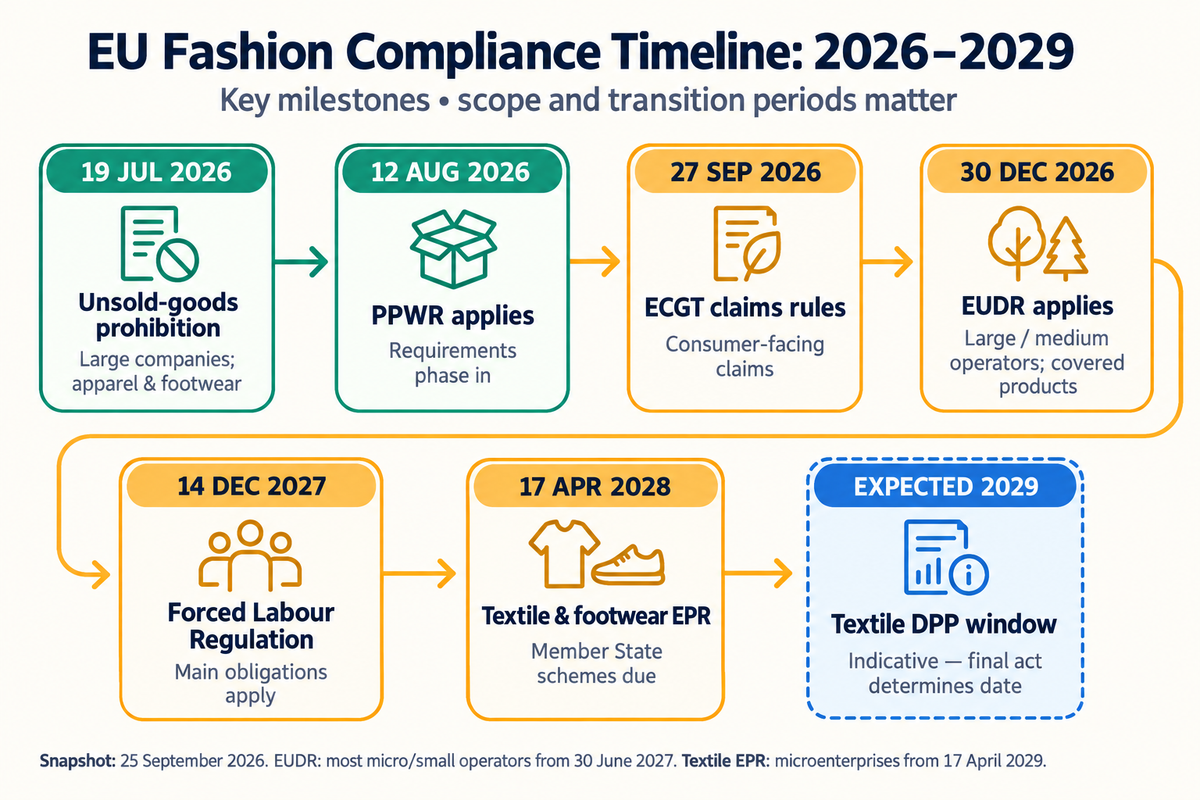
Timeline of key EU fashion and textile sustainability regulatory deadlines from 2026 through 2029.
Layer 1: Product obligations are becoming data obligations
ESPR and the Digital Product Passport
The Ecodesign for Sustainable Products Regulation (EU) 2024/1781 creates the framework through which product-specific requirements can address durability, repairability, recyclability, recycled content, environmental impacts and information requirements. Textiles, with a focus on apparel, are a priority product group under the 2025–2030 ESPR Working Plan. EUR-Lex
But there is an important distinction:
ESPR is already law; the final textile ecodesign and DPP requirements are not.
The Commission's current DPP timeline places the textile delegated act in Q3–Q4 2027 and states that economic operators will receive at least an 18-month transition after adoption. Meanwhile, the DPP Registry became operational in July 2026 and provides infrastructure for identifiers and registration metadata while full product information remains decentralised. Internal Market SMEs
For footwear companies, an additional caution is necessary: the ESPR working plan treats footwear separately from textiles and envisages a study running through 2027 rather than simply assuming that the textile delegated act covers footwear. Environment
Green claims: 27 September 2026 is the immediate deadline
Directive (EU) 2024/825 on Empowering Consumers for the Green Transition strengthens EU consumer law from 27 September 2026. Among other measures, it prohibits specified environmental claims based on offsetting greenhouse-gas emissions—for example, presenting a product as climate neutral because external carbon credits have been purchased. It also tightens requirements around generic environmental claims, sustainability labels and future environmental-performance claims. EUR-Lex
This should not be confused with the proposed Green Claims Directive. The Commission still lists that proposal as pending, while the European Parliament's legislative tracker describes the file as blocked. The rules applying on 27 September arise from the Empowering Consumers Directive, not from adoption of the Green Claims proposal. Environment
Action: create a claims register linking every environmental statement to its scope, calculation method, evidence, approval, validity period and supporting dataset.
PPWR adds packaging to the product-data architecture
The Packaging and Packaging Waste Regulation (EU) 2025/40 has applied since 12 August 2026, although many design, recyclability, recycled-content and labelling requirements phase in later. It matters to fashion because garment bags, cartons, shoe boxes, e-commerce mailers and transport packaging sit within the packaging lifecycle. Environment
A product-compliance system therefore needs packaging composition, weight, material type, recycled content and market-specific EPR information—not merely garment data.
Layer 2: Supply-chain rules make traceability operational
CSRD and CSDDD are narrower—but supplier data has not become irrelevant
The 2026 Omnibus I amendments narrowed CSRD scope to companies with more than 1,000 employees and above €450 million net annual turnover, while the amended CSDDD/CS3D threshold is more than 5,000 employees and above €1.5 billion net turnover. The CSDDD climate-transition-plan obligation was also removed, with application of the amended due-diligence requirements pushed to July 2029. Consilium
For suppliers outside direct scope, the implication is not “stop measuring sustainability.” Customer requirements, product legislation, carbon-footprint requests and due-diligence evidence still require structured information. The Commission also adopted revised ESRS and a voluntary standard for smaller companies in July 2026, including a value-chain cap intended to limit excessive information demands on protected smaller companies. Finance
Forced labour requires traceability beyond Tier 1
The EU Forced Labour Regulation applies from 14 December 2027 and can prevent products made with forced labour from being placed or made available on the EU market or exported from it. Commission implementation guidelines were published in September 2026. EUR-Lex
For textiles, effective preparation means being able to connect product → material → supplier → manufacturing site → upstream source → risk evidence → corrective action. A certificate stored separately from the underlying supplier relationship is not a traceability system.
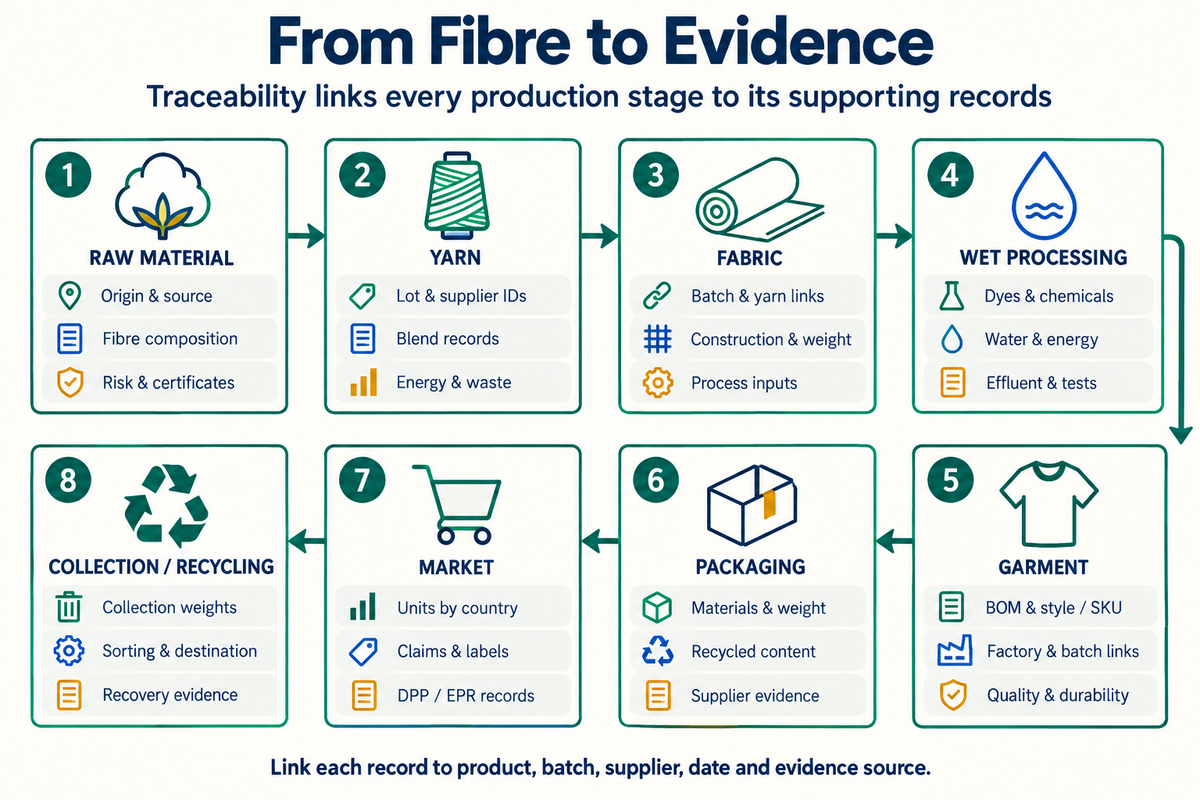
Textile supply-chain traceability showing sustainability and regulatory data required from fibre through recycling.
EUDR: check current product codes, not old fashion compliance guides
EUDR begins applying on 30 December 2026 for large and medium operators and on 30 June 2027 for most micro and small operators. But it is commodity- and product-code-based, not a blanket “fashion regulation.” Environment
A particularly important September 2026 change is that cattle hides, skins and leather were removed from EUDR Annex I by Delegated Regulation (EU) 2026/2102, effective 18 September 2026. Some older fashion compliance guides therefore already contain obsolete leather guidance. Companies should screen the current Annex I and CN classification rather than rely on historical lists. EUR-Lex
Layer 3: Circularity increasingly follows the product after sale
The revised Waste Framework Directive introduces common EU rules for extended producer responsibility for textiles, textile-related products and footwear. Member States must have their schemes established by 17 April 2028. Producer contributions can ultimately be eco-modulated using relevant ecodesign criteria, linking EPR directly back to ESPR. EUR-Lex
That connection is strategically important: better product design may eventually influence end-of-life fees, while the same product master data can support DPP and EPR reporting.
Waste itself is becoming more traceable. Since 21 May 2026, most provisions of the revised Waste Shipment Regulation apply and relevant shipment procedures are digitalised through DIWASS. Most new export rules apply from May 2027. Environment
The proposed Circular Economy Act and European Product Act shown in the wider legislative framework remain planned rather than current textile obligations as of 25 September 2026. The Commission still lists both among forthcoming initiatives. European Commission
The hidden common denominator: one regulatory data backbone
The regulations differ, but their data requirements overlap. A scalable compliance architecture should organise at least five connected data domains:
- Product data: SKU/style identifiers, CN codes, bill of materials, fibre composition, product weight, recycled content, durability and technical evidence.
- Supplier and traceability data: legal entities, factories, production processes, countries, tiers, material sources, certifications, risk assessments and corrective actions.
- Environmental-impact data: activity data, energy and fuels, emission factors, transportation, primary supplier data, PCF/LCA calculations, methodologies, versions and evidence.
- Claims and compliance evidence: each claim, its substantiation, system boundary, methodology, approvals, certificates, test reports and validity dates.
- Circularity data: packaging, units and weights placed on each market, unsold inventory disposition, EPR reporting, reuse/recycling routes and waste-shipment documentation.
This is where regulatory readiness and sustainability data management converge. DPP should be treated as an output layer of trusted product data—not as a QR-code project.
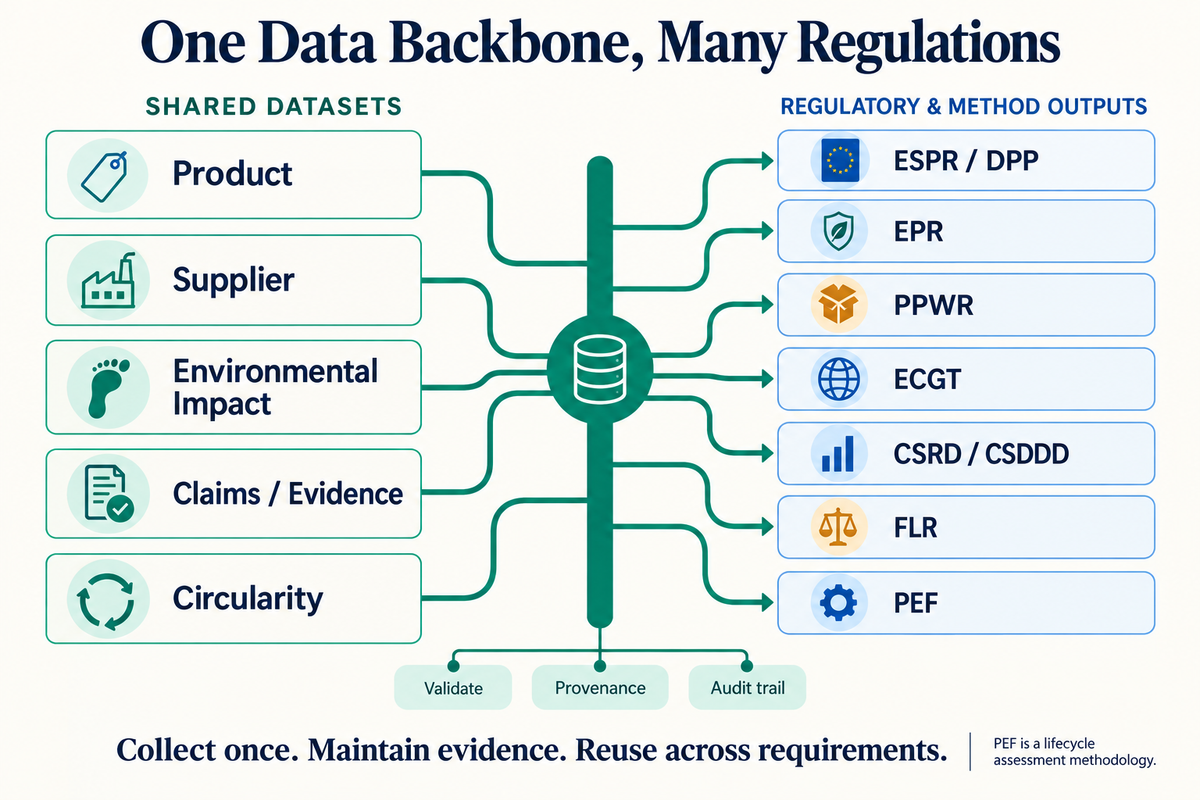
Shared textile sustainability data architecture supporting DPP, EPR, LCA, green claims and EU due diligence regulations.
Where does PEF fit?
The EU Product Environmental Footprint (PEF) is a lifecycle methodology covering multiple environmental impact categories rather than simply carbon emissions. The Apparel and Footwear PEF Category Rules provide sector-specific calculation rules intended to improve consistency, comparability and verifiability. Environment
PEFCR is therefore highly relevant to environmental-impact data architecture, but it should not be described as a universal standalone legal obligation for every garment. Its legal relevance depends on the regulatory or voluntary scheme invoking the methodology.
Practical implementation checklist
Must do
- Audit consumer-facing environmental claims before 27 September 2026, including websites, labels, packaging, campaigns and product pages.
- Confirm PPWR applicability and assign packaging-data ownership.
- For affected large businesses, implement controls for the ESPR unsold apparel/footwear destruction prohibition.
- Apply current Textile Labelling Regulation requirements rather than waiting for the proposed revision.
- Use DIWASS/current Waste Shipment Regulation procedures where applicable.
- Screen current EUDR Annex I CN codes before the 30 December 2026 application date.
- Determine whether the organisation falls within the revised CSRD or CSDDD scope.
Should do
- Build the product/material/supplier data model needed for the future textile DPP.
- Establish style/SKU-level BOM and traceability links instead of relying only on supplier-level records.
- Prepare textile and footwear quantities/weights by EU Member State for future EPR reporting.
- Map higher-risk upstream supply chains against Forced Labour Regulation requirements.
- Store PCF/LCA/PEF assumptions, emission factors, source data and calculation versions with an audit trail.
Good practice
- Maintain one regulatory requirements register with law, scope, effective date, owner, evidence and status.
- Establish a controlled evidence repository rather than exchanging compliance files through email.
- Assign data-quality scores and review dates to supplier information.
- Design product identifiers and APIs with future DPP interoperability in mind.
- Reassess the regulatory map quarterly because several textile-specific measures remain under development.
FAQ
Is the EU Digital Product Passport mandatory for textiles in 2026?
No. ESPR establishes the DPP framework and the EU Registry is already live, but textile-specific DPP requirements have not yet been adopted. The Commission currently indicates Q3–Q4 2027 for the textile delegated act, followed by at least an 18-month transition period. Internal Market SMEs
When is the textile DPP likely to become mandatory?
On the Commission's current indicative schedule, 2029 is the earliest realistic window, because the planned 2027 textile delegated act must be followed by at least 18 months of transition. The final date will depend on the adopted delegated act. Internal Market SMEs
When does EU textile EPR become mandatory?
Member States must establish compliant textile and footwear EPR schemes by 17 April 2028. Microenterprises receive additional time, with the relevant provisions applying to them from 17 April 2029. National implementation arrangements should therefore be monitored separately. EUR-Lex
Does EUDR still apply to cattle leather?
Cattle hides, skins and leather were removed from EUDR Annex I in September 2026. Businesses should use the current Annex I and CN code of the actual commodity or product rather than older sector guidance. EUR-Lex
Is the Green Claims Directive already law?
No. The proposed Green Claims Directive remains pending/blocked. However, Directive (EU) 2024/825 on Empowering Consumers for the Green Transition is adopted law and its strengthened consumer-protection rules apply from 27 September 2026. Environment
Key takeaways
The biggest mistake is to view ESPR, DPP, EPR, PPWR, green claims, LCA, traceability and due diligence as separate compliance projects. They increasingly depend on the same underlying product, supplier and environmental evidence.
For fashion and textile businesses, the strategic objective for 2026 should therefore be:
Collect once → validate once → maintain provenance → reuse across regulations.
That architecture is likely to be cheaper, more auditable and more resilient than building a new spreadsheet every time Brussels publishes another requirement.
Turn sustainability data into audit-ready intelligence
As sustainability regulation moves from narrative disclosure toward structured product and supply-chain data, companies need an auditable connection between GHG accounting, product footprints, LCA/PEF, supplier traceability, DPP information and supporting evidence.
Book a demo to see how FairlyGreen can help turn fragmented sustainability data into structured, audit-ready intelligence.
Authoritative external references
- Ecodesign for Sustainable Products Regulation — EUR-Lex
- European Commission — Digital Product Passport
- European Commission — ESPR 2025–2030 Working Plan
- Revised Waste Framework Directive — EUR-Lex
- European Commission — Packaging and Packaging Waste Regulation
- Directive on Empowering Consumers for the Green Transition — EUR-Lex
- Council of the EU — 2026 CSRD and CSDDD amendments
- EU Forced Labour Regulation — EUR-Lex
- European Commission — EUDR current implementation and dates
- European Commission — Apparel and Footwear PEFCR
- European Commission — Textile Labelling Regulation review
- European Commission — Waste Shipment Regulation and DIWASS
Share this article
Help others discover this content
Similar Articles

Digital Product Passports: A Practical Buyer’s Guide for Fashion and Textile Teams
Digital Product Passports are becoming a practical compliance and product-data challenge for fashion and textile teams. Here’s what buyers should understand before selecting a DPP solution.
Fashion 2026: Why Sustainability Is No Longer a Strategy—But the Operating System
SBTi Corporate Net-Zero Standard V2.0: Fashion & Textiles Guide
What SBTi Corporate Net-Zero Standard V2.0 changes, who must do what, and how fashion and textile companies can prepare for 2027–2028.