
SBTi Corporate Net-Zero Standard V2.0: Fashion & Textiles Guide
What SBTi Corporate Net-Zero Standard V2.0 changes, who must do what, and how fashion and textile companies can prepare for 2027–2028.
Executive Summary
SBTi published the final Corporate Net-Zero Standard Version 2.0 on 11 June 2026. The Standard becomes effective on 1 February 2027. From Q1 2027, companies can submit targets under either V1.3.1 or V2.0 during the transition; from 1 February 2028, new target submissions must use V2.0. Existing validated near-term targets generally remain valid through their target timeframe.
The biggest change is conceptual: SBTi V2.0 is no longer primarily a target-setting framework. It creates a repeating management cycle of inventory → target → transition plan → implementation → annual reporting → end-of-cycle assessment → new target. It places substantially more emphasis on governance, current emissions data, implementation evidence, Scope 3 action, market-instrument integrity and independent assurance.
For fashion and textiles, five implications stand out:
- Company classification comes first. Category A companies have substantially more demanding Scope 3, assurance and disclosure obligations than Category B companies.
- Scope 1 and Scope 2 near-term targets are required for all companies using V2.0; Scope 3 near-term targets are required for Category A.
- Scope 3 is now more operational. Companies must identify significant categories and separately identify emissions-intensive activities, or EIAs.
- Buying instruments does not automatically mean reducing the corporate inventory. V2.0 distinguishes physical inventory reductions from activity-pool and sector-level contributions and restricts the claims that can follow.
- Data infrastructure becomes a strategic requirement Fashion businesses need traceable supplier, facility, material, energy, logistics, methodology and evidence records that can survive assurance—not merely annual spreadsheet calculations.
SBTi Corporate Net-Zero Standard V2.0: What Fashion and Textile Companies Need to Know
SBTi Corporate Net-Zero Standard V2.0 changes the question companies must answer.
Version 1 largely asked: Is your target ambitious enough?
Version 2 increasingly asks: Can you demonstrate how the target will be delivered, what happened during the target cycle, what evidence supports your actions, and what you will do when barriers prevent progress?
That distinction matters particularly in fashion and textiles, where a large share of emissions can sit outside a brand's direct operations—in fibers and materials, yarn and fabric production, wet processing, assembly, electricity used by suppliers, freight and other value-chain activities.
The result is a Standard that connects carbon accounting much more closely with procurement, sourcing, investment, supplier management, energy purchasing, governance and assurance.
Important terminology: SBTi uses “shall” for conditions that are required when seeking validation under the Standard and “recommendation” for good practices that are not mandatory. SBTi itself distinguishes these requirements from legal obligations and explicitly states that conformity with its Standards is not a substitute for regulatory compliance.
In this article, Must do means an applicable SBTi “shall” requirement—not a statutory obligation.
When does SBTi Corporate Net-Zero Standard V2.0 apply?
SBTi V2.0 was published on 11 June 2026 and becomes effective on 1 February 2027. V1.3.1 remains available for new submissions through 31 January 2028. From 1 February 2028, new target submissions must use Version 2.0. Companies with existing validated targets generally do not have to replace them immediately.
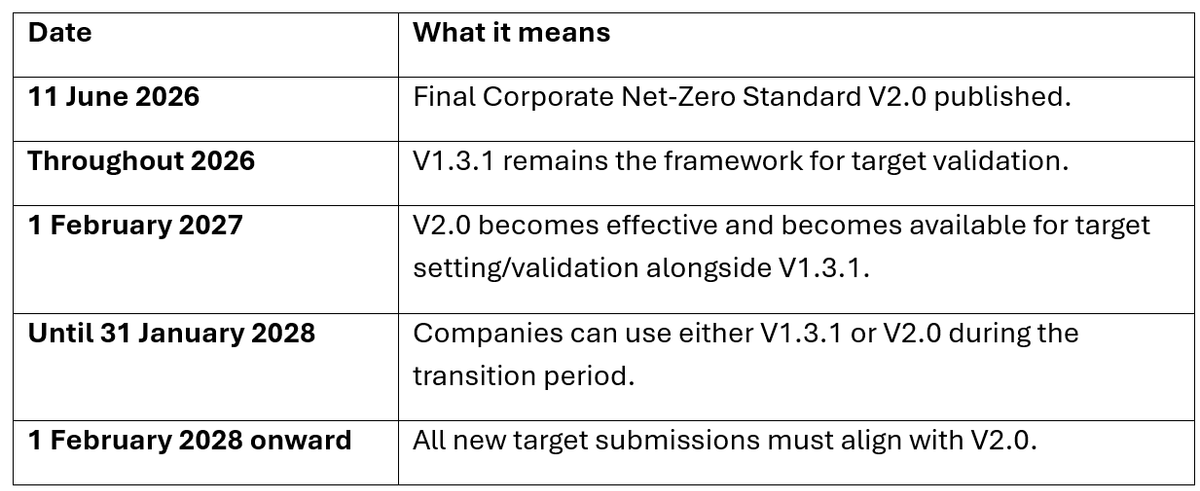
Companies with existing 2030 targets are expected to continue their current cycle and begin preparing the next 2030–2035 cycle under V2.0 from 2028.
There is also an important implementation caveat as of 19 September 2026: SBTi's V2.0 resource page still labels its Methods, Metrics and Pathways resource as a version for public commenting and its V2.0 target-setting tool as a beta for modelling and illustration. Companies should therefore use the latest effective SBTi documentation when they actually calculate and submit targets rather than freezing today's technical assumptions into a 2027 submission.
What fundamentally changes under SBTi V2.0?
V2.0 turns science-based target setting into a management cycle. Companies establish a current emissions baseline, set five-year targets, build an approved transition plan, implement actions according to a hierarchy, report annually, undergo an end-of-cycle assessment and then set the next cycle of targets.
The architecture can be understood as seven connected stages:
Current business → GHG inventory → science-based targets → transition plan → implementation → progress assessment → next target cycle
This makes several previously separate climate-management activities part of one operating system.
1. Targets become five-year management cycles
Near-term targets generally cover five years, with the next cycle following the previous target year. V2.0 also shifts emphasis toward the most recent year for which comprehensive emissions data are available as the target base year rather than relying indefinitely on an old historical base year.
This does not erase historical progress. Companies may still communicate against an earlier reference year when equivalent ambition has been confirmed during validation.
2. Scope 1, Scope 2 and Scope 3 become more distinct
Category A companies must establish separate Scope 1, Scope 2 and Scope 3 targets. Category B companies must establish separate Scope 1 and Scope 2 targets.
3. A transition plan becomes part of the target system
Every company using V2.0 must develop and maintain a transition plan showing how its targets will be implemented. The plan must identify actions, timeframes, material assumptions and dependencies and, where applicable, plans addressing significant EIAs.
4. Implementation matters, not just ambition
V2.0 introduces a hierarchy that prioritizes decarbonization as close as possible to the emissions source before more indirect action is used.
5. Assurance becomes more important
Category A companies face minimum limited-assurance requirements for relevant target-base-year information and end-of-cycle progress data.
6. Claims are linked to what actually happened
A reduction in the company's physical GHG inventory can support an emissions-reduction claim. Actions outside that physical inventory may instead support a more limited system-contribution claim.
7. Responsibility for ongoing emissions is explicitly separated from target achievement
V2.0 creates a voluntary Ongoing Emissions Responsibility program while keeping climate contributions separate from the core task of reducing the company's own inventory and value-chain emissions.
Is your company Category A or Category B?
Determine the category before designing the target. Category A includes large companies globally and additional companies incorporated in high-income countries that meet specified emissions, financial or employee thresholds. Category B covers companies that do not meet Category A criteria. The test uses consolidated group figures and the location of the ultimate parent company.
Category A/B decision table
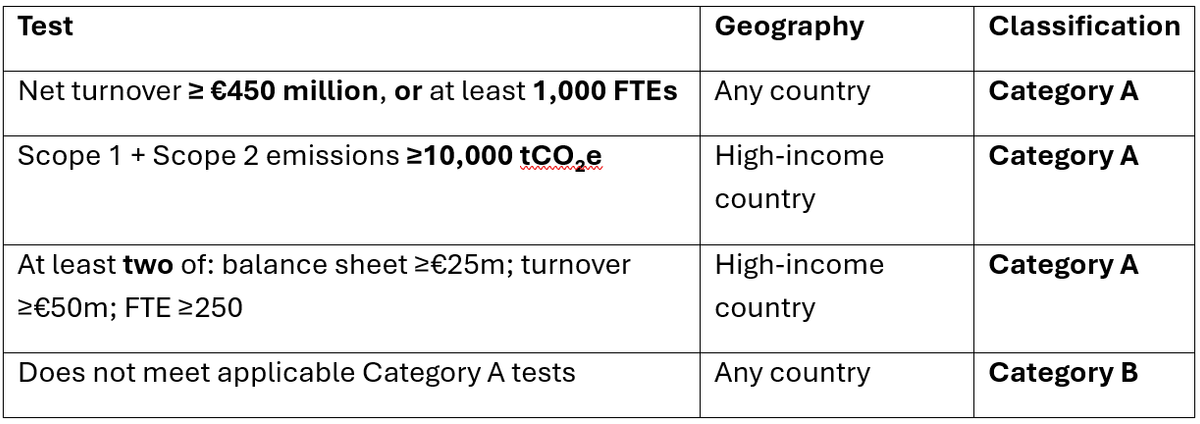
Three details can change the answer:
First, use consolidated figures. Employee numbers, turnover, balance sheet and emissions thresholds are assessed at group level even if the target boundary is established lower in the group.
Second, geography means the jurisdiction where the ultimate parent company is incorporated, classified using World Bank income categories.
Third, classification is not permanent. It is determined at registration, reconfirmed at validation and recalculated when a new target cycle begins.
Why this matters for textile groups
A textile mill or apparel subsidiary may look like a Category B company when viewed independently but sit inside a group that crosses the Category A threshold.
Implementation rule: establish the corporate structure and ultimate-parent information before designing the carbon-data architecture. Otherwise, a team may build a Category B program only to discover that Category A Scope 3 and assurance requirements apply.
Which targets are mandatory under V2.0?
All companies need near-term Scope 1 and Scope 2 targets. Category A companies also need near-term Scope 3 targets. Long-term targets are generally optional except where particular methods trigger them. An overarching SBTi net-zero target is itself optional—but choosing one creates comprehensive Scope 1, 2 and 3 near- and long-term obligations.
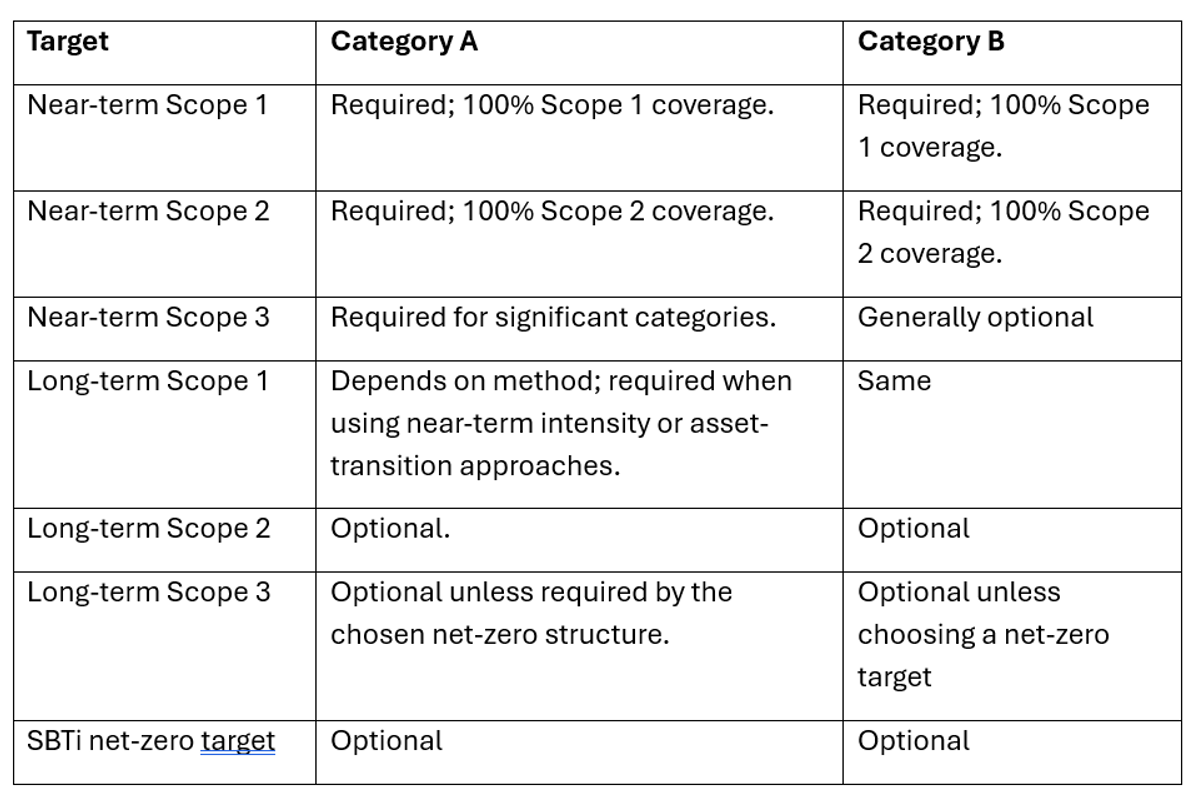
An important trap: “net-zero target is optional” does not mean net zero is irrelevant
V2.0's near-term targets are still calibrated toward net-zero pathways. But a company does not have to package them into a validated SBTi “net-zero target.”
If it does choose an SBTi net-zero target, it must establish near- and long-term targets across all three scopes, reduce emissions to zero or eligible residual levels and neutralize residual emissions at the target date and thereafter.
For Category B companies, this choice is consequential: a Category B company that voluntarily chooses an SBTi net-zero target also takes on Scope 3 target requirements associated with that target.
How does Scope 3 change under SBTi V2.0?
For Category A companies, Scope 3 moves from broad percentage coverage toward identifying material categories and specific high-emitting activities. Every Scope 3 category representing at least 5% of total Scope 3 emissions across categories 1–14 enters the near-term target boundary unless a defined exclusion applies. EIAs then undergo a separate 5% significance test.
This is especially important for fashion because two different 5% tests must not be confused.
The two 5% tests
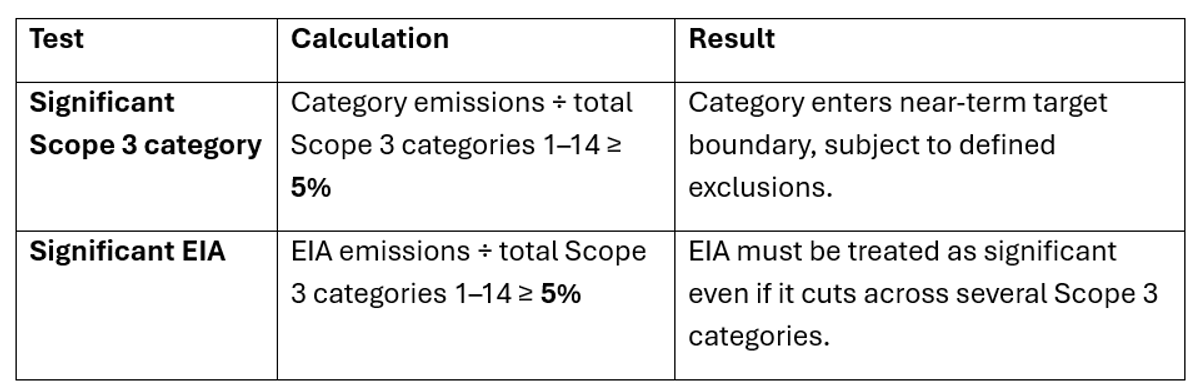
This distinction matters because an EIA is an activity, not a GHG Protocol Scope 3 category.
Example
Imagine a fashion brand has:
- Category 1 purchased goods and services = 72% of Scope 3;
- Category 4 upstream transport = 8%;
- other categories = 20%.
Category 1 and Category 4 both cross the 5% category threshold.
Within Category 1, the brand may then need to examine whether specific Annex A activities—such as primary polymer production for PET—cross the separate EIA threshold.
The result is more decision-useful than treating the entire supply chain as one undifferentiated Scope 3 number.
Which emissions-intensive activities matter to fashion and textiles?
Fashion is not automatically classified as an emissions-intensive industry under Annex A. Instead, companies must look through their value chains and identify listed activities that occur within them. For fashion businesses, particularly relevant candidates include primary PET/polymer production, leather, timber/wood fiber and freight transport.
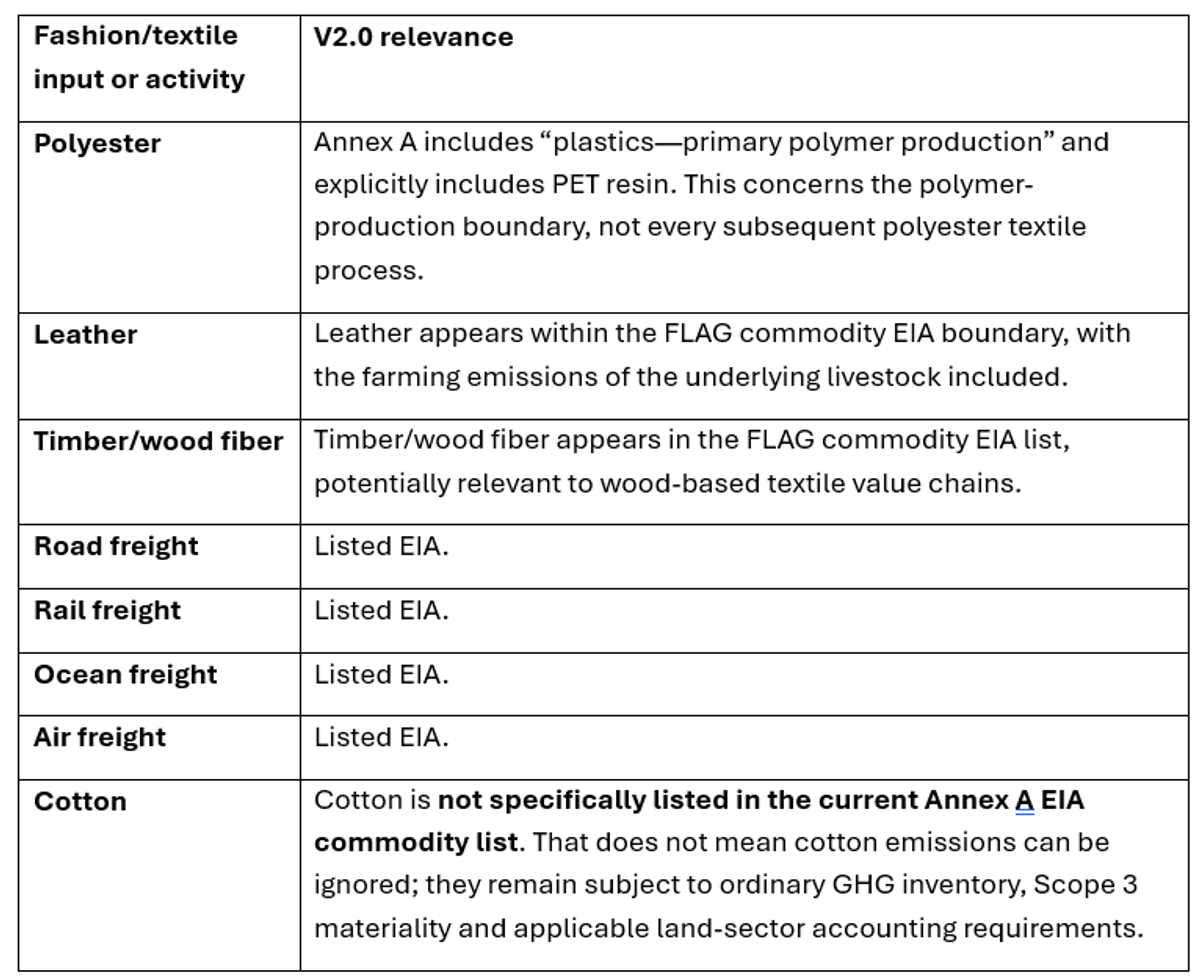
That last distinction is important:
Not being an Annex A EIA is not the same as being outside the GHG inventory or target boundary.
Natural fibers also intersect with the new GHG Protocol Land Sector and Removals Standard
V2.0 requires applicable land, bioenergy and removals accounting to follow the GHG Protocol Land Sector and Removals Standard (LSR Standard). The GHG Protocol's current LSR Standard becomes effective on 1 January 2027 and applies to companies that produce, purchase or sell agricultural products or otherwise have relevant land activities in their value chains.
That can make land-sector data increasingly relevant to natural-fiber value chains.
Forestry has a special caveat. GHG Protocol's current LSR version does not yet apply to forestry; SBTi V2.0 therefore permits a robust and transparently reported alternative methodology until applicable GHG Protocol forestry guidance exists.
Can Scope 3 emissions still be excluded?
Yes, but V2.0 permits only specified exclusions rather than a general licence to omit difficult data. Companies using an exclusion must identify the applicable condition, quantify the excluded emissions in absolute and percentage terms, and describe how those emissions will nevertheless be mitigated.
Examples include certain circumstances involving:
- second-hand purchased or capital goods;
- Category 3 fuel- and energy-related activities already addressed through reductions in Scope 1 or 2 energy consumption;
- employee commuting;
- leased assets where the company genuinely lacks operational, contractual or practical influence;
- transportation where there is no contractual or direct means to influence mode, route or fuel;
- specified downstream processing and franchise situations.
For fashion sourcing teams, one implication is particularly important:
“We do not have supplier-specific data” is not, by itself, a general exemption from Scope 3.
The Standard explicitly recognizes data gaps and proxy data, but requires material gaps, limitations, uncertainty and estimates to be reported.
A practical response is therefore:
estimate → identify hotspot → request better data → validate → replace proxy → retain evidence
rather than:
missing primary data → omit emissions.
What Scope 3 targets can companies choose?
V2.0 offers three broad routes: an overarching absolute emissions-reduction target; an overarching supplier/customer alignment target; or category/activity-specific targets. The third route can use different mechanisms—including emissions reduction, volume alignment and supplier/customer/product alignment—where the relevant SBTi method allows them.
What these options look like in fashion
Absolute reduction:
Reduce emissions across the target boundary over the five-year cycle. This is conceptually simple but places heavy demands on activity data when sourcing volumes, product mix or sales grow.
Supplier alignment:
Increase the proportion of relevant Tier 1 suppliers that are in transition or net-zero aligned. This can translate climate strategy directly into supplier-management processes. SBTi allows the metric to be based on emissions or spend where applicable.
Activity/category-specific approaches:
A business may use eligible pathways for particular materials, freight or other activities rather than forcing every Scope 3 source into one mechanism.
The strategic point is not to select the easiest-looking metric. It is to choose a target structure that matches the actual levers the company controls or influences.
What must the transition plan contain?
Every V2.0 company must develop and maintain a transition plan demonstrating how validated targets will be implemented. The plan must cover the relevant targets and emissions sources, implementation actions and timing, material assumptions and dependencies and, where relevant, significant EIAs. It must be approved by the highest governing body and integrated with corporate strategy.
For Category A companies, disclosure of the required transition-plan elements must be published within 15 months after Target Validation, unless applicable regulation requires an earlier disclosure. All companies must review the plan at least every five years.
A textile transition plan should convert carbon targets into operating decisions
A credible plan should be able to answer questions such as:
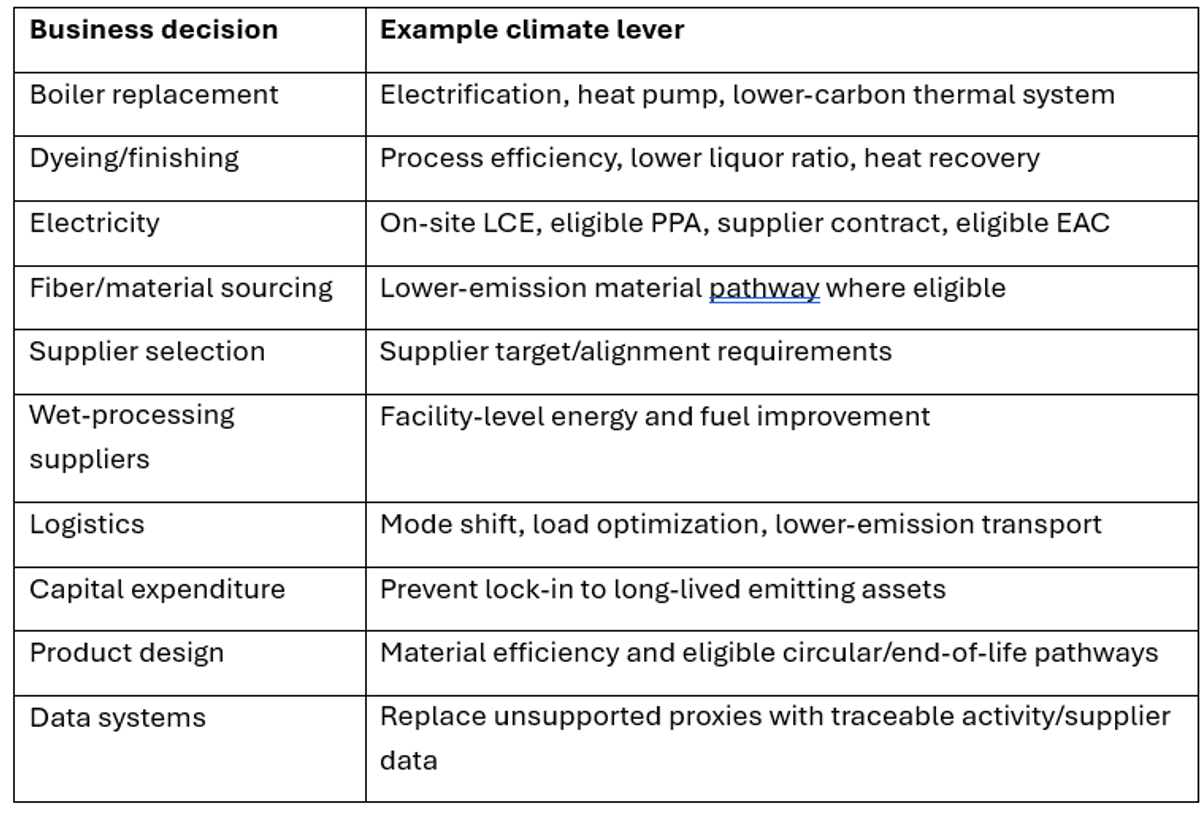
A target therefore stops being “the sustainability department's percentage.”
It becomes an allocation of operational, procurement, sourcing, finance and supplier-management responsibilities.
What is the new SBTi implementation hierarchy?
V2.0 says companies should tackle emissions as close to their source as feasible. Activity-level action comes first. Actions within a shared activity pool—such as an electricity grid, logistics network or supply shed—come next. Sector-level action is available where structural constraints prevent sufficient activity or activity-pool action.
Level 1 — Activity-level action
Reduce emissions from the actual activity generating the footprint.
Fashion examples:
Factory fuel use → improve efficiency or change energy source.
Purchased electricity → reduce electricity consumption or increase direct low-carbon electricity.
Supplier emissions → work with the supplier to reduce the relevant activity's emissions.
Level 2 — Activity-pool action
Act within the shared system where the emissions-generating activity exists.
Examples include a particular:
- electricity grid;
- supply shed;
- logistics network.
Level 3 — Sector-level action
Use this only when sufficient lower-level action is prevented by a genuine structural constraint.
SBTi identifies constraints such as unavailable technology, infrastructure, regulation, market structure or supply. Cost or internal procurement preference alone does not qualify as a structural constraint.
This hierarchy gives sustainability teams a useful decision question:
Can we change the activity itself? If not, can we change the system serving it? If not, what documented structural constraint prevents us—and what sector-level intervention is credible?
Does SBTi V2.0 allow book-and-claim and other market instruments?
Potentially, yes—but not as an unrestricted substitute for direct decarbonization. V2.0 permits eligible market instruments within its implementation hierarchy, subject to requirements covering activity matching, system association, quantification, verifiability, temporal alignment, attribution and double-counting prevention. Programs must also demonstrate relevant system-level decarbonization.
This is a crucial distinction for fashion's emerging low-carbon material markets.
A certificate cannot be treated as credible merely because a certificate exists.
Among other things, companies must address:
- activity matching — does it represent the same activity, material, fuel or energy source?
- system association — is it connected to a relevant system?
- quantification — is the outcome conservatively measured?
- verifiability — is there auditable evidence?
- temporal alignment — generally within 12 months unless a justified production/storage/lifespan exception applies?
- unique attribution — has the outcome been appropriately attributed?
- double counting — is issuance, transfer and retirement controlled?
Market-instrument programs must demonstrate decarbonization of the relevant system, while energy and commodity certificates must use secure tracking systems designed to prevent double counting.
The claims rule may be even more important than the accounting rule
V2.0 creates a clear claims hierarchy:
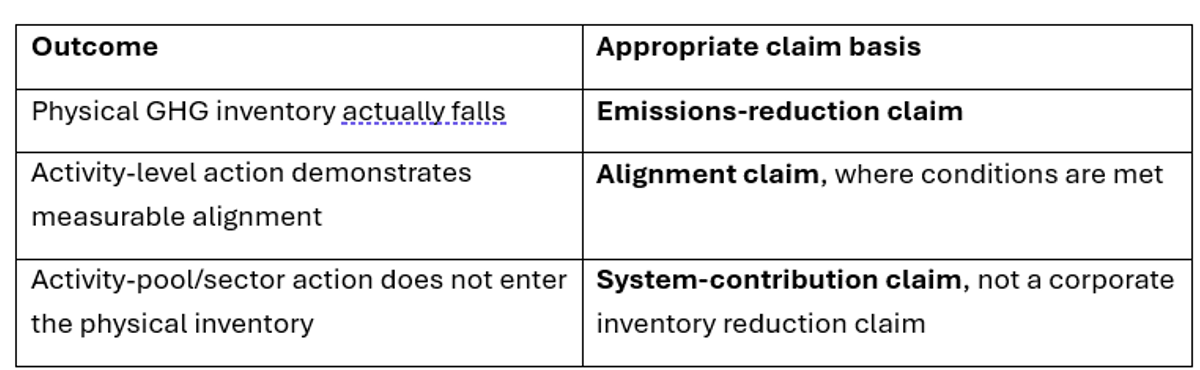
For brands, that distinction can reduce the risk of turning a legitimate climate-finance mechanism into an overstated environmental claim.
What changes for renewable electricity and Scope 2?
Scope 2 becomes more granular. Companies must cover 100% of Scope 2 emissions with near-term targets, and implementation increasingly considers where low-carbon electricity was generated, whether it is deliverable to the consumption location and, for significant loads, when generation and consumption occurred.
Eligible electricity instruments can include physical and virtual PPAs, supplier contracts for low-carbon electricity attributes, unbundled energy attribute certificates and specified forms of default-delivered low-carbon electricity.
V2.0 also introduces conditions concerning generator age. As a general rule, eligible instruments are linked to generators commissioned or repowered within the preceding 15 years, subject to the detailed provisions and legacy arrangements in the Standard.
Is hourly matching mandatory?
This is frequently misunderstood.
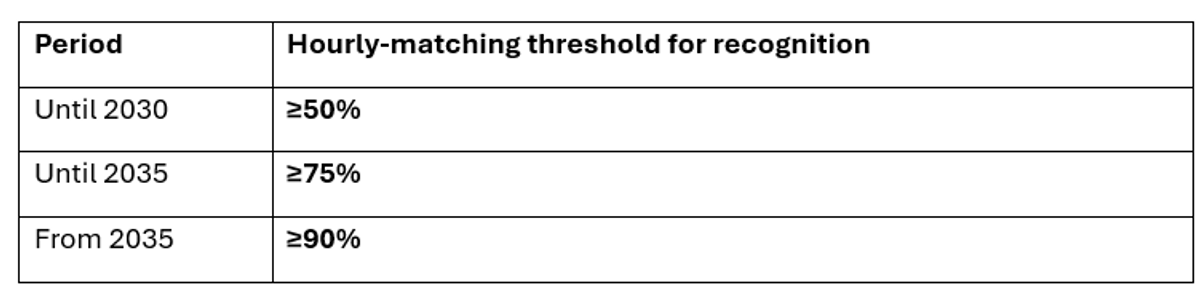
Reporting hourly matching is required where electricity use is significant; achieving the optional recognition thresholds is not the same thing as a universal requirement to procure 100% hourly-matched electricity.
An activity pool has “significant electricity use” where annual electricity consumption is 10 GWh or more. Companies must calculate and report the percentage of this Scope 2 electricity matched with low-carbon electricity on an hourly basis. Category A companies must also obtain applicable assurance of that percentage.
SBTi's optional recognition thresholds are:
For energy-intensive textile mills, this creates a practical data challenge: annual utility bills may no longer provide all the information needed for the more granular parts of the V2.0 system.
What data will fashion and textile companies actually need?
V2.0 increases the value of granular, traceable and evidence-linked carbon data. A company should be able to move from a reported Scope 3 number back through its calculation method, supplier or activity, source data, emission factor, assumptions and documentary evidence.
A practical data architecture looks like this:
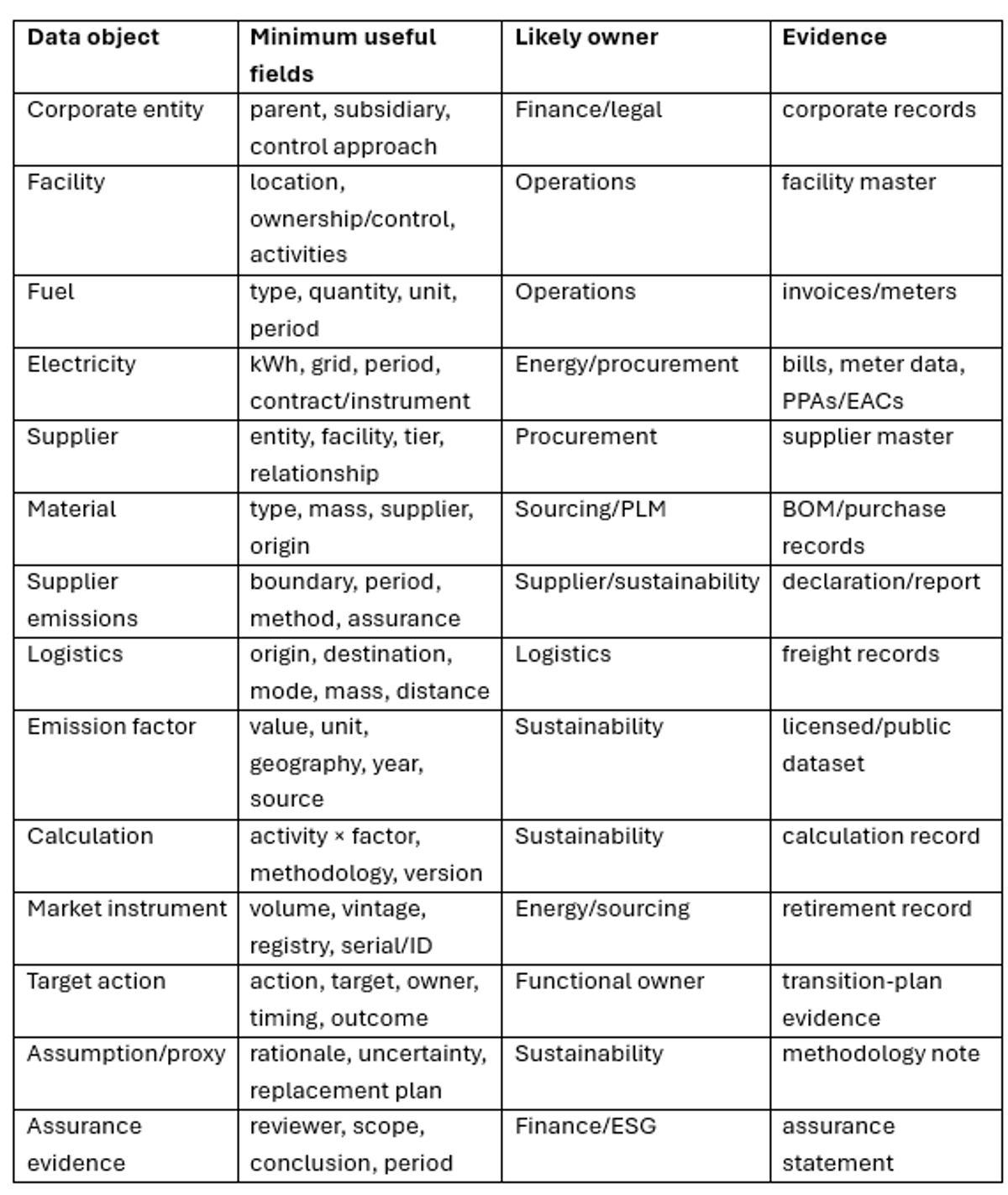
The important design principle is lineage:
Reported result → calculation → activity data → source → evidence → owner → methodology version
That lineage is what turns carbon accounting from an annual calculation into an assurance-ready management system.
What assurance does V2.0 require?
Category A companies must obtain independent third-party assurance of specified target-base-year information at at least a limited-assurance level. They also need limited assurance over data and calculations substantiating progress at the end of the target cycle. Category B assurance is less prescriptive but is strongly encouraged in relevant parts of the Standard.
For the target base year, the assurance scope can include:
- Scope 1;
- Scope 2;
- Scope 3;
- low-carbon electricity calculations;
- significant EIA emissions;
- other target-setting metrics.
This creates an important implementation principle:
Do not design the dataset first and think about assurance later. Design the dataset so that every material figure can be reconstructed later.
That means retaining supplier submissions, utility evidence, invoices, factor versions, calculation methods, exclusions, assumptions, proxy logic, certificate identifiers, approvals and changes.
What must companies report each year?
V2.0 requires annual progress reporting beginning in the reporting cycle after Target Validation. Companies must report against targets individually, disclose Scope 1 and 2 emissions, describe implementation actions and material barriers and report the assurance status of relevant data. Annual Scope 3 inventory reporting is an SBTi recommendation rather than a universal C36 requirement.
At the end of the five-year target cycle, the requirements become broader.
Companies must prepare an end-of-cycle assessment including a full Scope 1–3 GHG inventory for the target year, changes from the target base year, target-level progress and implementation actions. Category A companies must obtain at least limited third-party assurance over the data and calculations supporting the progress assessment.
The practical consequence is significant:
V2.0 rewards continuous data management and makes an annual “carbon-accounting scramble” increasingly difficult to defend.
What happens if a company misses its target?
V2.0 introduces a best-efforts approach rather than treating every shortfall as if it arose from the same cause. Companies must use available levers, disclose barriers and dependencies and explain what they did to address them. A shortfall does not disappear, however: higher remaining emissions increase the reductions required in subsequent cycles.
This is not permission to lower ambition because implementation became inconvenient.
It is a mechanism for distinguishing:
“We could have acted but chose not to”
from:
“We pursued available levers, encountered a documented structural barrier and took credible steps to overcome it.”
That makes evidence of implementation almost as important as evidence of calculation.
What is Ongoing Emissions Responsibility?
Ongoing Emissions Responsibility, or OER, is a separate mechanism for climate contributions alongside—not instead of—value-chain decarbonization. Under the current V2.0 framework, companies can seek voluntary recognition for supporting eligible mitigation, removals and other climate actions while continuing to pursue their science-based targets.
This distinction prevents a common accounting error:
Corporate emissions = 100,000 tCO₂e
Climate credits purchased = 20,000 tCO₂e
Corporate inventory ≠ 80,000 tCO₂e
Unless the applicable inventory accounting framework itself recognizes an action within the physical inventory, a climate contribution does not simply subtract from corporate emissions.
SBTi explicitly states that actions outside the physical inventory are reported separately, and removals purchased because targets were missed do not count toward target progress.
What happens from 2035?
V2.0 contains an illustrative future requirement signalling that, from 2035, companies would begin supporting eligible removals for at least 1% of ongoing emissions, increasing toward 100% by the net-zero year. However, the Standard explicitly says this future criterion is to be reviewed in the next major revision—Version 3—before it takes effect. It should therefore not be treated today as an immutable 2035 rule.
At the actual net-zero target year, companies with an SBTi net-zero target must reduce Scope 1–3 emissions to zero or eligible residual levels and neutralize the residual emissions with eligible removals.
What does V2.0 mean specifically for a fashion brand?
For most fashion brands, the hardest part of V2.0 will not be calculating the target percentage. It will be connecting corporate Scope 3 accounting to sourcing decisions, supplier facilities, materials, energy systems, logistics and verifiable implementation evidence.
A brand should be able to answer:
Which suppliers generate our largest emissions?
Not merely which suppliers have the highest spend.
Which material/process combinations are driving Category 1?
Which emissions are calculated from primary supplier data and which are estimated?
Which supplier facilities use coal, gas, grid electricity, renewables or on-site generation?
Which actions actually reduce our physical inventory?
Which actions are separate system contributions?
Can we prove ownership, vintage and retirement of market instruments?
Which EIAs exist anywhere in the value chain?
Can an assurer reproduce the number?
That requires tighter integration between sustainability, sourcing, procurement and product data.
What does V2.0 mean specifically for textile and apparel manufacturers?
Manufacturers often have a larger direct Scope 1 and Scope 2 challenge than brands. Boilers, thermal processes, electricity-intensive machinery and purchased energy therefore sit alongside customer-driven Scope 3 requirements. V2.0 makes decarbonization planning, energy procurement and evidence management central operating issues rather than reporting exercises.
For an integrated textile operation, the transition plan may need to connect:
spinning → weaving/knitting → pretreatment → dyeing/printing → finishing → garmenting
with facility-specific:
- electricity consumption;
- boiler and process fuel;
- thermal energy;
- renewable electricity;
- refrigerants;
- chemicals and material inputs where relevant;
- waste;
- purchased products;
- freight;
- capital investments;
- reduction projects.
The value of better data extends beyond the manufacturer's own SBTi target. The same governed supplier/facility records can improve responses to customer Scope 3 questionnaires, product carbon footprint calculations and other sustainability-data requests.
What should companies do now? A 10-step V2.0 implementation roadmap
Step 1 — Determine Category A or B
Use consolidated group information, the ultimate parent's jurisdiction and applicable thresholds.
Output: documented classification and evidence.
Step 2 — Confirm organizational and operational boundaries
Align the corporate GHG boundary with applicable GHG Protocol requirements and map subsidiaries, facilities and consolidation approach.
Output: approved organizational-boundary map.
Step 3 — Build the most recent comprehensive GHG inventory
Establish Scope 1 and Scope 2 and, where required, Scope 3 using the most recent comprehensive data.
Output: base-year inventory plus methodology register.
Step 4 — Screen Scope 3 twice
First identify categories representing ≥5% of Scope 3 categories 1–14. Then separately screen Annex A EIAs and determine whether any individually reach the 5% EIA threshold.
Output: category materiality matrix + EIA register.
Step 5 — Assess data quality
Label each result as primary, supplier-specific, secondary, estimated or proxy-based. Record uncertainty, methodology and missing evidence.
Output: data-quality and evidence-gap register.
Step 6 — Select the target architecture
Choose applicable Scope 1, Scope 2 and Scope 3 methods based on actual decarbonization levers rather than convenience.
Output: proposed target package and rationale.
Step 7 — Translate targets into a transition plan
Assign action, investment, owner, timing, KPI, dependency and evidence requirement.
Output: board-ready transition plan.
Step 8 — Apply the implementation hierarchy
Document why activity-level action is or is not feasible before using activity-pool or sector-level alternatives.
Output: decision record for each major intervention.
Step 9 — Build assurance controls before submission
Create version control, source-document retention, approval workflows, traceability and calculation reproducibility.
Output: validation/assurance evidence pack.
Step 10 — Operate the target continuously
Track emissions, implementation actions, barriers and target progress through the year rather than rebuilding the dataset retrospectively.
Output: management dashboard + annual reporting dataset + end-of-cycle evidence trail.
Must do vs should do vs good practice
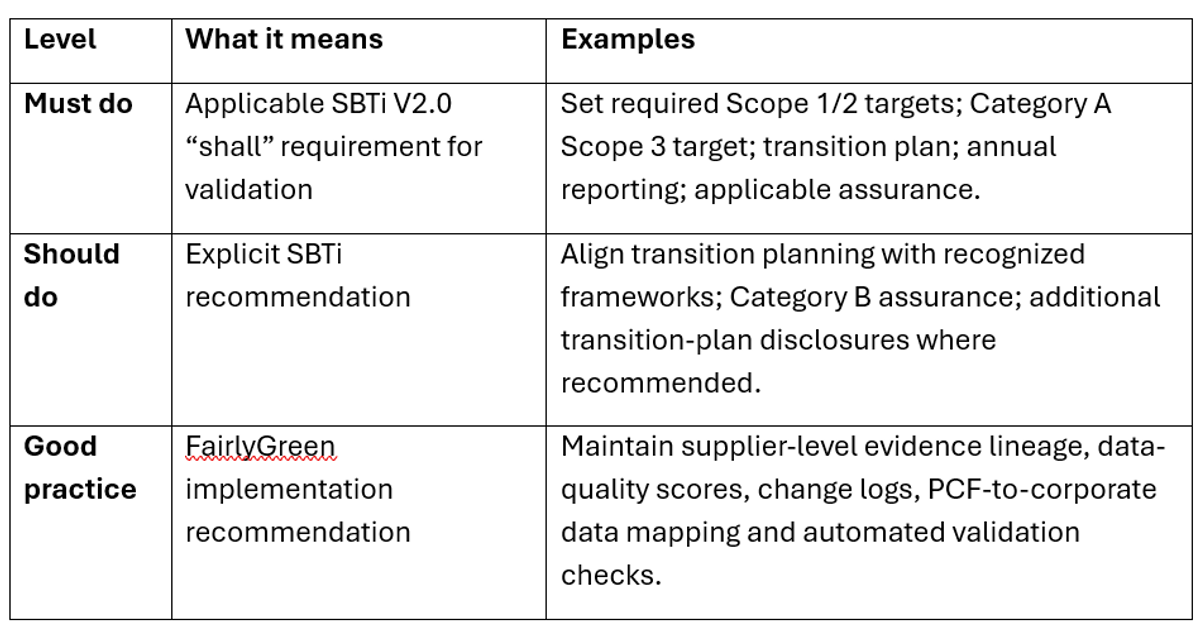
This hierarchy should not be confused with law. Companies must separately evaluate regulatory obligations in every jurisdiction where they operate or report. SBTi itself states that its Standard does not guarantee legal or regulatory compliance.
The most common implementation mistakes
Mistake 1: Starting with the target calculator instead of company classification
Category determines requirements. Establish it first.
Mistake 2: Treating “Scope 3 5%” as one rule
There are distinct significance tests for Scope 3 categories and EIAs.
Mistake 3: Treating missing supplier data as zero emissions
Use defensible estimates where needed, disclose limitations and create a plan to improve the data.
Mistake 4: Assuming an old baseline can be reused indefinitely
V2.0 generally moves each target cycle to the most recent comprehensive target base year.
Mistake 5: Treating certificates as automatically equivalent to physical reductions
Inventory effects, activity-level actions and system contributions must remain distinguishable.
Mistake 6: Designing assurance after the calculation is finished
Evidence lineage should be part of the original data architecture.
Mistake 7: Making claims broader than the accounting outcome
A system-contribution action does not automatically justify an emissions-reduction claim.
Mistake 8: Keeping SBTi inside the sustainability department
Transition planning involves investment, sourcing, procurement, operations, energy, logistics, finance and governance.
Why V2.0 makes sustainability software more important—but not sufficient
V2.0 increases the amount of structured information that must remain connected across years: corporate boundaries, supplier activity, Scope 3 categories, EIAs, energy procurement, target methods, interventions, assumptions, market instruments, assurance evidence and progress. Software can reduce the administrative burden, but it cannot replace methodological judgment or accountable management decisions.
The best data architecture should support three questions simultaneously:
Measurement: What emitted the GHGs?
Management: What action are we taking to change it?
Evidence: Can we demonstrate both the calculation and the outcome?
FairlyGreen already structures Scope 1–3 data across facilities and suppliers, supports category-level drilldowns and evidence-linked sustainability records, and connects corporate, supplier and product-level sustainability data.
The strategic opportunity is therefore bigger than producing an SBTi submission.
A well-governed sustainability dataset can be reused across:
corporate GHG accounting → supplier engagement → target tracking → product footprints → customer requests → sustainability reporting → DPP and audit evidence
while preserving different accounting boundaries and methodologies where required.
Practical implementation checklist
Corporate structure and applicability
- Identify ultimate parent and all relevant subsidiaries.
- Confirm World Bank income classification of the parent's jurisdiction.
- Calculate Category A/B thresholds using consolidated figures.
- Document why the resulting classification applies.
- Identify any applicable SBTi sector standards.
Carbon accounting
- Establish organizational and operational boundaries.
- Select the most recent comprehensive target base year.
- Complete Scope 1 inventory.
- Complete Scope 2 inventory.
- Complete Category A Scope 3 inventory across categories 1–14.
- Document emission-factor sources and versions.
- Record estimates, proxies, uncertainty and data gaps.
- Assess applicable land-sector and removals accounting.
Scope 3
- Calculate each category's percentage of total Scope 3.
- Flag every category at ≥5%.
- Screen the entire value chain against Annex A EIAs.
- Quantify EIA emissions.
- Flag every EIA at ≥5% of Scope 3.
- Record and quantify any permitted exclusions.
- Create supplier-data improvement plans.
Target setting
- Set separate required Scope 1, 2 and 3 targets.
- Select appropriate target-setting method for each.
- Document target dependencies.
- Confirm applicable long-term target requirements.
- Decide whether to seek an overarching SBTi net-zero target.
Transition plan
- Connect every target to named implementation actions.
- Assign owner and timeframe.
- Identify capital expenditure requirements.
- Identify supplier and technology dependencies.
- Develop plans for significant EIAs.
- Obtain highest-governance-body approval.
- Prepare Category A disclosure.
Implementation
- Prioritize activity-level reductions.
- Document why indirect action is required where used.
- Define activity-pool boundaries.
- Document structural constraints.
- Validate market-instrument integrity.
- Retain registry/serialisation/retirement evidence.
- Prevent double counting.
Electricity
- Map electricity by facility and deliverability region.
- Document low-carbon electricity source.
- Check instrument eligibility and generator requirements.
- Identify activity pools consuming ≥10 GWh/year.
- Prepare hourly-matching data where required.
Assurance and reporting
- Establish evidence retention requirements.
- Preserve calculation and emission-factor versions.
- Establish internal review/approval controls.
- Arrange Category A limited assurance where applicable.
- Report progress annually.
- Maintain end-of-cycle assessment evidence.
- Prepare the next five-year target cycle before the existing cycle ends.
FAQ
What is SBTi Corporate Net-Zero Standard V2.0?
SBTi Corporate Net-Zero Standard V2.0 is the Science Based Targets initiative's updated corporate framework for setting, implementing, reporting and assessing greenhouse-gas reduction targets aligned with net-zero pathways. It was published on 11 June 2026 and becomes effective on 1 February 2027.
When will SBTi V2.0 become mandatory?
For new SBTi target submissions, companies can use either V1.3.1 or V2.0 during the 2027 transition period. From 1 February 2028, all new target submissions must use V2.0. Existing validated targets generally remain valid through their target timeframe.
Is Scope 3 mandatory under SBTi V2.0?
For Category A companies, near-term Scope 3 targets are required and must cover significant Scope 3 categories. For Category B companies, Scope 3 near-term targets are generally optional—unless the company chooses an SBTi net-zero target, in which case Scope 3 becomes part of the required comprehensive target structure.
Is an SBTi net-zero target mandatory?
No. V2.0 states that net-zero targets are optional. If a company chooses one, however, it must establish near- and long-term targets across Scope 1, Scope 2 and Scope 3 and neutralize residual emissions at the net-zero target year.
What is the 5% Scope 3 rule?
A Category A company must identify Scope 3 categories that individually represent 5% or more of total Scope 3 emissions across categories 1–14. These significant categories enter the target boundary subject to defined exclusions. A separate 5% test applies to emissions-intensive activities.
Does SBTi V2.0 allow carbon credits to meet reduction targets?
Climate contributions and carbon credits do not simply subtract emissions from the physical corporate GHG inventory. V2.0 separates inventory reductions, eligible implementation actions and the OER framework. The physical inventory remains the basis for emissions-reduction claims.
Does SBTi V2.0 allow book-and-claim?
V2.0 permits certain market instruments and chain-of-custody approaches subject to detailed integrity requirements. Their treatment depends on activity matching, system association, quantification, verification, temporal alignment, attribution, double-counting prevention and system-level impact. They are not a blanket substitute for direct decarbonization.
Is hourly renewable-electricity matching mandatory?
Companies must calculate and report hourly matching for Scope 2 electricity in activity pools with 10 GWh or more annual electricity consumption. The SBTi recognition thresholds—50%, 75% and 90% at different periods—belong to an optional recognition program rather than a universal requirement to reach those percentages.
Does V2.0 require a climate transition plan?
Yes. All companies using V2.0 must develop and maintain a transition plan demonstrating how validated targets will be implemented. Category A companies must disclose specified plan elements within 15 months of Target Validation unless applicable regulation requires earlier disclosure.
Does SBTi V2.0 replace the GHG Protocol?
No. V2.0 requires companies to maintain GHG inventories aligned with applicable GHG Protocol Standards and Guidance. The frameworks perform related but different functions: GHG Protocol provides the accounting foundation, while SBTi establishes target-setting and implementation requirements.
Does SBTi compliance mean a company complies with climate law?
No. SBTi explicitly states that its Standards should not be treated as a substitute for, or guarantee of, compliance with national, regional or other applicable law.
Key takeaways
- V2.0 is an implementation system, not simply a target calculator.
- Classification drives obligations: determine Category A or B before doing anything else.
- All companies need Scope 1 and 2 near-term targets; Category A also needs Scope 3.
- The most recent comprehensive emissions data become the foundation for each new target cycle.
- Scope 3 requires two different materiality lenses: significant categories and significant EIAs.
- For fashion, relevant EIAs can include PET primary polymer production, leather, timber/wood fiber and freight.
- Transition planning moves climate targets into board, finance, sourcing, procurement and operational decisions.
- Direct decarbonization comes before more indirect activity-pool or sector action.
- Physical inventory reductions and system contributions support different claims.
- Traceable, assurance-ready data will increasingly determine whether a climate program is operationally credible.
SBTi V2.0 makes fragmented spreadsheets, disconnected supplier files and undocumented assumptions increasingly difficult to manage.
FairlyGreen brings Scope 1–3, facility, supplier, product and evidence-linked sustainability data into a governed structure designed to improve traceability and audit readiness.
Book a demo to see how FairlyGreen can help turn fragmented sustainability data into structured, audit-ready intelligence.
Share this article
Help others discover this content
Similar Articles

Digital Product Passports: A Practical Buyer’s Guide for Fashion and Textile Teams
Digital Product Passports are becoming a practical compliance and product-data challenge for fashion and textile teams. Here’s what buyers should understand before selecting a DPP solution.

A Fashion Leader’s Guide to Measuring Scope 1, 2, and 3 Emissions
PEFCR v3.1 Is Final - Here’s What Fashion Brands Must Do Next
After five years of development, the Product Environmental Footprint Category Rules (PEFCR v3.1) for apparel and footwear are official. This is no longer a pilot - this is the standard.