
How to Calculate Scope 3 Purchased Goods and Services Emissions
Calculate Scope 3 Category 1 emissions with supplier-specific, hybrid, average-data and spend-based methods, including practical textile examples.

At a glance
Scope 3 Category 1 emissions are the greenhouse gas emissions generated while producing the goods and services a company purchases, excluding purchases assigned to other Scope 3 categories.
To calculate them, multiply purchased quantities or expenditure by appropriate cradle-to-gate emission factors, then sum the results.
The GHG Protocol recognizes four methods: supplier-specific, hybrid, average-data and spend-based.
For fashion and textile companies, the most practical approach is to screen all relevant purchases, prioritize high-impact materials and suppliers, improve estimates using primary data, and maintain an auditable record of every calculation.
A practical guide for fashion and textiles
A fashion brand purchases garments from suppliers. A weaving mill purchases yarn. A dyeing facility purchases chemicals. An apparel manufacturer pays subcontractors for embroidery, washing and finishing.
Each purchase can create greenhouse gas emissions before the purchasing company receives the product or service.
These emissions are often invisible in the purchasing company's electricity bills, fuel records and factory emissions inventory. Yet they represent a potentially significant part of its environmental impact.
Under the GHG Protocol Corporate Value Chain (Scope 3) Accounting and Reporting Standard, these upstream emissions are addressed through Category 1: Purchased Goods and Services.
GHG Protocol Category 1 calculation guidance
This guide explains how to calculate them, which data to collect and how to avoid common accounting errors.
What are Scope 3 Category 1 emissions?
Scope 3 Category 1 covers the upstream, cradle-to-gate greenhouse gas emissions associated with producing goods and services purchased or acquired during the reporting year, except those assigned to Scope 3 Categories 2–8.
Cradle-to-gate means emissions from extracting or producing raw materials through the purchased product's production, including relevant upstream processing, energy, transportation and waste treatment.
Consider a garment purchased by a fashion brand.
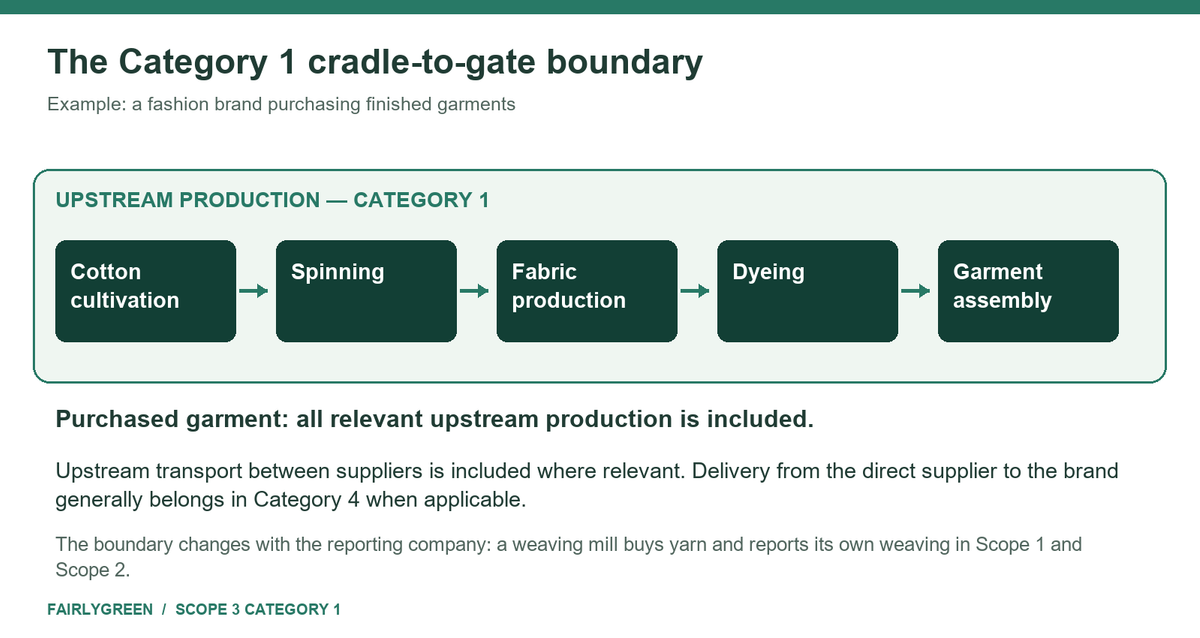
Scope 3 Category 1 cradle-to-gate emissions boundary for a textile and apparel supply chain
Transportation between upstream suppliers is included where relevant. Transportation from the direct supplier to the brand is generally accounted for under Category 4 when applicable.
The purchasing brand's Category 1 inventory includes the garment's upstream production emissions even if those activities occurred at suppliers several tiers away.
For a weaving mill, by contrast, purchased yarn may belong in Category 1, while emissions from weaving performed in the mill's own operations generally belong in its Scope 1 or Scope 2 inventory.
The reporting boundary depends on which company is calculating the emissions.
Which purchased goods and services belong in Category 1?
Category 1 covers both direct procurement—materials used in products—and indirect procurement—goods and services supporting operations.
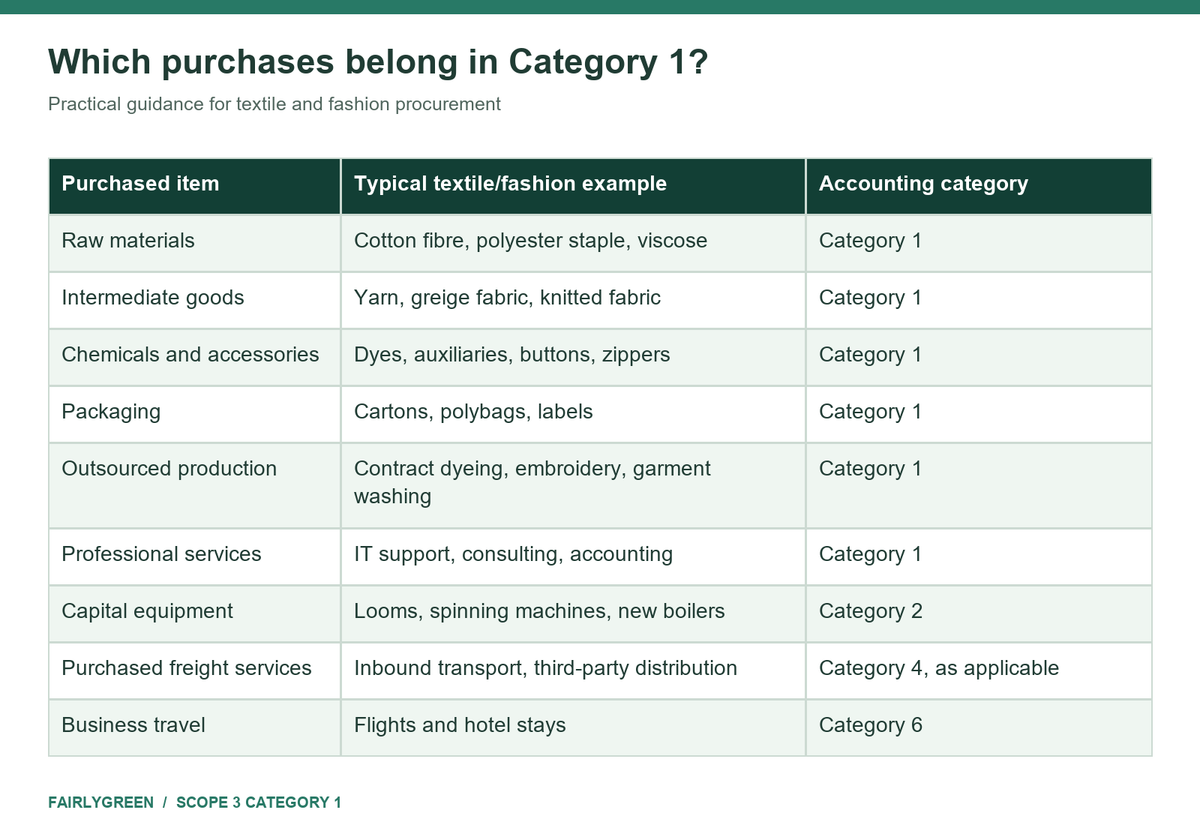
Classification of textile purchases into Scope 3 Categories 1, 2, 4 and 6
The GHG Protocol separates categories to improve consistency. Goods and services belonging to Categories 2–8 should not also be counted in Category 1.
What are the four methods for calculating Category 1 emissions?
The GHG Protocol provides four methods. They differ primarily in their data requirements and specificity to the purchased product or supplier—not in a guaranteed ranking of accuracy.
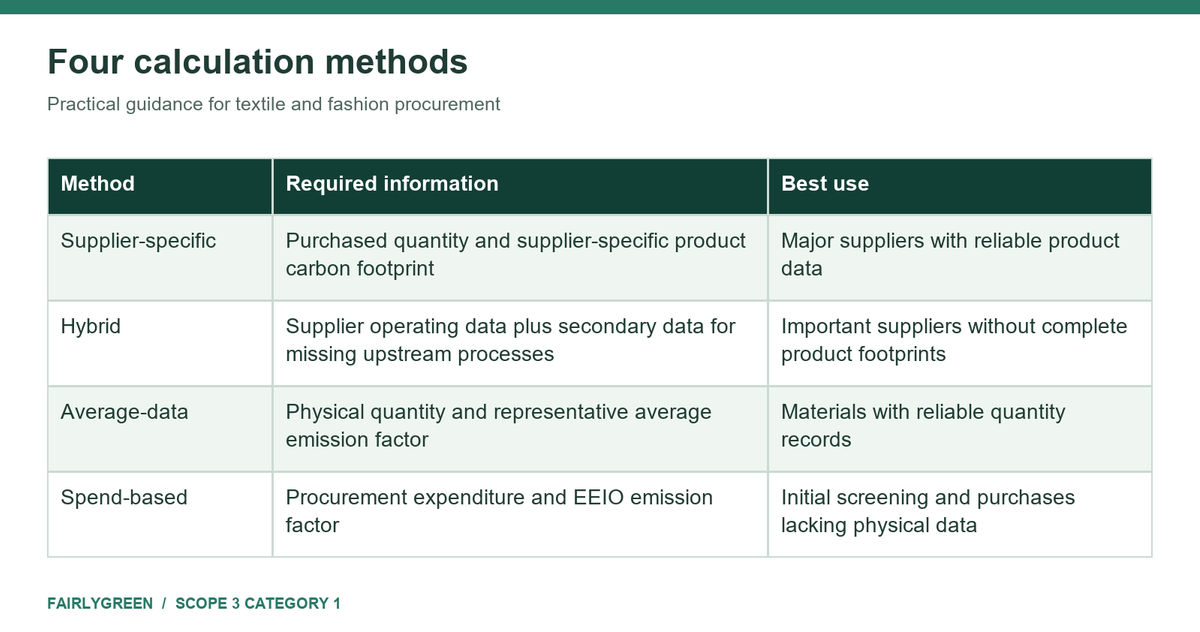
Comparison of supplier-specific, hybrid, average-data and spend-based calculation methods
A company can use all four methods within the same Category 1 inventory, provided purchases are assigned consistently and are not counted twice.
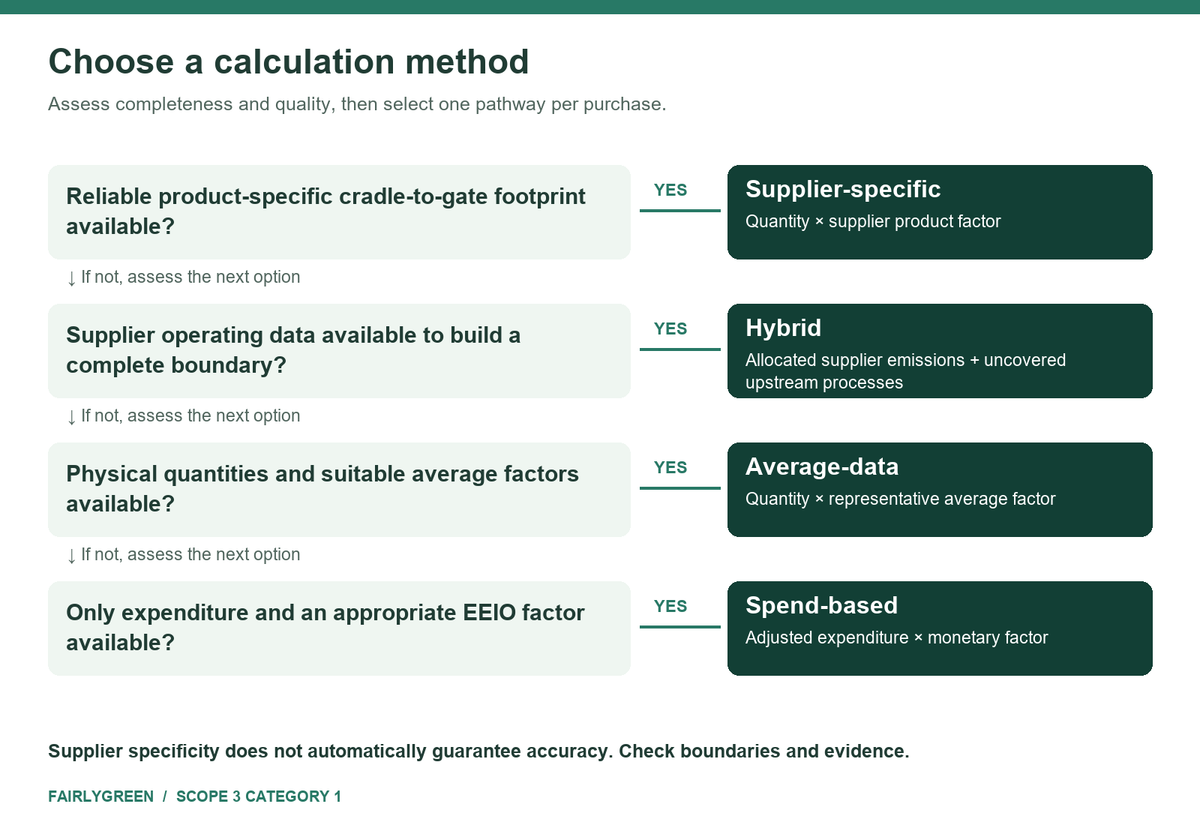
Decision tree for choosing Scope 3 purchased goods and services emissions calculation methods
GHG Protocol Category 1 calculation guidance
Method 1: Supplier-specific calculation
The supplier-specific method multiplies the purchased quantity by a product-specific cradle-to-gate emission factor supplied by the manufacturer.
E = Σ (Qᵢ × EF supplier,ᵢ)
Where:
E = emissions in kg CO₂e
Qᵢ = quantity purchased
EF supplier,ᵢ = supplier-specific emission factor per unit
Example: A fashion brand purchases 100,000 garments with a documented cradle-to-gate footprint of 4 kg CO₂e per garment.
100,000 × 4 = 400,000 kg CO₂e
Total: 400 tonnes CO₂e.
The factor must represent the purchased garment's complete relevant upstream boundary, not merely the sewing factory's electricity and fuel emissions.
Supplier-specific data should ideally be product-matched, geographically representative, contemporaneous and supported by disclosed methodology.
GHG Protocol Category 1 calculation guidance
Method 2: Hybrid calculation
The hybrid method combines primary operating data obtained from suppliers with secondary emission factors for processes where supplier-specific information is unavailable.
For example, an apparel supplier might provide:
Electricity and fuel emissions allocated to garment production
Quantities of fabric, trims and chemicals consumed
Upstream transportation activity
Production waste quantities and treatment methods
The buyer can calculate upstream emissions using suitable emission factors, then add the supplier's allocated production emissions and other relevant components.
E hybrid = allocated supplier emissions + upstream input emissions + other uncovered process emissions
This simplified equation is valid only when the components cover distinct processes without overlapping boundaries.
The hybrid method is particularly useful for mills that collect operating data but have not yet developed complete product carbon footprints.
GHG Protocol Category 1 calculation guidance
Method 3: Average-data calculation
The average-data method multiplies purchased quantities by representative industry-average cradle-to-gate emission factors.
E = Σ (Qᵢ × EF average,ᵢ)
For example, a manufacturer purchasing 20,000 kg of polyester yarn might apply an appropriately selected factor expressed in kg CO₂e per kg of yarn.
The factor must match the product's processing stage, material specification, geography and system boundary as closely as possible.
An emission factor for polyester polymer is not necessarily an appropriate cradle-to-gate factor for finished polyester yarn.
Method 4: Spend-based calculation
The spend-based method estimates emissions from the financial value of procurement using environmentally extended input-output (EEIO) emission factors.
E = Σ (Sᵢ × EF spend,ᵢ)
Where Sᵢ is expenditure and EF spend,ᵢ is expressed in kg CO₂e per monetary unit.
For example, a company spending USD 50,000 on a service, using an illustrative factor of 0.20 kg CO₂e/USD, obtains:
50,000 × 0.20 = 10,000 kg CO₂e
This method is useful for broad screening but cannot reliably distinguish the actual environmental performance of individual suppliers.
Important: Match the expenditure currency, price year and purchasing-price basis to the EEIO dataset. Inflation, exchange rates and trade margins can materially affect results.
GHG Protocol Category 1 calculation guidance
Step-by-step: How to calculate purchased goods emissions
Step 1: Establish the reporting boundary
Identify the reporting company, financial or calendar year, and relevant organizational entities.
Define how purchases and acquisitions will be recorded. Ensure the approach is consistent across procurement, inventory and finance systems.
Step 2: Build a complete purchasing inventory
Export purchasing records from ERP, procurement and accounting systems.
Capture materials, packaging, subcontracted manufacturing, maintenance and professional services—not just major production inputs.
Reconcile purchase orders, goods receipts and invoices to avoid omissions and duplicate entries.
Step 3: Classify every purchase
Assign procurement lines to appropriate Scope 3 categories before calculating emissions.
Separate capital goods, energy-related purchases, freight, waste services and travel where applicable.
Within Category 1, group purchases by material, product specification, supplier, facility and service type.
Step 4: Screen and prioritize emissions hotspots
Use average-data or spend-based estimates to identify purchases likely to contribute most to emissions.
Prioritize supplier engagement using emissions significance, data quality, purchasing importance and potential for reduction.
A small-volume chemical can have a high emission intensity, so expenditure or purchase weight alone should not determine priority.
Step 5: Select calculation methods
Choose the most appropriate method for each group.
Use reliable supplier-specific product data where available, hybrid calculations for suitable high-impact suppliers, average physical data for well-characterized materials and spend-based estimates for remaining data gaps.
Step 6: Calculate and aggregate
Calculate emissions at the most practical level—purchase line, material, supplier, facility or service—then aggregate into Category 1.
Each purchase should have one clearly defined calculation pathway for a given reporting period.
Step 7: Validate the inventory
Check units, boundaries, duplicate transactions, unsupported factors and supplier data.
Review unexpected changes in emissions intensity against purchasing patterns, production volume and emission-factor updates.
Step 8: Report and improve
Report the Category 1 result with methodology, assumptions, data sources, exclusions and data-quality limitations.
Replace weaker estimates progressively and preserve previous calculation versions for comparison and assurance.
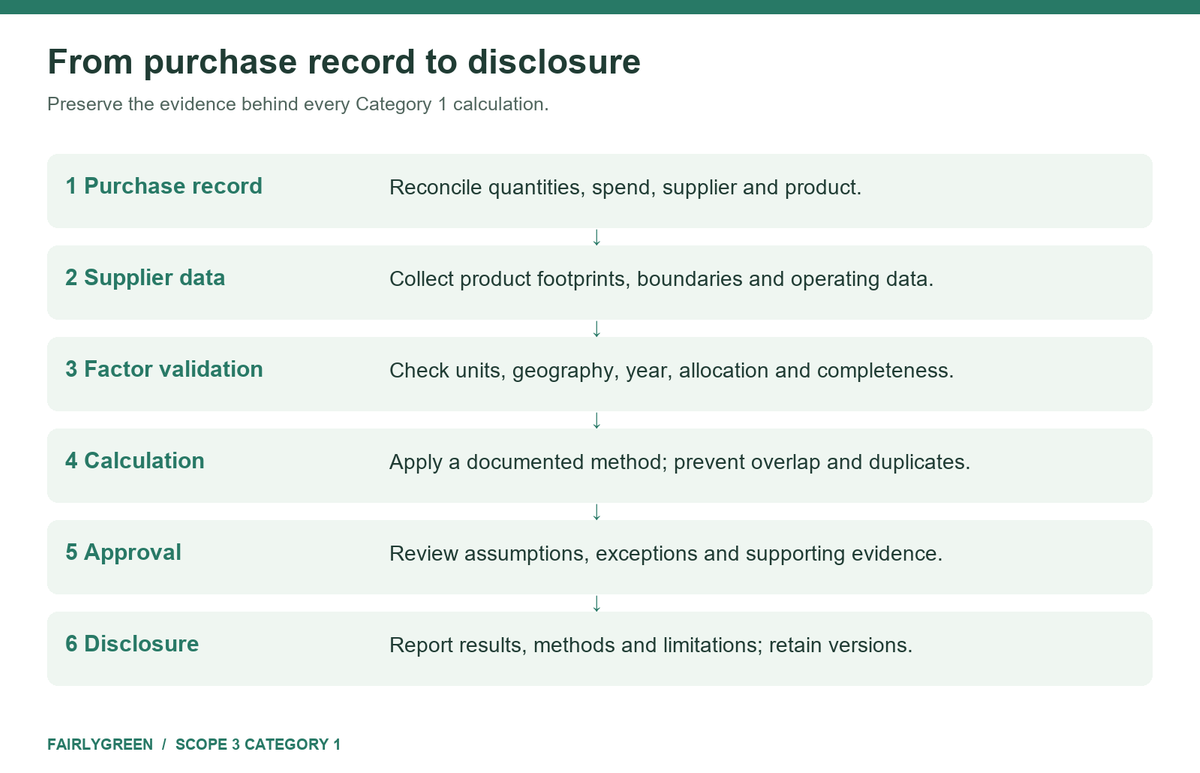
Audit-ready Scope 3 supplier emissions data collection and verification workflow
Worked example: Scope 3 calculation for a textile manufacturer
Consider a textile manufacturer calculating annual Category 1 emissions using a combination of physical activity data and expenditure.
The following figures and factors are hypothetical, for teaching purposes only. They are not verified emission factors for commercial reporting.
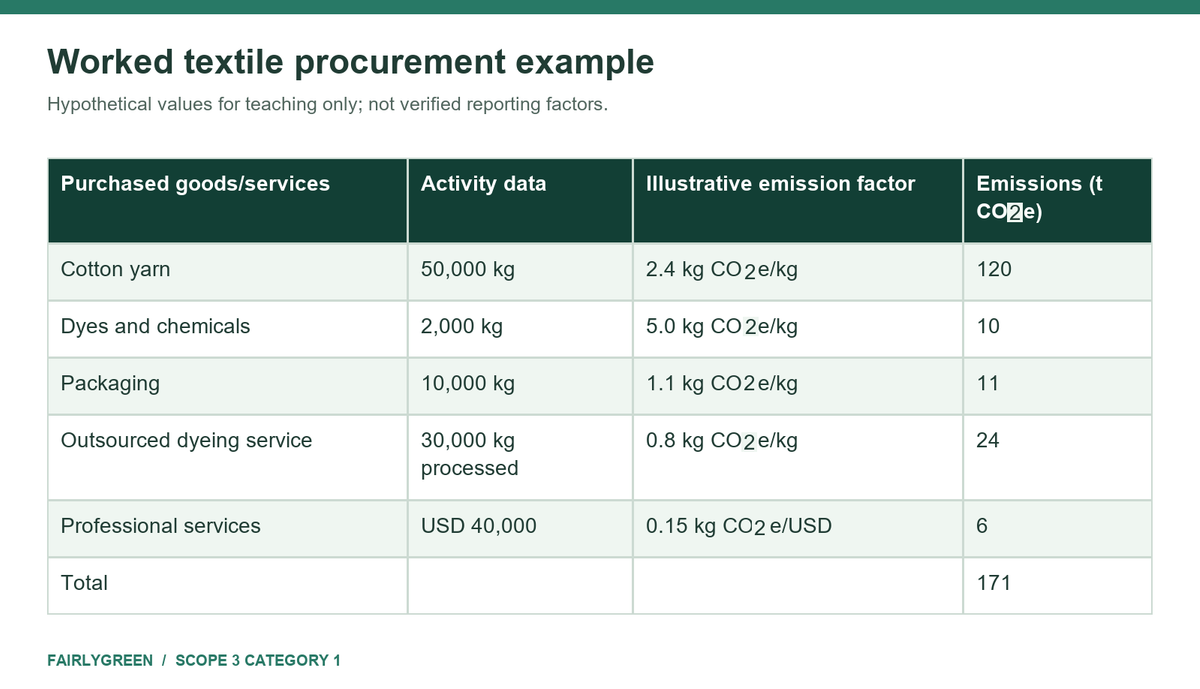
Hypothetical textile procurement calculation: cotton yarn 120, dyes 10, packaging 11, outsourced dyeing 24 and professional services 6 tonnes CO₂e; total 171
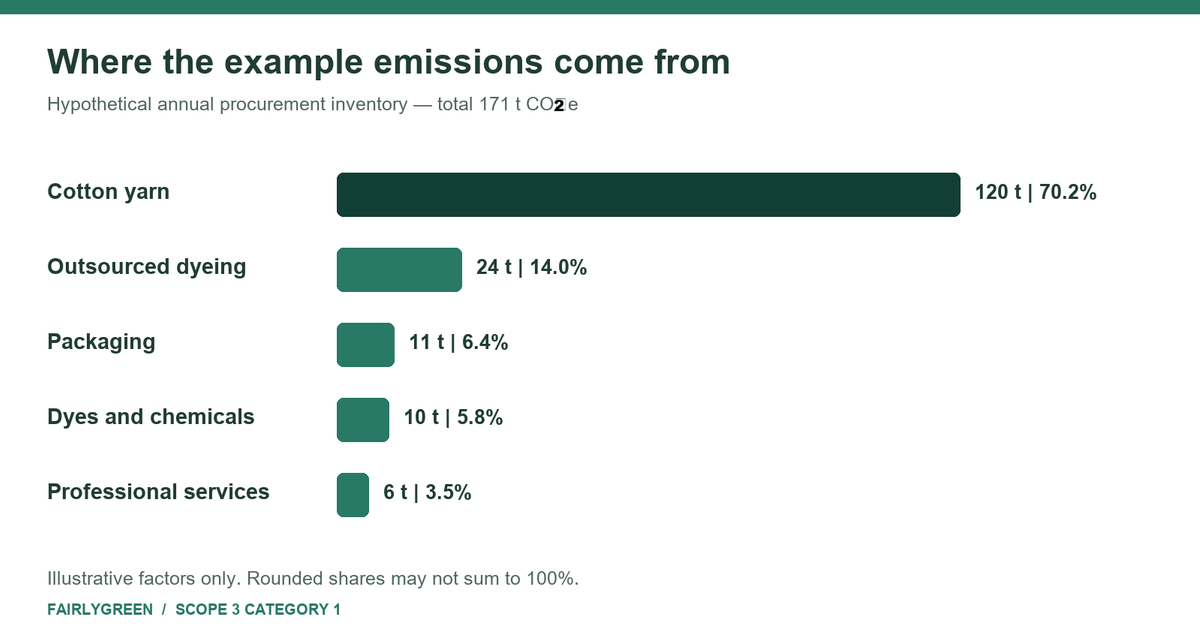
Worked example showing purchased yarn, dyes, packaging and outsourced processing emissions
The company can identify cotton yarn as its largest estimated hotspot and prioritize improving supplier data for that purchase.
Two boundary precautions matter: the outsourced dyeing factor must exclude inputs already counted separately, and the professional-services expenditure must be adjusted to match the monetary emission factor's price basis.
The result demonstrates how an initial inventory can support targeted supplier engagement rather than indiscriminate data collection.
What data should you request from suppliers?
The most useful supplier data identifies both the environmental result and how that result was calculated.
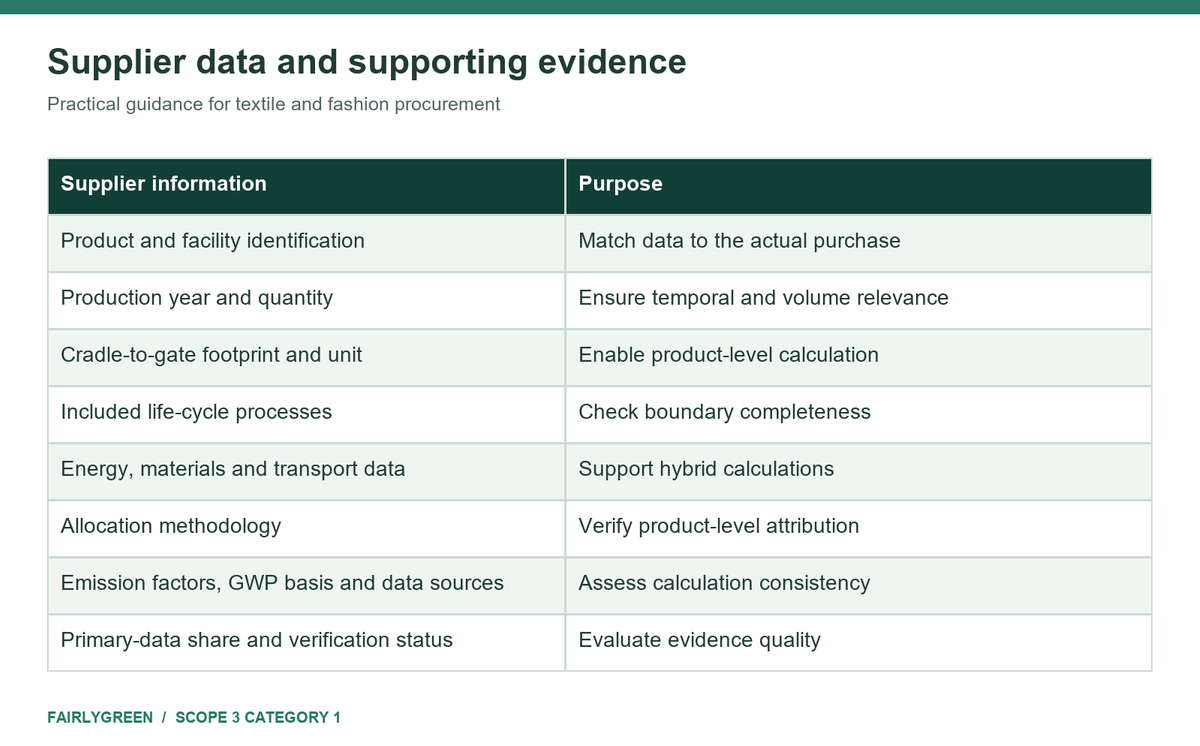
Supplier information to request and its purpose for emissions accounting
For textile facilities, existing Higg Facility Environmental Module (FEM) records may provide useful energy and operational inputs.
However, a FEM facility emissions result is not automatically a complete GHG Protocol-compliant product footprint. Its methodology and boundary must be checked before reuse.
Where can companies find reliable emission factors?
Select sources based on the purchasing activity and geographical relevance.
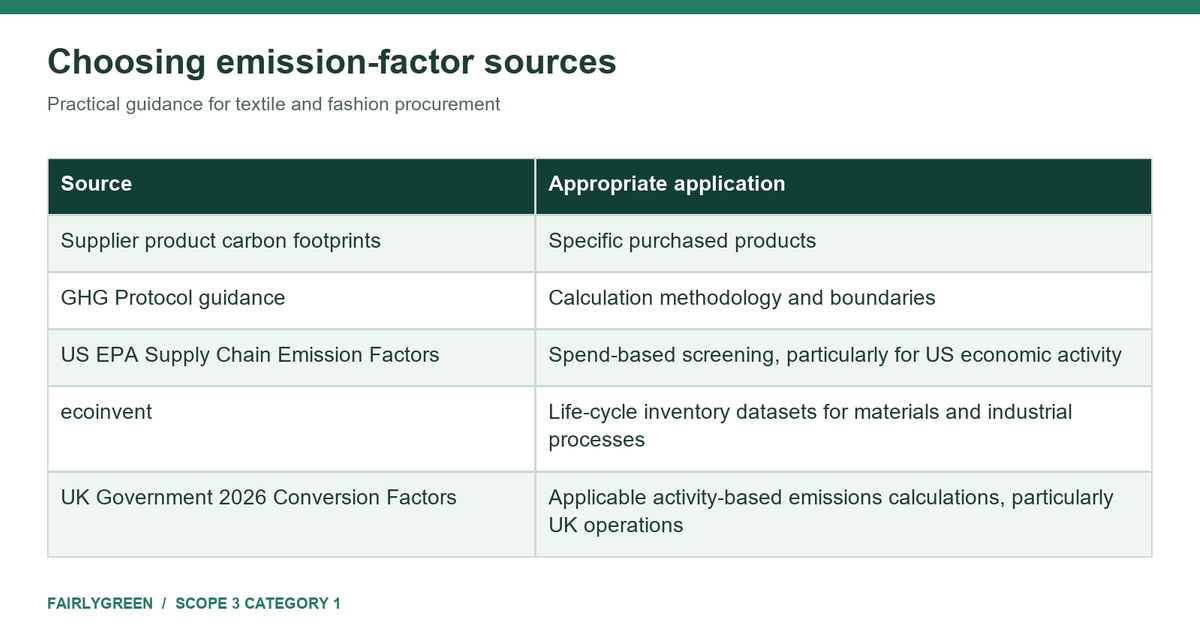
Emission-factor sources and their appropriate applications
The US EPA's Supply Chain Emission Factors v1.3 use 2022 US-dollar purchasing values. They should not be applied directly to unadjusted spending from other years or countries without assessing compatibility.
EPA Supply Chain Emission Factors v1.3
Similarly, the UK Government's 2026 company-reporting factors are not a universal library of cradle-to-gate textile material footprints.
UK Government 2026 conversion factors
Evaluate every factor for technological, temporal and geographical representativeness, completeness and reliability—the five data-quality indicators identified by the GHG Protocol.
GHG Protocol emission-factor selection guidance
How do you avoid double counting and misleading reductions?
Most Category 1 calculation errors arise from inconsistent system boundaries rather than incorrect arithmetic.
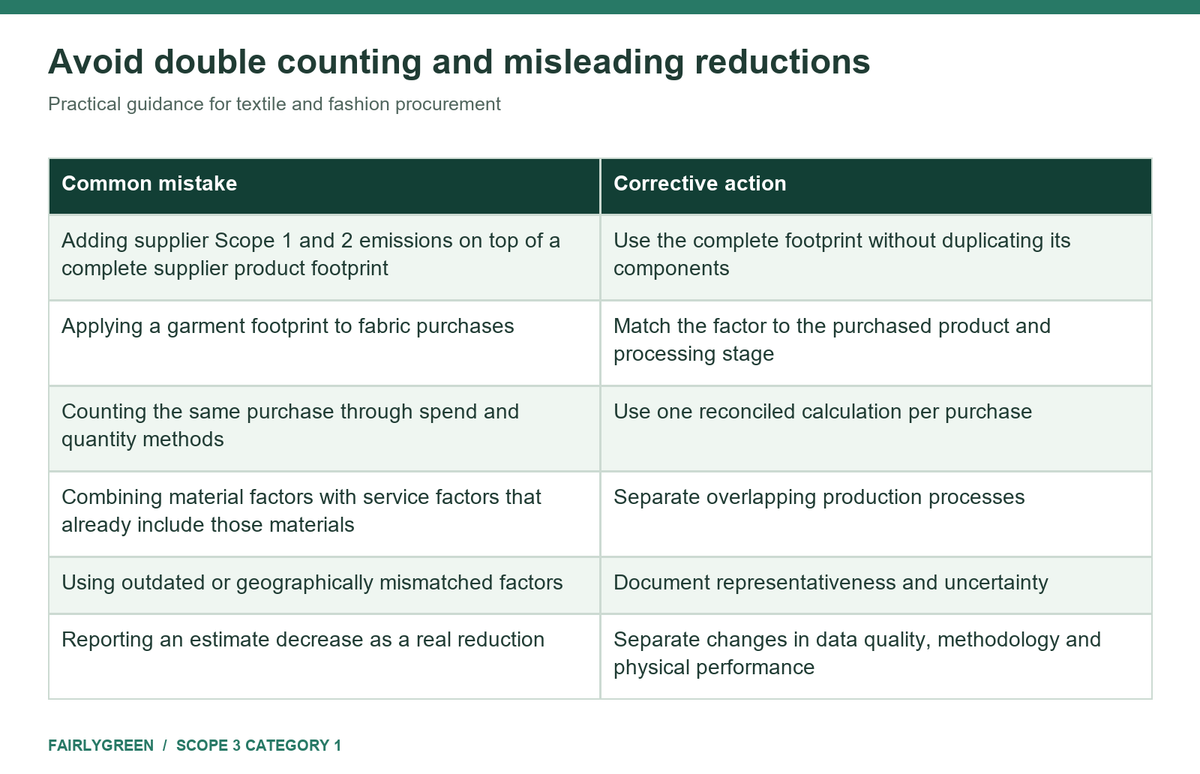
Common Category 1 accounting mistakes and corrective actions
A supplier's corporate Scope 1 and Scope 2 total cannot simply be transferred into a buyer's Category 1 inventory. It must be appropriately allocated and supplemented with relevant upstream emissions.
Moreover, an apparent reduction caused by replacing a generic factor with a more specific factor does not necessarily indicate real-world decarbonization.
The GHG Protocol explicitly cautions that greater supplier specificity does not automatically guarantee greater accuracy.
GHG Protocol Category 1 calculation guidance
How does Category 1 calculation relate to sustainability reporting requirements?
GHG Protocol: Its Scope 3 Standard provides accounting and reporting requirements for organizations choosing or required to use that framework. It is not itself legislation applicable to every company.
European Union: Following the 2026 sustainability-reporting revisions, the simplified European Sustainability Reporting Standards entered into force on 10 November 2026 and generally apply to financial years beginning on or after 1 January 2027, with specified early-use options for 2026.
Revised ESRS E1-8 requires undertakings to which the relevant disclosure applies to report gross Scope 3 emissions by significant category and disclose their measurement approach. CSRD applicability must be assessed separately under the revised legal thresholds.
EU Delegated Regulation 2026/1563
For Pakistani and other non-EU textile exporters, supplying European buyers does not automatically create a direct CSRD reporting obligation. However, relevant customers may request supplier emissions information for their own reporting and reduction programs.
In practice, retaining consistent supplier data is valuable even when direct regulatory reporting is not required.
Practical implementation checklist
Must do for a GHG Protocol-aligned inventory
Define the reporting period and organizational boundary.
Identify applicable purchases and separate Category 1 from Categories 2–8.
Account for Category 1 to its required cradle-to-gate boundary, documenting justified exclusions.
Calculate emissions, document methods and report data-quality limitations.
Should do
Reconcile ERP, inventory and procurement data.
Prioritize supplier-specific information for significant hotspots.
Verify emission-factor units, geography, reporting year and boundaries.
Retain source documents and calculation versions.
Good practice
Reuse existing supplier energy and operational data instead of duplicating questionnaires.
Implement supplier, facility and product-level data-quality scores.
Separate physical emissions reductions from methodological changes.
Review purchasing hotspots and supplier improvements annually.
Frequently asked questions
Is Scope 3 Category 1 mandatory?
Category 1 accounting is required for companies preparing a GHG Protocol Scope 3 inventory to the standard's applicable requirements. Legal disclosure obligations depend on the reporting entity's jurisdiction, applicable legislation and reporting framework. Companies should not assume that every supplier must independently report Scope 3 solely because its customer requests emissions data.
Can Scope 3 emissions be calculated without supplier data?
Yes. The GHG Protocol permits average-data and spend-based approaches when supplier-specific information is unavailable. These methods enable screening and inventory development, but their results may be less representative of individual suppliers and less sensitive to real operational improvements.
Is spend-based calculation accurate enough?
Spend-based calculation can be appropriate for screening and certain data-limited activities, provided the assumptions, economic classification and emission-factor basis are suitable. For supplier comparisons, product-level sourcing decisions and tracking physical reductions, higher-quality product or activity data is generally preferable.
What is the difference between Category 1 and a product carbon footprint?
Category 1 is part of a company's annual organizational GHG inventory, covering purchased goods and services. A product carbon footprint measures emissions associated with a defined product and life-cycle boundary. A supplier's cradle-to-gate product footprint can be an input into the buyer's Category 1 calculation.
Should supplier Scope 1 and Scope 2 emissions be included?
Yes, the relevant emissions from producing purchased goods and services form part of the buyer's upstream footprint. However, supplier totals must be attributed appropriately to the purchased products and must not duplicate emissions already included in complete product footprints.
How often should Category 1 calculations be updated?
An annual inventory generally requires an annual Category 1 calculation. Significant purchased quantities, new suppliers, major process changes and data improvements should be incorporated in the appropriate reporting period. Organizations should apply consistent recalculation policies to preserve comparability over time.
Key takeaways
Start with the purchasing boundary. Correct category classification prevents major accounting errors.
Use the four GHG Protocol methods intelligently. Match calculation methods to available data and business needs.
Prioritize product-level data for significant purchases. Supplier-specific factors are valuable when complete, representative and reliable.
Treat spend-based results as estimates. They are useful for screening but often insufficient for evaluating supplier decarbonization.
Preserve evidence and calculation history. Accurate Scope 3 management requires more than a final emissions number.
Turn procurement data into audit-ready intelligence
Category 1 accounting becomes difficult when purchasing records, supplier declarations, emission factors and calculation evidence are maintained in disconnected systems.
FairlyGreen brings procurement-related emissions, supplier information, product-level data and supporting evidence into a structured sustainability intelligence workflow.
Book a demo to see how FairlyGreen can help turn fragmented sustainability data into structured, audit-ready intelligence.
References
GHG Protocol Category 1 calculation guidance
GHG Protocol emission-factor selection guidance
EPA Supply Chain Emission Factors v1.3
UK Government 2026 conversion factors
EU Delegated Regulation 2026/1563
WBCSD PACT Methodology Version 3
Editorial basis: GHG Protocol Category 1 methods and boundaries. Factor and regulatory references checked as of 15 November 2026. All worked-example emission factors are illustrative.
Share this article
Help others discover this content
Similar Articles

A Fashion Leader’s Guide to Measuring Scope 1, 2, and 3 Emissions

Why Measuring Emissions at Every Stage of Manufacturing Matters More Than Ever
As the EU tightens sustainability regulations across the fashion industry, the bar for environmental transparency is rising fast. The Product Environmental Footprint Category Rules (PEFCR v3.1) and the upcoming Ecodesign for Sustainable Products Regulation (ESPR) demand more than general claims—they require measurable, stage-specific carbon data.

Emission Factors Explained: How to Choose, Calculate and Use Them in Carbon Accounting
Learn what emission factors are, how to calculate GHG emissions, where to find reliable 2026 data, and how to avoid costly carbon accounting errors.