
AccountGrid Co. · Oct
Usage12,400 ???
CategoryPurchased elec.
Organizational GHG inventory for fashion supply chains
Turn utility bills, supplier files, fuel logs, and freight records into a clear, traceable, review-ready GHG inventory.
Standards supported for review-ready reporting
References shown for preparation context only. No certification, endorsement, or affiliation implied.








Fragmented supply-chain data
Utility bills, fuel logs, supplier spreadsheets, invoices, freight records, and water data all carry part of the footprint — but they arrive in different formats, from different teams, at different levels of quality.
Scroll to see fragments converge into one platform
Bills, spreadsheets, and supplier files are often incomplete, inconsistent, or hard to trace
FairlyGreen turns fragmented bills, logs, supplier files, and freight records into a structured, traceable emissions workflow.
FairlyGreen workspace
One platform for carbon data
Prepared for internal review. Not verified, certified, or assurance-issued.
Measure workflow
Upload spreadsheets, use guided forms, or start from category-specific templates. FairlyGreen normalizes units, applies calculation logic, and turns raw activity data into clean Scope 1, 2, and 3 records.
Built for fashion and textile teams collecting real operational data.
Step 01: Start with the files your team already uses.
Step01/ 04
Bring in activity data through the workflows your team already knows.
Both paths stay structured from the first step — ready to normalize, calculate, and review.
Both paths feed the same structured workflow.
Example recordNovel Fabrics · Purchased goods · 99,990 kg
CSV / Excel upload
Guided manual entry
CSV, Excel, templates, or guided forms · Ready to normalize and calculate
Step01/ 04
Bring in activity data through the workflows your team already knows.
Both paths stay structured from the first step — ready to normalize, calculate, and review.
Both paths feed the same structured workflow.
CSV / Excel upload
Guided manual entry
CSV, Excel, templates, or guided forms · Ready to normalize and calculate
Step02/ 04
FairlyGreen recognizes the source data your team already has.
The result is a cleaner intake layer — ready for factor selection, emissions calculation, and review.
Source columns
Structured fields
Step03/ 04
FairlyGreen applies the right calculation context to turn structured activity data into category-ready emissions outputs.
The result is a cleaner emissions row — ready for inventory, analytics, and downstream reporting.
Prepared record
Output row
Step04/ 04
Turn accepted activity records into a searchable emissions inventory.
The result is a stronger inventory foundation — ready for dashboards, category analysis, and scope-level insights.
Selected record
Supplier collection
Give suppliers focused forms instead of open-ended spreadsheets, then organize every response by supplier, category, evidence status, and emissions impact.
Your team controls what each supplier sees. Suppliers submit only the data assigned to them, while FairlyGreen keeps responses traceable and ready for review.
From request to supplier-wise analysis
Assign categories
Choose exactly what each supplier is responsible for.
Selected supplier
Scope 1 · Direct
Select allScope 3 · Value chain
Invite by email
Suppliers receive a request with access only to assigned forms.
Invite by email
VN-04 Mill Ltd · scoped access
Assigned scopes
Analyze supplier emissions
Compare supplier contribution, scope mix, and submission quality.
Total supplier emissions
7,860 tCO₂e
Scope 1
428
Scope 2
1,240
Scope 3
6,192
Contribution
Scope mix
Supplier-backed purchased goods data
Analyze & act
Analyze emissions by scope, supplier, facility, category, and trend so your team can move from total CO₂e (carbon dioxide equivalent) to supplier hotspots, category drilldowns, and the gaps that need attention first.
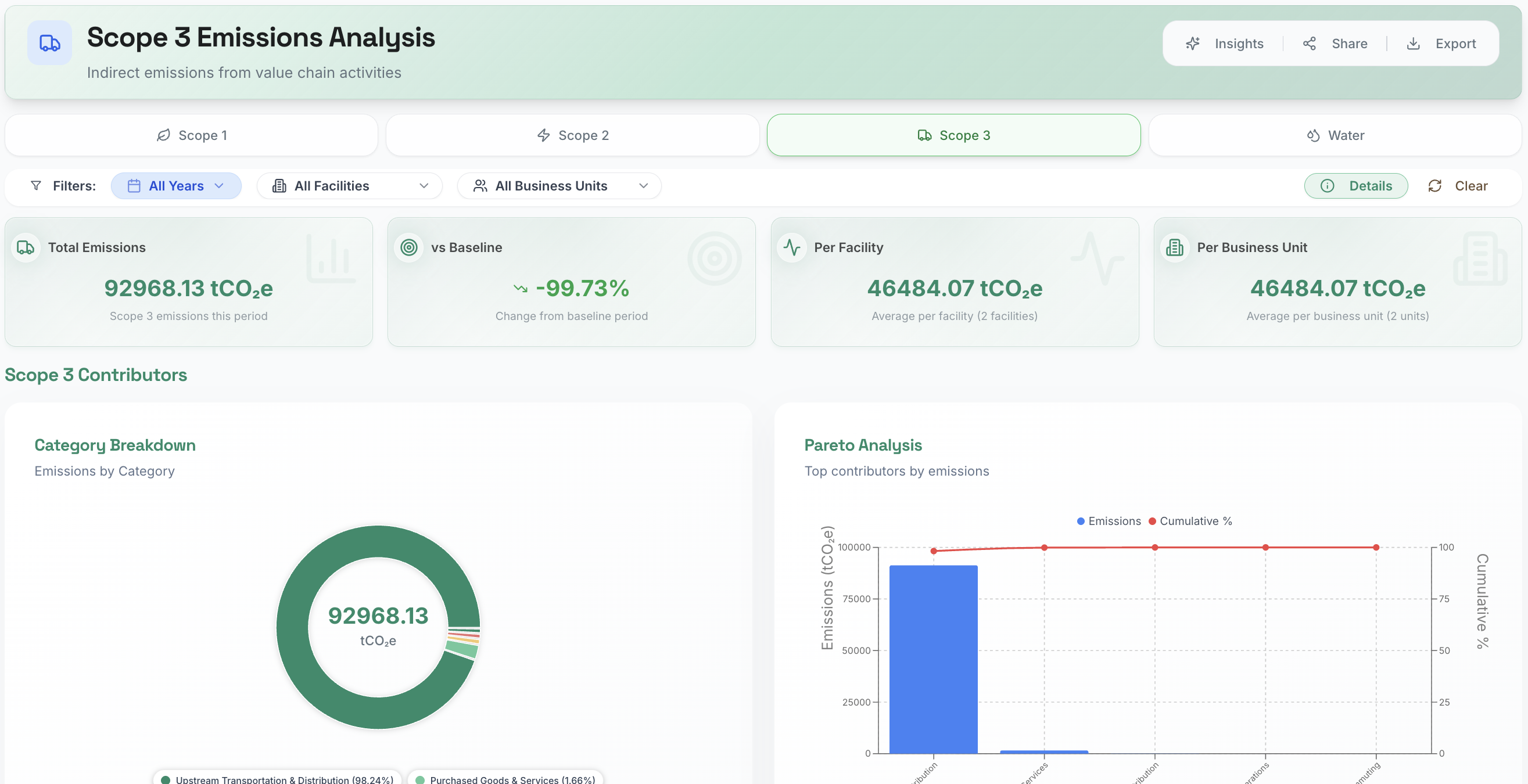
Real product previewDemo dataScreens simplified for clarity
Reporting
FairlyGreen turns emissions inventories, evidence, assumptions, and review context into structured reporting outputs, using a purpose-built reporting engine and exported evidence folders (source files, factors, assumptions), so teams can prepare internal or external review materials faster.
Prepared for internal and external review. Not verified, certified, or assurance-issued.
Generate polished draft report language in concise or detailed style, with chapters, assumptions, limitations, and source context woven in.
Built on FairlyGreen's own reporting engine — designed specifically for reporting workflows rather than generic prompting.
Same evidence base, different reporting depth.
Draft outputs are structured around organization boundaries, inventory summaries, methodology, assumptions, evidence references, limitations, and appendices — with ISO 14064-1-oriented internal review context where applicable.
Assumptions, evidence links, factor context, and review decisions stay connected from the original activity record through draft reporting outputs and exports.
Export the draft report together with the evidence behind it, so internal teams and external reviewers can inspect assumptions, lineage, and supporting records in one place.
From measured inventory to draft report to evidence folder.
Start here
Walk through how FairlyGreen collects carbon and water data, surfaces gaps, prioritizes supplier follow-ups, and turns the inventory into clearer actions and easier reporting.
No prep needed. Bring your current reporting process, spreadsheet pain, or supplier data questions.
FAQ
Carbon accounting, supplier data, GHG inventories, and export formats for your next reporting cycle.
FairlyGreen supports internal review and disclosure preparation.